

AI CERTs
2 hours ago
Google Gemma 4: Open Model Strategy Shake-Up
Google shocked the open AI market on 2 April 2026. Gemma 4 arrived with multimodal prowess and a surprising Apache-2.0 license. The permissive shift rewrites enterprise risk calculations instantly. Consequently, strategists are reassessing tooling budgets, legal stances, and deployment timelines. This article dissects the move through an Open Model Strategy lens. Moreover, it contrasts Google’s play with ongoing License War narratives. We examine technical claims, ecosystem reactions, and long-term Model Sovereignty implications. Meanwhile, the shadow of Alibaba Qwen Lock-in still looms over global enterprises. Readers will gain concrete data points, balanced perspectives, and practical next steps. Additionally, professionals can validate expertise via the AI for Everyone™ certification. Therefore, keep reading for tactical insights that inform next-quarter roadmaps.
License Shift High Stakes
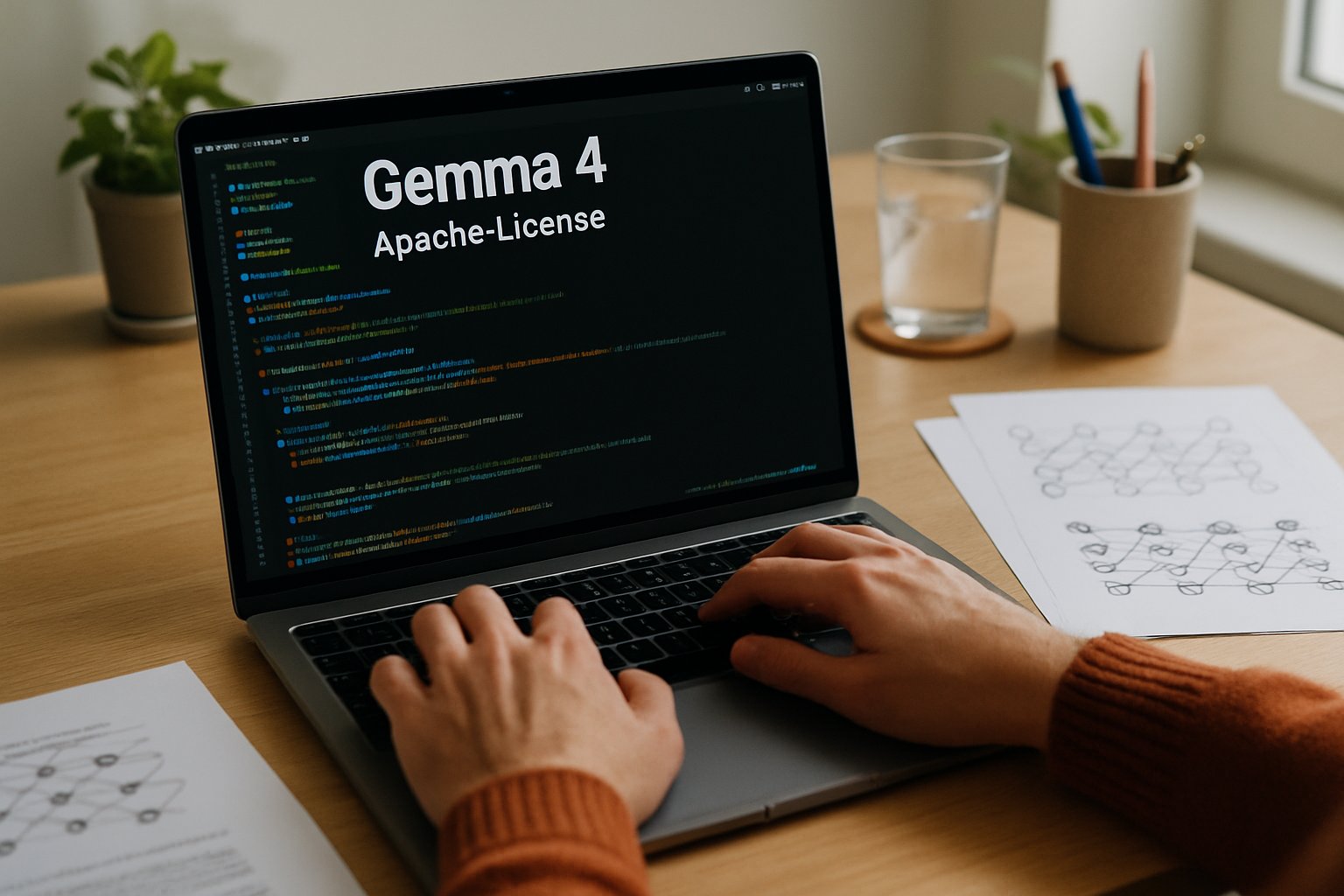
Apache-2.0 grants broad use, modification, and resale rights with minimal obligations. Consequently, legal teams previously wary of custom Gemma terms now breathe easier. Google removed distribution fees, patent uncertainty, and data usage ambiguity in one stroke. In contrast, many rivals still rely on bespoke terms that fuel the License War narrative.
- Commercial redistribution allowed without revenue sharing.
- Derivative models may remain closed source.
- Patent grant shields downstream developers.
- Attribution requirement remains lightweight.
These privileges heighten the Open Model Strategy appeal for regulated industries. Moreover, they weaken Alibaba Qwen Lock-in arguments centered on compliance hurdles. Consequently, procurement cycles shorten, and pilot projects exit the lab faster.
Apache licensing alters risk calculus and accelerates deals. Subsequently, attention turns toward the model’s raw capabilities.
Technical Edge Explained Clearly
Gemma 4 arrives in four variants ranging from 2.3B to 31B parameters. However, effective parameter tricks keep inference costs modest. The 26B Mixture-of-Experts activates only select experts per token. Therefore, throughput rivals smaller dense models while quality climbs.
Benchmarks reinforce the story. Gemma 4 31B scores 89.2% on AIME 2026 and 80% on LiveCodeBench v6. Meanwhile, Arena ELO lists the model third among open competitors. These numbers challenge Alibaba Qwen Lock-in boosters who tout exclusive performance leadership.
Long-context windows reach 256K tokens on workstation builds. Edge variants still manage 128K, supporting entire legal docs on phone chips. Consequently, Model Sovereignty advocates can host domain archives locally. Such agility strengthens any Open Model Strategy anchored in data locality.
Google pairs efficiency with context length to widen use cases. Nevertheless, ecosystem adoption must validate these promises in practice.
Ecosystem Day-One Adoption Surge
Support arrived immediately from Hugging Face, Kaggle, Ollama, and vLLM. Furthermore, NVIDIA NIM pipelines and llama.cpp ports landed within hours. This breadth secures Developer Mindshare at a crucial moment. In contrast, slower rollouts often dampen community enthusiasm.
Hugging Face CEO Clément Delangue labelled the release a milestone. Google cited 400 million Gemma downloads and 100,000 community forks. Moreover, quantised checkpoints already run on consumer GPUs, fuelling hobby demos. Consequently, tutorial videos and blog posts flood feeds, compounding Developer Mindshare gains.
The momentum undermines rival attempts to create new lock-in patterns. Alibaba Qwen Lock-in warnings now face a diversified tooling landscape. Therefore, early movers can prototype without heavy integration risk. Yet, sustained engagement needs governance and enterprise proof.
Day-one integrations accelerate experimentation and community learning. Next, we explore how enterprises convert buzz into deployments.
Enterprise Adoption Key Drivers
CIOs value cost, compliance, and roadmap clarity above novelty. Gemma 4 addresses each factor simultaneously. Consequently, many procurement teams slot pilots into Q2 sprints. Apache terms also boost Model Sovereignty for public sector clients.
Hardware guidance proves pragmatic. Google confirms 31B fits an 80GB H100 while mobile variants target Snapdragon chips. Therefore, budgeting teams can map capacity against workload classes. Moreover, quantization options trim cloud invoices without retraining cycles.
Key enterprise motivators include:
- Clear patent grant under Apache-2.0.
- Proven performance across standard suites.
- Seamless toolchain availability.
- Offline operation enabling policy compliance.
These levers align with a disciplined Open Model Strategy playbook. Nevertheless, risk teams still monitor misuse potentials and dataset pedigree. Licenses reduce barriers, yet governance rules remain essential. We now assess those governance themes.
Enterprises embrace Gemma because incentives, tooling, and licensing converge. Meanwhile, responsible use frameworks evolve quickly.
Governance And Risk Balance
Permissive licenses increase freedom and threat surfaces simultaneously. Therefore, organizations embed audit hooks and content filters before production use. Google ships model cards with red-team findings, yet operators hold ultimate duty. Consequently, Model Sovereignty goals demand additional policy layers.
Independent researchers urge watermarks, usage logging, and prompt hygiene training. Furthermore, some enterprises draft internal acceptable-use charters for staff. Such measures defuse License War criticism about unchecked proliferation. Nevertheless, balance remains delicate amid accelerating releases.
Regulators may soon weigh in with formal guidance. However, proactive controls can pre-empt heavy mandates. Developer Mindshare improves when governance is transparent and community driven. Subsequently, trust loops reinforce adoption flywheels.
Robust governance complements open licensing for sustained impact. Our final section maps competitive implications across the market.
Emerging Competitive Market Dynamics
Google’s release reframes the Open Model Strategy debate industry-wide. Competitors like Mistral and GLM-5 must respond with clearer terms. Meanwhile, Alibaba Qwen Lock-in rhetoric loses urgency in boardrooms. Consequently, we may witness a permissiveness cascade.
Analysts predict a rising License War focused on patent covenants rather than data. Model Sovereignty advocates welcome the trend as leverage against proprietary gatekeepers. Developer Mindshare will then hinge on documentation quality and benchmark transparency. Therefore, maintaining open evaluation pipelines becomes crucial.
Google already publishes evaluation scripts and invites pull requests. Moreover, Hugging Face provides reproducible notebooks for rapid validation. Such openness reinforces the broader Open Model Strategy narrative. Subsequently, industry norms may tilt permanently toward permissive sharing.
Competitive pressures appear set to favour openness and community tooling. Consequently, decision-makers should prepare now.
Strategic Moves Charted Forward
Gemma 4’s release shows how an Open Model Strategy converts legal shifts into market momentum. Enterprises that embed an Open Model Strategy now can capture faster prototyping cycles and lower costs. Furthermore, aligning governance with an Open Model Strategy secures stakeholder trust. Consequently, leaders should audit pipelines, update SDK matrices, and train staff on Open Model Strategy principles. Before scaling, reinforce safety nets and monitor benchmark reproducibility. Moreover, consider certifying teams through the AI for Everyone™ program for foundational competence. Act now, and your organisation will navigate emerging License War currents with confidence.


