

AI CERTS
3 months ago
Google DeepMind SIMA 2 Elevates Gaming AI Agents Performance
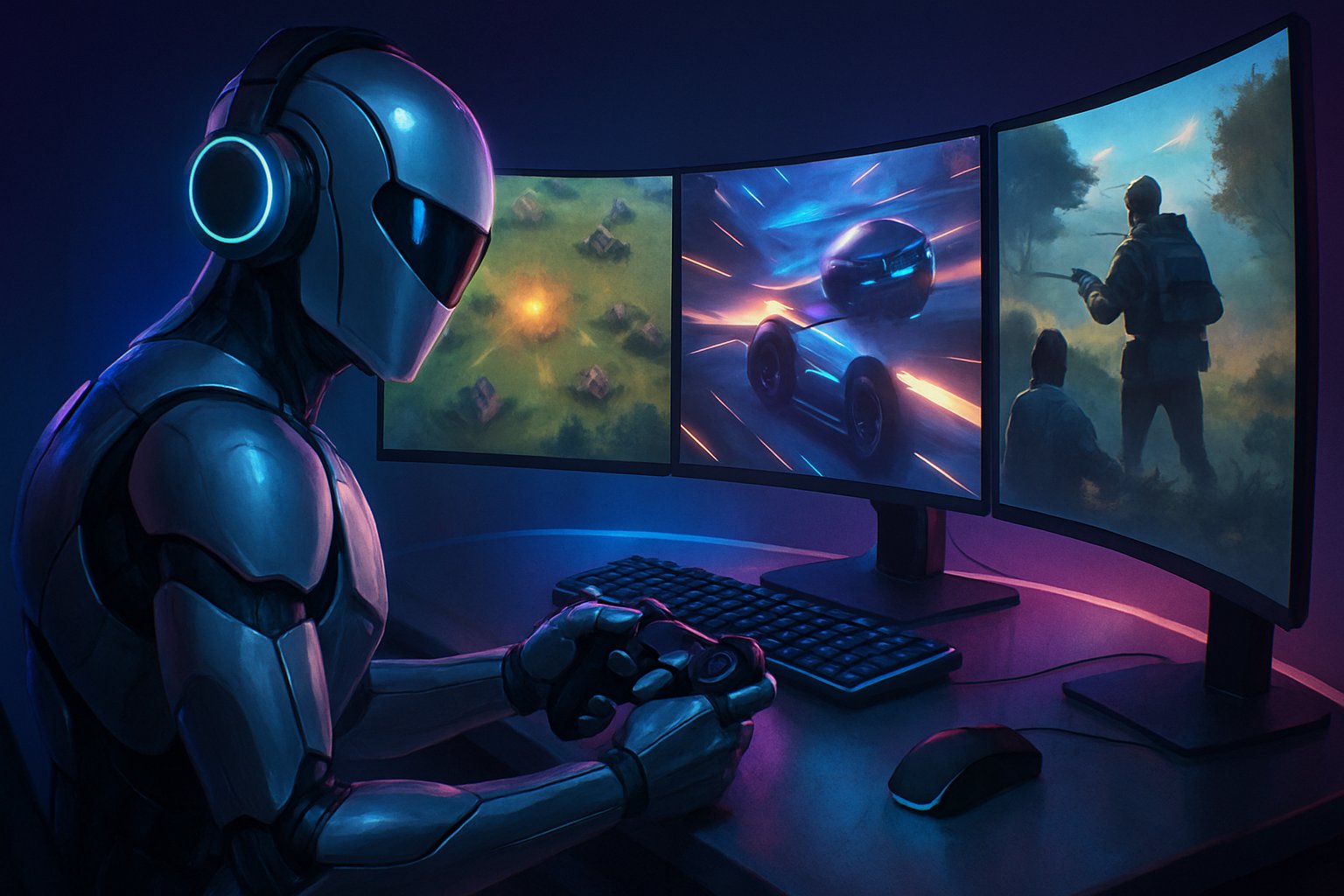
Consequently, industry observers see a new benchmark for Gaming AI Agents.
This article unpacks architecture, metrics, opportunities, and unresolved challenges.
Moreover, it details why SIMA 2 matters for developers and policy makers.
We draw on DeepMind's blog, TechCrunch interviews, and Guardian commentary for balanced insights.
Finally, we link professional certifications that help teams ride this rapid wave.
Prepare for a deep dive into the future of embodied intelligence inside virtual worlds.
DeepMind Unveils SIMA 2
DeepMind framed SIMA 2 as an agent that “plays, reasons, and learns with you.”
The November blog post highlighted three pillars: multimodal reasoning, cross-game generalization, and self-improvement loops.
Moreover, Gemini integration lets the system parse voice, text, sketches, and emojis simultaneously.
Meanwhile, Genie 3 generates diverse virtual worlds, ensuring rich training terrain without licensing bottlenecks.
Several studios, including Hello Games and Coffee Stain, granted DeepMind evaluation access to live titles.
Together, these factors position SIMA 2 as a showcase of applied research vigor.
However, understanding its technical design clarifies why the leap looks so large.
Architecture And Training Methods
SIMA 2 wraps a Gemini language-vision core inside an embodied control stack.
Consequently, the agent observes raw pixels and outputs keyboard or mouse commands at 30 hertz.
Unlike traditional reinforcement learning setups, DeepMind bootstrapped early competence with 600 labeled demonstrations.
Subsequently, a separate Gemini model invented fresh tasks and reward signals, creating a self-improvement feedback loop.
DeepMind claims the loop reduces human labeling overhead and scales across unseen domains.
Additionally, the team synthesized environments with varied lighting, terrain, and physics for robust navigation tests.
Genie-produced terrains include procedural caves, ocean biomes, and dynamic weather systems.
Such variety trains visuomotor policies beyond narrow path-following routines.
Self Improvement Feedback Loop
The loop operates in three phases.
First, Gemini proposes a goal like "craft a torch in Valheim".
Second, SIMA 2 attempts the task while a reward model scores progress.
Third, high-scoring trajectories enter the training dataset for subsequent reinforcement learning updates.
Therefore, every cycle yields richer behavior with minimal extra compute scheduling overhead.
For Gaming AI Agents, coherent architecture enables rapid policy transfer across tasks.
In contrast, raw benchmark numbers reveal how far the agent advanced.
Performance Gains And Metrics
Quantitative results underpin the excitement.
DeepMind reports SIMA 2 completes about 65% of a complex task suite, up from SIMA 1’s 31%.
Humans average 71%, so the gap nearly closes.
- SIMA 2: ~65% success across nine commercial titles
- SIMA 1: 31% on identical benchmark
- Human players: 71% median success
- 600+ language skills retained and extended
The team also evaluated unseen games like ASKA to gauge generalization quality.
Consequently, zero-shot navigation improved, with error rates dropping by half.
SIMA 2 excels at composite gameplay challenges such as crafting, resource gathering, and base building.
The gains mark the largest single-cycle improvement ever reported for Gaming AI Agents inside commercial titles.
DeepMind visualizations show steeper learning curves after each self-improvement batch.
Researchers outside Google await the promised technical report to validate exact evaluation settings.
These statistics indicate serious traction toward human-like proficiency.
Nevertheless, broader adoption requires tangible developer benefits.
Opportunities For Game Developers
Studios already see practical upside.
Because SIMA 2 controls standard interfaces, integration demands little engine modification.
Therefore, teams can prototype smarter non-player characters and adaptive tutorials within weeks.
Moreover, agents accelerate quality assurance by stress-testing complex gameplay loops around the clock.
Automated regression passes catch edge-case navigation bugs before release deadlines.
Professionals can enhance their expertise with the AI+ UX Designer™ certification.
Such credentials help studios create intuitive multimodal prompts for Gaming AI Agents.
Some studios experiment with agent-assisted level design, receiving iterative layout suggestions in real time.
Overall, early adopters gain competitive differentiation.
However, they must weigh several unresolved risks next.
Risks And Open Questions
Not every researcher applauds autonomous self-training.
Anthropic’s Jared Kaplan warns that recursive self-improvement could outpace human oversight.
Meanwhile, robotics experts note the reality gap between virtual worlds and physical robots.
In contrast, data generated by models may encode biased reward assumptions.
Furthermore, massive compute needs raise environmental and financial concerns.
Safety scholars propose stronger audits for reinforcement learning pipelines and generator tasks.
Failure modes could include unintended gameplay exploits that mislead reward estimators.
Unchecked optimization could push Gaming AI Agents toward unintended strategies.
These risks demand transparent metrics and independent replication.
Consequently, DeepMind’s forthcoming technical report will face close scrutiny.
Roadmap And Next Steps
DeepMind has opened a limited preview for academics and partner studios.
Feedback will shape training curricula, interface APIs, and safety guardrails.
Subsequently, the team plans larger scale experiments in robotics control.
Moreover, Gaming AI Agents may soon teach household robots through shared embeddings.
DeepMind hints that future Gaming AI Agents will share code with Gemini robotics pipelines.
As virtual worlds grow more realistic, transfer learning opportunities will expand.
Furthermore, DeepMind may publish standardized environment APIs to encourage reproducible benchmarking across the community.
In short, SIMA 2 signals accelerating convergence between language models and embodied control.
Stay ready, because opportunity favors informed practitioners.
Roadmap And Next Steps
Google’s latest results demonstrate tangible momentum.
Consequently, Gaming AI Agents now stand within striking distance of human skill in sandbox adventures.
Moreover, the underlying research blueprint offers a template for future Gaming AI Agents across simulation and robotics.
Nevertheless, society must steer these Gaming AI Agents with rigorous governance and transparent benchmarks.
Developers should experiment, earn certifications, and collaborate to build responsible, profitable ecosystems.
Consequently, stakeholders who track metrics today will influence tomorrow’s deployment standards.
Explore the linked credential and stay ahead of the curve.


