

AI CERTs
2 months ago
Google Calendar Gemini reshapes enterprise scheduling
Few work tasks feel as repetitive as juggling calendars. However, Google is betting conversational AI can remove that friction. Its latest move, Google Calendar Gemini, brings the Gemini assistant directly into scheduling workflows. Consequently, users can query agendas, create events, and receive summaries without leaving familiar screens. The rollout started in late 2024 and accelerated through 2025 across Workspace tiers. Meanwhile, administrators gained new toggles to manage data access and compliance. This article unpacks the timeline, capabilities, governance issues, and market stakes behind the feature. Additionally, it reviews emerging best practices for AI meeting scheduling inside enterprises. Industry analysts view the integration as another salvo in the productivity assistant race. Therefore, decision-makers must understand both the upside and the current limitations before enabling it domain-wide.
Gemini Evolution Timeline Highlights
Google began weaving Gemini into Calendar through Gmail's side panel in November 2024. Moreover, that pilot let workers ask schedule questions and create simple events, yet guest management remained absent. Subsequently, March 2025 introduced an "Ask Gemini" panel inside Calendar itself for Workspace Labs testers. In parallel, Gmail gained a Gemini-powered "Add to calendar" button which parsed email dates. During summer 2025 these features reached paid consumer and enterprise tiers, completing the initial Google Calendar Gemini rollout. Consequently, many organizations saw the assistant appear with little manual setup once admins approved access. These milestones chart Google's careful, staged launch strategy. However, understanding the features themselves requires closer inspection.
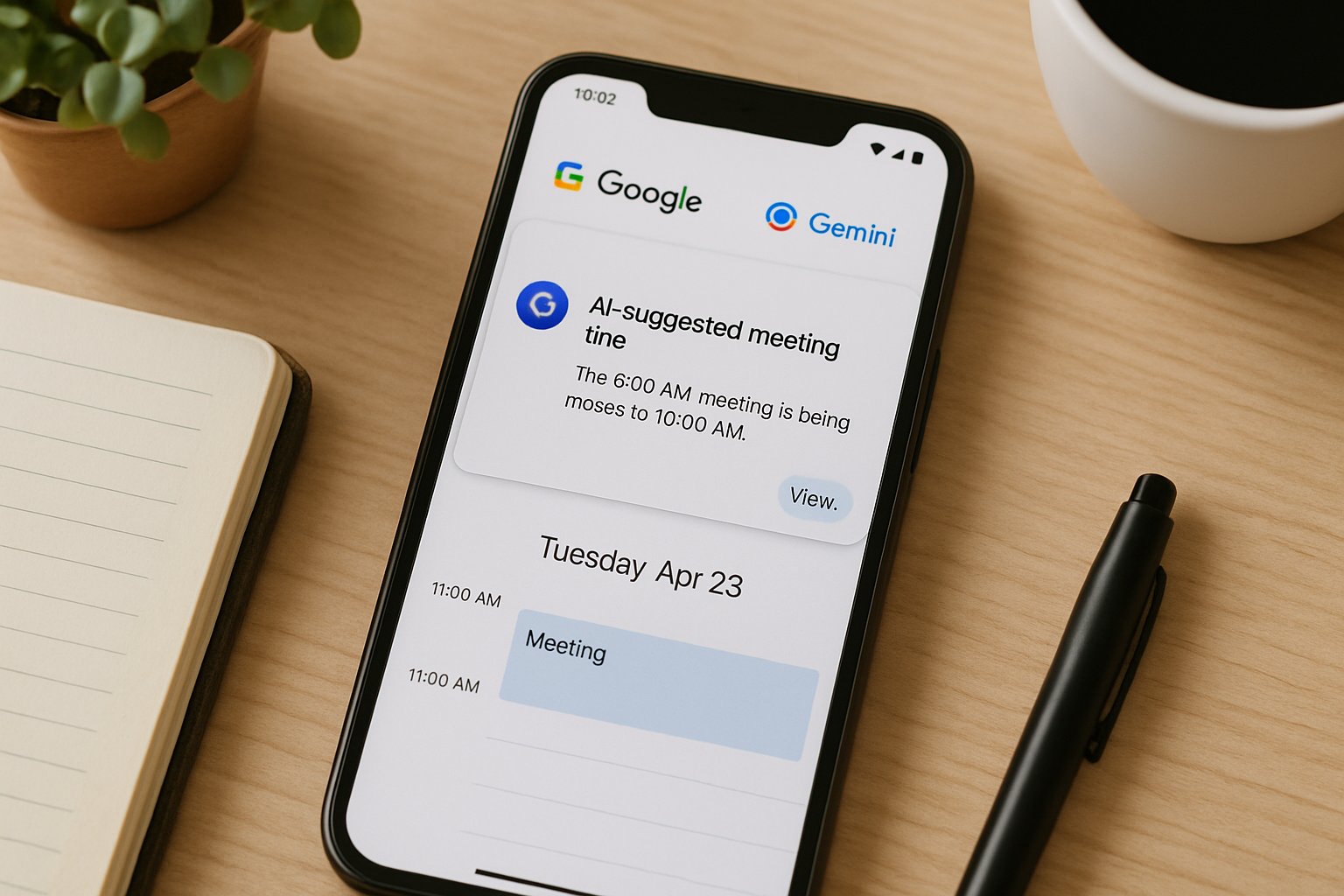
Gemini Core Feature Set
At its heart, the assistant answers natural-language queries about personal and shared schedules. For example, users may ask, “When is my next one-on-one with Maria, and where?” Additionally, chat commands create recurring events, set reminders, or adjust times without opening full screens. The Gmail shortcut scans messages for dates and launches the panel to confirm details. Cross-app context lets Gemini pull drive links, attendee lists, and meeting documents into one response. Meanwhile, scheduled actions send morning agenda digests or weekly project reminders automatically. However, Google Calendar Gemini still cannot negotiate times with external guests or parse restaurant reservations reliably. Event accuracy therefore depends on human verification and supplemental tools. The capabilities improve everyday tasks and reduce context switching. Consequently, many teams see quick productivity wins, setting the stage for enterprise adoption details ahead.
Enterprise Rollout Key Details
Rollout pathways vary by channel and subscription. Firstly, the Gemini mobile app exposes Calendar data when users enable connected apps. Secondly, the Workspace side panel surfaces the same assistant inside Gmail, Docs, Drive, and Calendar. Paid Workspace Enterprise, Business Plus, and Education tiers received broad availability between May and August 2025. Moreover, consumer access sits behind Google One AI Premium, which surpassed 150 million subscribers last year. Admins remain gatekeepers, configuring smart features and data sharing policies in the Admin console. In contrast, individual users cannot override a disabled setting, a choice that comforts risk-averse industries. Google Calendar Gemini appears automatically once an eligible account toggles personalization and privacy consents. Therefore, change management focuses more on training than on deployment logistics. Deployment proves straightforward for licensed domains. However, governance questions now dominate, as the next section explains.
Broader Market Context Numbers
Google counts billions of consumer Gmail users and millions of Workspace organizations. Consequently, even incremental assistant adoption can shift huge volumes of workplace behavior. Reuters reported Google One subscriptions hitting 150 million in May 2025, with "millions" on the AI tier. Meanwhile, Microsoft markets Copilot to a similar customer base, intensifying competitive pressure. Industry analysts estimate that AI meeting scheduling assistants could save knowledge workers five minutes per meeting. Multiply that figure by enterprise calendars and the savings become material for productivity metrics. Google Calendar Gemini therefore plays a strategic role in subscription retention and upsell models. Moreover, its presence counters rivals pitching similar assistants with premium pricing. The numbers highlight sizable revenue stakes across vendor ecosystems. Subsequently, benefits and constraints deserve balanced assessment.
Key Benefits And Limits
Teams cite faster event creation and reduced context switching as leading advantages. Furthermore, cross-app context surfaces files and chat threads, saving additional clicks. Early pilots show single-user scenarios succeeding most, such as self-service vacation entries. In contrast, multi-party scheduling remains cumbersome because the assistant cannot yet negotiate across calendars.
- Five minutes saved per meeting, according to Gartner estimates.
- 150 million Google One subscribers supply a ready user base.
- Gemini remains ad-free, DeepMind CEO confirmed.
Hallucination risk persists; The Verge recorded location errors and missing attachments during tests. Therefore, many admins require human confirmation for every Gemini-generated event. Google Calendar Gemini addresses some issues through incremental updates, yet foundational model accuracy needs further gains. Nevertheless, survey respondents still report net time savings when tasks stay simple. Benefits outweigh drawbacks for straightforward personal scheduling today. However, privacy remains the decisive factor, explored next.
Privacy And Governance Considerations
Google states that Workspace data does not train Gemini’s core models. Additionally, processing occurs under the same enterprise agreements that govern existing Google Cloud services. Privacy researchers nonetheless urge admins to document consent flows, retention periods, and audit procedures. Moreover, regulators may scrutinize cross-border data transfers facilitated by connected app personalization. Admins can disable Google Calendar Gemini or limit connected apps through granular policies. Meanwhile, role-based access controls prevent junior staff from seeing executive calendars inside the assistant. Google logs every Gemini action, enabling forensic audits when compliance teams investigate. Consequently, organizations with strong governance frameworks feel more comfortable enabling advanced features. Transparent controls mitigate many regulatory risks. Subsequently, competitive dynamics gain prominence in strategic planning.
Competitive Landscape Forward Outlook
Microsoft’s Copilot, OpenAI’s ChatGPT integrations, and Anthropic’s Claude all chase the same productivity niche. However, Google commands unmatched consumer reach, giving Google Calendar Gemini a built-in user funnel. Feature comparisons show Microsoft ahead on enterprise meeting negotiation, whereas Google leads on cross-app context. Furthermore, Google promises an ad-free experience, differentiating it from ChatGPT’s sponsored suggestions. Analysts expect sustained rapid iteration, with quarterly drops bringing broader language support and stronger AI meeting scheduling capabilities. Nevertheless, trust and accuracy will likely determine which vendor secures long-term leadership. Competitive pressure ensures steady innovation for users. Therefore, continuous learning remains essential, as addressed in the conclusion.
Google Calendar Gemini has evolved from a Labs curiosity to a mainstream productivity assistant within two years. Moreover, enterprises now access conversational scheduling, cross-app insights, and proactive reminders directly inside core workflows. Benefits include faster entries and contextual summaries, while limitations involve negotiation gaps, hallucinations, and privacy diligence. Consequently, success depends on admin guardrails, user training, and continuous accuracy monitoring.
Meanwhile, rivals accelerate feature releases, intensifying the AI meeting scheduling innovation cycle. Nevertheless, organizations that skill up employees and certify talent will capture the most value. Professionals can deepen expertise through the AI Learning Development™ certification. Therefore, now is the time to pilot, measure, and iterate with Google Calendar Gemini. Act today to keep your scheduling strategy ahead of the curve.


