

AI CERTS
2 hours ago
Genie 3 Tornadoes Transform Autonomous Systems
This bold experiment showcases how Autonomous Systems can grow resilient by learning from synthetic chaos. Moreover, it spotlights a shift toward data-driven safety validation at trillion-frame scale. Regulators, investors, and rival labs watch closely. Meanwhile, simulation experts debate realism, governance, and compute cost. These debates underline the high stakes for self-driving adoption. The following report unpacks Genie 3’s tornado testing, the Waymo adaptation, and broader industry implications.
Genie 3 Breakthrough Story
Genie 3 debuted in August 2025 as a real-time generative world model. DeepMind claims the system renders interactive scenes at 720p and 24 frames per second. Furthermore, the model sustains environmental coherence for several minutes, eclipsing earlier research.
Shlomi Fruchter called it “the first general-purpose world model” during a TechCrunch interview. In contrast, previous models limited users to brief, low-fidelity clips. Therefore, researchers view Genie 3 as a milestone on the road to embodied intelligence.
A world model predicts future sensory states so agents can train offline. Consequently, Autonomous Systems gain richer experience than recorded driving footage alone. However, DeepMind still restricts access to a research preview while it studies safety.
Waymo World Model Adaptation
Waymo engineers adopted Genie 3 and layered proprietary controls on top. Subsequently, the “Waymo World Model” outputs synchronized camera and lidar streams. Those streams feed directly into the Waymo Driver stack without code changes.
Multimodal Sensor Output Pipeline
The pipeline converts each generated pixel into a corresponding point-cloud coordinate. Moreover, the conversion preserves occlusion edges and material reflectivity needed for tracking. As a result, Autonomous Systems can stress-test perception under controlled distortion.
Waymo reports billions of simulated miles annually, dwarfing its 200 million real-world miles. Additionally, engineers accelerate throughput four-fold using an efficient Genie variant. These numbers underscore the potential scale advantage.
- 200 million autonomous miles on public roads
- Billions of virtual miles generated yearly
- 720p, 24 fps real-time rendering
- Several minutes of continuous interaction
Together, these optimizations turn data scarcity into abundance. However, simulating tornadoes pushes the system even further.
Testing Extreme Tornado Scenarios
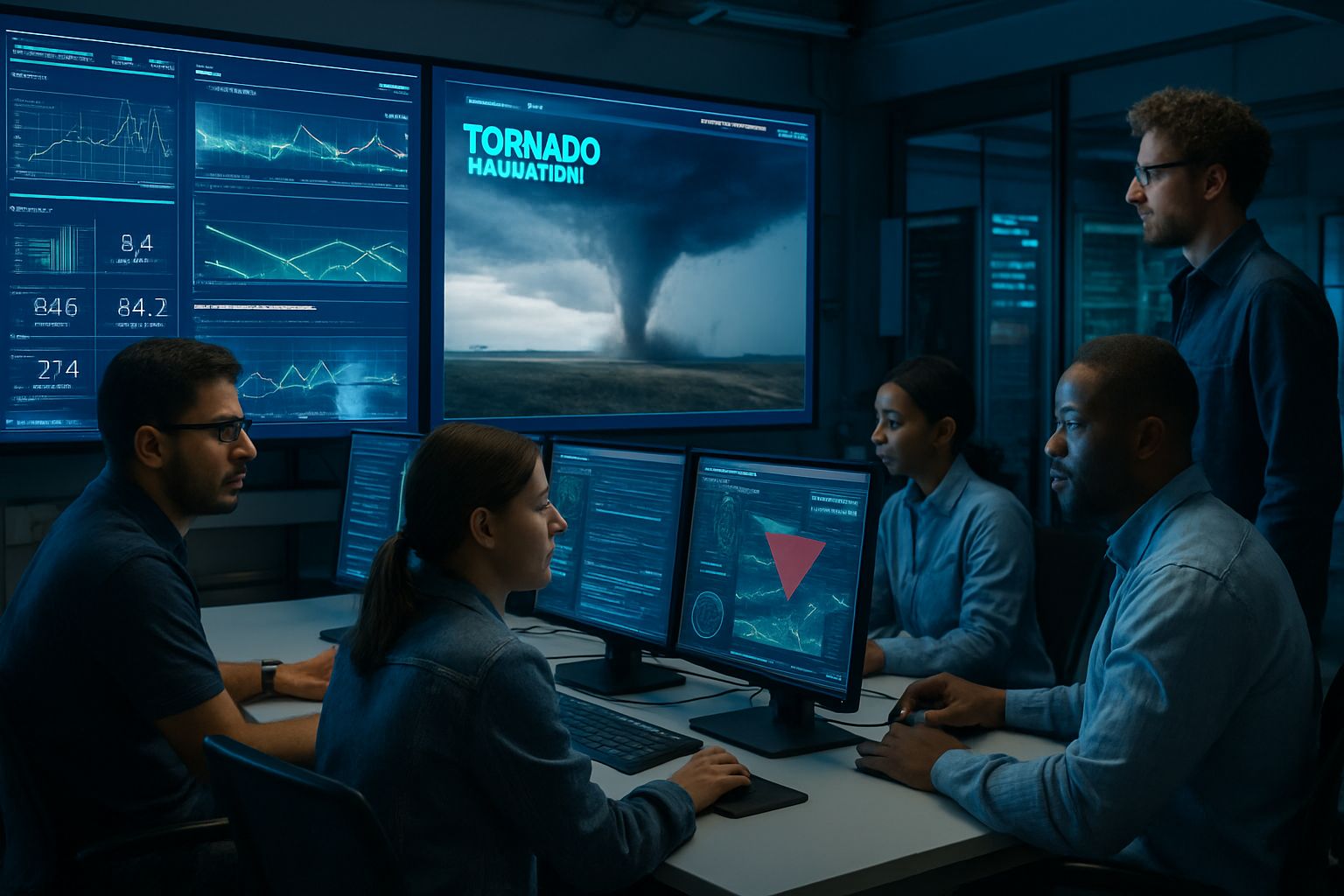
Waymo wanted exposure to long-tail disasters rarely caught on dashcams. Therefore, developers scripted a tornado as a promptable mutation. The swirling funnel degrades visibility, hurls debris, and shifts dynamic obstacles.
Prompt tweaks vary funnel size, wind vectors, and debris density. Consequently, perception and planning modules face thousands of variant runs. Meanwhile, engineers track failures through scalable analytics dashboards.
Text prompts such as “quarter-mile wide tornado at noon” spawn new sequences instantly. Furthermore, knobs adjust rain intensity, lightning frequency, and downed powerlines. That flexibility exemplifies modern Weather Simulation.
Each sequence stresses braking, steering, and fallback policies. Consequently, measurable gains in Robotaxi Safety arise without real passengers at risk. DeepMind researchers praise the creative application.
Tornado injections validate corner cases unreachable through traditional test fleets. Nevertheless, synthetic data still carries caveats. The approach could reshape how Autonomous Systems confront meteorological chaos.
Safety Data And Caveats
Simulation realism remains imperfect despite photoreal frames. In contrast, lidar artifacts sometimes misrepresent thin cables or glass reflections. Analysts warn that over-confidence in synthetic scenes could blind Autonomous Systems to real physics.
Ars Technica highlighted limited interaction lengths of only several minutes. Moreover, complex multi-agent traffic still challenges the model. Therefore, Waymo blends generated runs with reconstructed logs and on-street driving.
- Short interaction duration restricts scenario chaining
- Physics quirks under high force impacts
- Potential bias from training distribution gaps
- Limited public transparency for third-party auditors
Nevertheless, cross-validation pipelines compare synthetic sensor traces to matching real recordings. Consequently, error bars guide release gating decisions. Such checks intend to prove gains in Robotaxi Safety derived from rigorous Weather Simulation.
Balanced evaluation tempers hype with quantitative discipline. Next, stakeholders assess commercial and governance impacts.
Commercial Impact And Governance
Waymo positions tornado testing as a marketing differentiator. Meanwhile, investors view scalable simulation as capital efficient. Competitors like Cruise and Zoox may license world models or build rivals. Future Autonomous Systems across drones and delivery bots could reuse the same tooling.
Regulators increasingly ask for traceable scenario evidence before approving driverless expansion. Consequently, Waymo faces calls for transparency, audit logs, and open metrics. DeepMind’s responsible AI framework supplies some principles, yet operational details sit with the operator.
Professionals can enhance their expertise with the AI Robotics certification. Moreover, such credentials help engineers navigate emerging compliance standards.
Commercial opportunity grows alongside scrutiny. Therefore, resilience planning becomes essential.
Building Future Resilience Today
Research continues on longer horizons and higher sensor fidelity. Subsequently, DeepMind teases incremental models beyond Genie 3. Waymo also hints at earthquake and wildlife scenarios.
Integration with reinforcement learning could let vehicles practice corrective maneuvers autonomously. Furthermore, cloud acceleration promises near real-time policy evaluation across fleets. That outlook excites both academia and industry.
Expanded Weather Simulation catalogs and deeper Robotaxi Safety metrics will underpin these ambitions. As complexity rises, governing Autonomous Systems demands cross-disciplinary skill sets.
Progress depends on compute, data, and oversight. Finally, the takeaway for practitioners is clear.
Tornado testing demonstrates how Autonomous Systems can mature faster than roads can present dangers. Moreover, scalable Weather Simulation reduces the risk of unforeseen meteorological hazards. Consequently, iterative insights feed directly into elevated Robotaxi Safety benchmarks.
Nevertheless, synthetic fidelity gaps remind developers that lab victory does not guarantee street success. Therefore, policy consultation, third-party audits, and certified talent remain vital. Readers committed to advancing Autonomous Systems should explore the linked certification and join the resilience movement. Ultimately, responsible governance will decide whether Autonomous Systems earn global trust.


