

AI CERTS
3 months ago
Gemini’s Generative Leap: AI Redefines the User Interface
Furthermore, the concept aligns with industry rhetoric about a New UI era. Microsoft markets Copilot similarly, while Gartner forecasts $644 billion in 2025 generative-AI spending. Professionals now ask how quickly design, development, and governance must adjust. This article examines Gemini’s strategy, supporting data, opportunities, and risks for enterprise teams. Each section concludes with actionable insights leading to the next perspective.
Why AI Transforms Interfaces
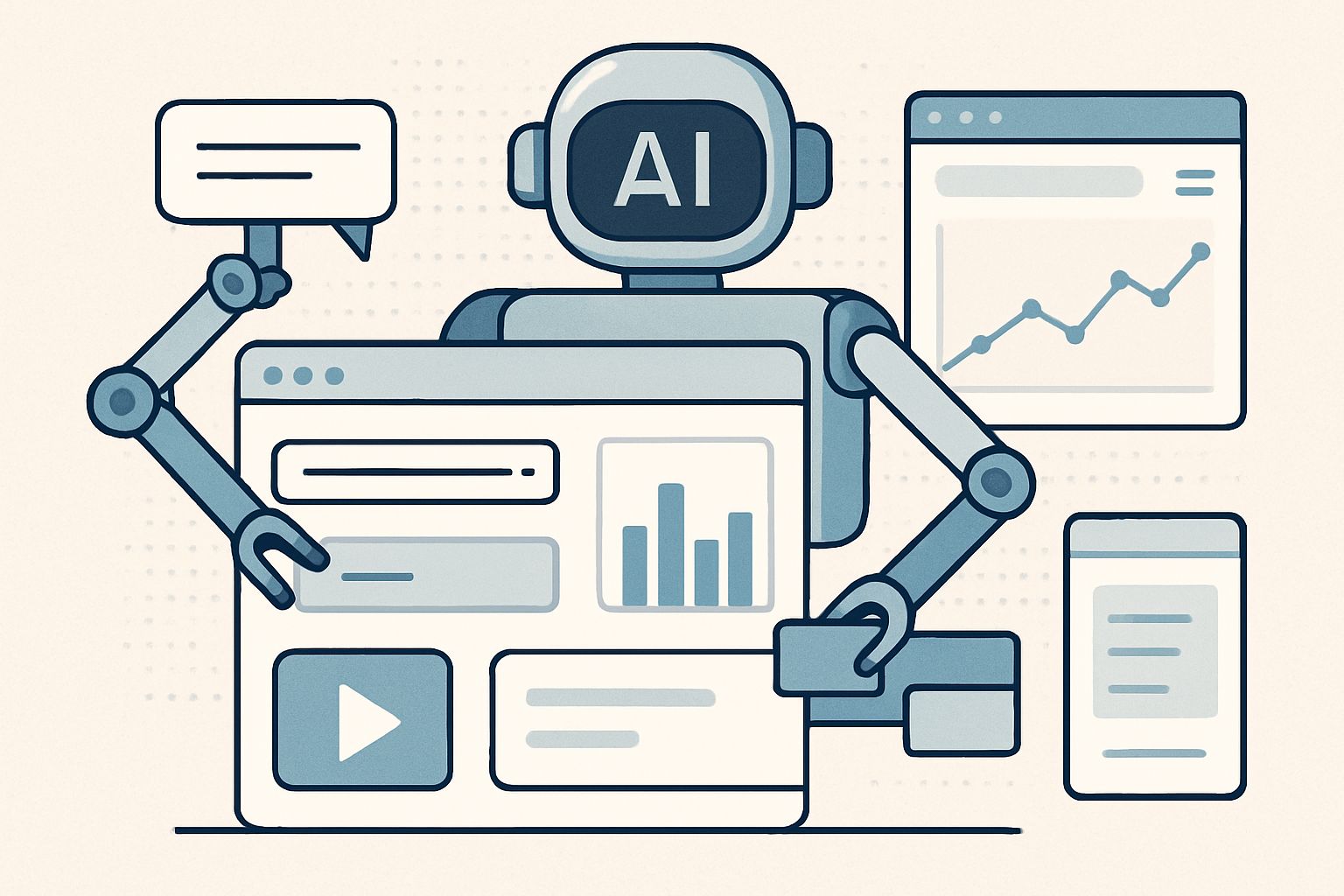
Historically, graphical menus required designers to plan every pathway. However, large language models can now build pathways themselves, guided by real-time context. Google describes this shift as Generative UI, where models output HTML, data bindings, and styling together. Therefore, the User Interface becomes fluid, adapting per prompt rather than per release cycle. Multimodal inputs reinforce that leap because vision and speech sensing drive richer Interaction possibilities. Every adaptive User Interface moment relies on rich context signals. In contrast, traditional tooling struggles to match such dynamism without heavy manual prototyping. These fundamentals explain why AI alters interface economics. Design once, generate many, is the emerging mantra. Consequently, interface agility advances but consistency control grows more complex, setting up Gemini’s value case.
Gemini's Generative UI Push
Google announced Gemini 3 Pro on 18 November 2025 with dynamic views inside the mobile app. Meanwhile, Search AI Mode started rolling the same New UI to 75 million daily users. Alphabet reports the application already exceeds 650 million monthly active users worldwide. Moreover, Google Research published “LLMs are Effective UI Generators,” detailing tool-access pipelines and post-processing guards. The paper shows models rendering code snippets that browsers execute instantly, delivering direct Interaction without servers. Therefore, the User Interface emerges directly from model output, not from static component libraries.
Emma Roth’s hands-on review praised vivid charts yet warned of inconsistent fidelity during complex Experience tasks. Nevertheless, Sundar Pichai calls Gemini 3 “our most intelligent model,” emphasizing multimodal strength and agentic Automation. Gemini’s early footprint is already large. Therefore, every imperfect demo still reaches millions, accelerating feedback loops and competitive pressure.
Rivals Shape Platform Strategies
Microsoft frames Copilot as the New UI across Windows, Office, and Azure. In contrast, OpenAI and Anthropic chase API ubiquity rather than deep device bundling. Consequently, platform control battles hinge on who owns the User Interface layer stitching services together. Gartner expects hardware spending to dominate GenAI budgets, favoring hyperscalers with massive procurement power. Competitive gravity will intensify as chips, models, and distribution intertwine. Subsequently, design teams must track vendor lock-in alongside feature polish.
Market Adoption And Metrics
Numbers clarify hype from substance. Alphabet totals show the model processing billions of tokens per minute through direct API calls. Additionally, Gartner pegs worldwide generative-AI spending at $644 billion next year. That projection implies deep enterprise commitments beyond marketing pilots. At massive scale, the User Interface becomes a measurable funnel for engagement and revenue. However, Gartner analyst John-David Lovelock warns of high proof-of-concept failure rates hampering Experience expectations. Independent reviewers echo caution, citing latency that sometimes exceeds one minute for interactive renders. Nevertheless, 75 million daily Search users expose bottlenecks quickly, enabling rapid iteration.
- Gemini app counts more than 650 million monthly active users, according to Alphabet Q3 data.
- Search AI Mode records roughly 75 million daily users since October rollout.
- Gartner forecasts $644 billion generative-AI spending during 2025, with hardware as largest component.
These numbers illustrate traction yet underscore operational stakes. Consequently, governance frameworks must scale alongside traffic, not after launch.
Opportunities For Rich Experience
Dynamic layouts promise shorter learning curves for employees. Furthermore, simulations built on demand can convert abstract finance data into tangible visuals. Educators already test Gemini demos that animate cell mitosis at variable speeds, enhancing student Experience. Moreover, agentic Automation stitches calendar, email, and booking APIs into a single conversational flow. Prototype assessments show time-on-task reductions of up to 45 percent for repetitive workflows. Professionals can validate skills with the AI+ UX Designer™ program. Such certification aligns design vocabulary with Gemini’s tooling, smoothing later integration. The upside is clear: faster task completion and richer storytelling. However, the next section addresses the risks that accompany fluid Interaction.
Risks And Governance Challenges
Hallucinated prices or directions can mislead consumers and damage brand trust. Therefore, dynamic User Interface elements must disclose provenance and refresh schedules. Latency remains another barrier; some visualizations still require thirty seconds to load. Nevertheless, Google reports steady speed gains as it tunes compilation and caching pipelines. Security teams highlight agentic Automation risk because booking or payment flows might execute incorrectly. Moreover, adaptive layouts may confuse accessibility tooling, raising legal compliance questions. Publishers fear reduced traffic when Search results embed entire interactive answers. In contrast, Google argues new interaction models create fresh advertising surfaces. These tensions demand rigorous testing, rollback strategies, and transparent audit logs. Risk management will decide long-term adoption more than raw capability. Subsequently, enterprises need structured playbooks, outlined next.
Strategic Moves For Enterprises
First, inventory workflows that rely heavily on repetitive clicks or form navigation. Next, pilot Generative UI overlays where the User Interface transforms but core data remains anchored. Additionally, embed human-in-the-loop reviews until confidence metrics reach acceptable thresholds. Legal teams should monitor evolving regulation around AI disclosure and data provenance. Meanwhile, procurement leaders must model hardware, licensing, and cloud egress costs using Gartner benchmarks. Employee upskilling is essential; certification courses and internal workshops accelerate familiarity with the New UI approach. Consequently, enterprises that balance innovation with governance will capture productivity gains sooner. Playbooks that integrate people, process, and platforms unlock sustainable value. Finally, we review emerging themes before closing.
Google’s Generative UI push signals a decisive pivot toward AI-built surfaces. The platform showcases early promise through millions of users and vivid demonstrations. However, speed, accuracy, and governance gaps remind leaders to proceed deliberately. Meanwhile, rivals such as Microsoft escalate the platform contest, amplifying urgency for quick learning. Enterprises should map workflows, launch controlled pilots, and measure task completion rigorously. Moreover, employees can formalize design expertise by earning certifications like the linked AI+ UX Designer™ program. Consequently, teams who treat the User Interface as living code will unlock automation at scale. Explore the resources, experiment responsibly, and shape the next Experience frontier today.


