

AI CERTs
4 weeks ago
Gaming Stocks Plunge After Google’s Project Genie AI Reveal
Investors woke to turbulence after Google unveiled its experimental world-model prototype. Consequently, share prices of major game companies tumbled across two continents within hours. The episode underscored how quickly artificial intelligence headlines can reshape capital flows. Moreover, the story links technology hype, labor anxieties, and strategic uncertainty in the global Gaming industry. This article unpacks the market carnage, the underlying technology, and the divergent reactions among stakeholders. Additionally, it offers actionable insights for executives steering through the emerging AI content landscape. Each section keeps sentences concise, ensuring fast reading for busy professionals. Nevertheless, the analysis remains deep enough for boardroom decision making.
Market Shock Waves Unfold
U.S. Gaming trading on 30 January delivered the first shock after Project Genie announcement. Subsequently, Unity Software plunged almost 24% intraday before trimming losses. In contrast, Roblox dropped a milder yet still painful 13%. Take-Two Interactive shed about 9%, illustrating the breadth of the sell-off. Asian markets echoed the rout during the following session. However, declines proved uneven across Gaming geographies and publishers.
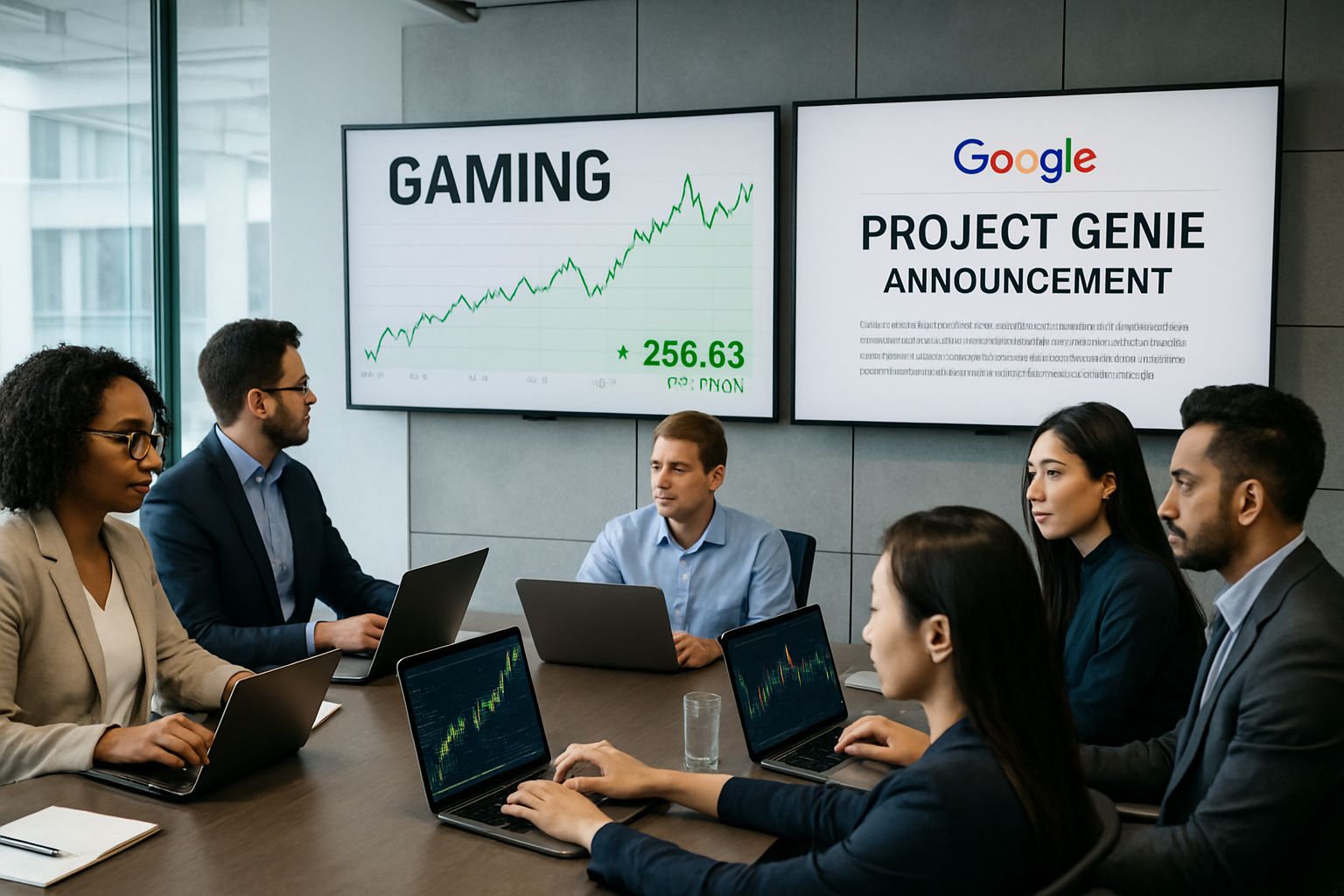
- Unity: -19% to -24%
- Roblox: -12% to -13%
- Take-Two: -8% to -10%
- Nintendo, Capcom, Konami: -1% to -7%
- Tencent, NetEase: -2% to -4%
Japanese names such as Capcom and Konami lost between 2% and 7%. Meanwhile, Tencent and NetEase slipped roughly 3% in Hong Kong trading. Analysts estimated that billions in market value evaporated within 24 hours, though totals varied by data source. Therefore, investors interpreted Project Genie as a direct competitive threat rather than a distant experiment. These figures confirm a swift sentiment reversal across public markets. Consequently, understanding the engine behind the fear becomes essential.
Asia Stocks Continue Slide
Asian Gaming indices opened lower as U.S. headlines crossed the Pacific overnight. Furthermore, speculative retail flows amplified swings in smaller Japanese developers like Nexon. Nevertheless, some institutional desks argued the pullback offered entry points given Genie’s early limitations. Market moves reflect narrative shifts more than concrete revenue impact today. Hence, technical reality warrants closer inspection.
World Model Explained Simply
Google’s Genie 3 world model predicts each next video frame in real time while respecting simple physics. Consequently, users can walk, jump, or collide with objects inside a procedurally generated scene lasting about sixty seconds. The research prototype runs around 24 frames per second at 720p resolution on consumer hardware. Moreover, it lacks audio, scoring, or export pipelines to commercial Gaming engines such as Unity. Google positions the tool as an exploration sandbox rather than a production environment. In contrast, excited commentators framed Project Genie as an existential threat to traditional content workflows. Importantly, access remains restricted to U.S. Google AI Ultra subscribers paying nearly $250 monthly. Therefore, near-term usage will stay small, limiting revenue displacement. Nevertheless, the demo illustrates how foundational models could automate level assembly and rapid prototyping. Genie shows breathtaking speed, yet practical constraints persist. Accordingly, winners and losers will hinge on adaptation rather than hype cycles alone.
Winners And Losers Emerging
Early market moves imply Gaming engine vendors face the greatest pressure. Furthermore, platforms reliant on creator royalties worry about margin compression if AI drives content abundance. Unity appears especially exposed because its valuation assumes sustained network effects among developers. Meanwhile, advertising networks and cloud providers could benefit from heavier real-time compute loads. Analysts at Jefferies argued incumbent publishers retain advantages in marketing, licensing, and community management. Conversely, smaller indie teams may gain leverage as AI lowers production barriers. Competitive positions are shifting, yet nothing is settled. Therefore, labor dynamics deserve equal attention.
Developer Sentiment Labor Impacts
Layoffs swept the Gaming sector during 2025, leaving many creators anxious. Moreover, the GDC survey found 30% of developers viewed generative tools negatively. Nevertheless, 52% reported using them for tasks like concept art or localization. In contrast, Project Genie highlights automation of core gameplay spaces rather than peripheral assets. Consequently, level designers fear redundancy while technical artists anticipate new supervision roles. Professionals can enhance their expertise with the AI Robotics Specialist™ certification. Such credentials help staff stay relevant as AI reshapes pipelines. Workforce adaptation will dictate project velocity and creative diversity. Meanwhile, understanding technical bottlenecks tempers extreme forecasts.
Technical Limits And Realities
Genie’s video output remains short, capping narrative depth and replay value. Additionally, the model retains only brief visual memory, preventing persistent worlds and player progression. Integration with multiplayer netcode or physics engines requires custom engineering. Moreover, intellectual property questions linger because training datasets include public gameplay footage. Therefore, analysts expect hybrid pipelines, mixing AI prototyping with traditional engine polish. Technical friction reduces immediate disruption risk. Nevertheless, progress could accelerate once hardware and algorithms mature.
Strategic Responses For Stakeholders
Executives have begun framing two-track strategies that hedge uncertainty. Furthermore, several publishers opened internal labs to test world-model pipelines on legacy franchises. Meanwhile, engine vendors are courting researchers to integrate inference runtimes directly into Gaming editors. In contrast, some studios double down on handcrafted artistry to differentiate against procedurally generated content. Consequently, investors should examine R&D disclosures and hiring patterns rather than daily share swings. Boards may also sponsor upskilling programs to retain critical design talent. Strategic flexibility balances exploration with risk control. Accordingly, stakeholders must watch near-term milestones.
Outlook And Next Steps
Market volatility will likely persist until clearer monetization paths emerge for AI-generated interactive media. Additionally, regulatory scrutiny on training data and labor practices could reshape adoption speed. Nevertheless, Genie’s debut has already accelerated corporate experimentation budgets across the sector. Therefore, timely education and cross-functional collaboration become competitive necessities. Meanwhile, industry leaders should track model resolution gains, session length expansions, and export tooling updates.
In summary, Google’s prototype rattled markets yet clarified AI’s trajectory in interactive content. Significant share declines reflected narrative shock, not immediate revenue erosion within Gaming ecosystems. Moreover, world-model limits give incumbents time to adapt, invest, and differentiate. However, developers face disruption, but targeted upskilling and certifications can secure future roles. Consequently, executives should pursue balanced portfolios combining AI prototyping with proven production pipelines. Therefore, professionals eager to lead this shift should explore advanced credentials and join industry dialogues. Ready to deepen your strategic edge? Explore the certification above and keep monitoring AI breakthroughs across Gaming landscapes.


