

AI CERTS
3 months ago
Forward Edge’s Quantum Security Breakthrough
The latest example comes from Forward Edge-AI, a San Antonio startup specialising in post-quantum defense. On 2 December 2025, the company shipped an Isidore Quantum-Safe Data Diode to Taiwan’s National Central University. Meanwhile, the vendor also received a USPTO Notice of Allowance for attack-resilient communications. These twin announcements signal growing market readiness for quantum-resistant infrastructure. However, decision-makers still need objective analysis before committing budgets. This article unpacks the news, evaluates claimed performance, and maps the broader policy landscape. Readers will gain practical insights for planning next-generation protections.
Market Drivers Keep Rising
Therefore, regulatory pressure tops the list of current drivers. Executive Order 14144 mandates federal agencies adopt post-quantum protections by 2030. Consequently, procurement offices search for hardware that offers Quantum Security without disrupting existing Communications architectures.
Third-party researchers value the Data Diode market at several hundred million dollars today. Fortune Business Insights projects growth beyond one billion dollars by the early 2030s. Moreover, MarketsandMarkets expects the Post-Quantum Cryptography segment to hit 2.84 billion dollars by 2030.
Harvest-now-decrypt-later worries also accelerate spending. Attackers already collect encrypted traffic, hoping future quantum computers will break classical keys. In contrast, organizations want Quantum-Safe countermeasures that neutralize the threat retroactively.
Key market forces include:
- White House deadlines demanding PQC compliance
- NIST release of ML-KEM and ML-DSA standards
- Rising operational Technology attacks on critical plants
- Growing adoption of unidirectional gateways inside defense Communications
These dynamics create a perfect storm for vendors able to prove real resilience. Subsequently, Forward Edge aims to ride that momentum.
Forward Edge Data Diode
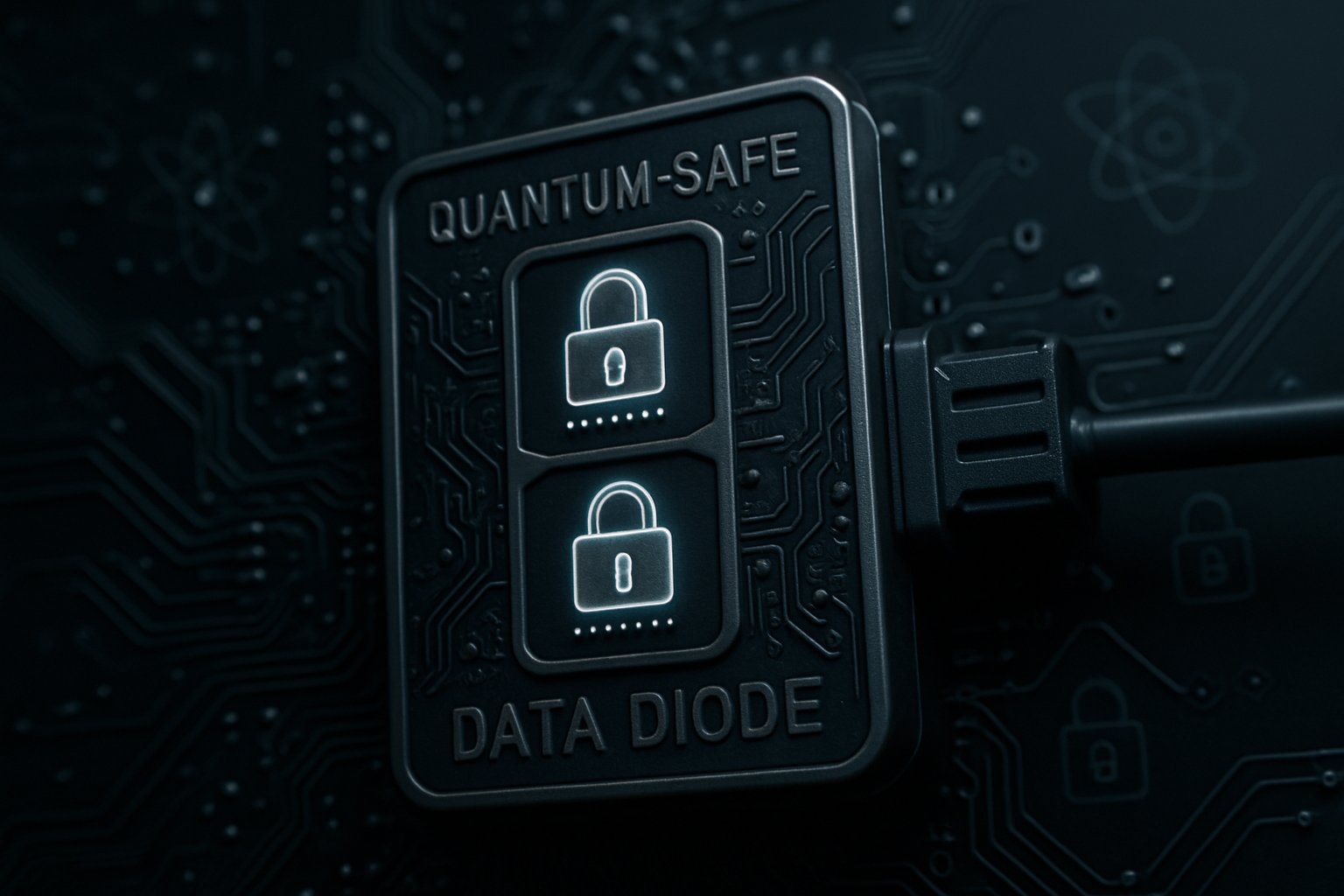
Forward Edge positions Isidore as the first Data Diode with integrated post-quantum algorithms. CEO Eric Adolphe stated the delivery “protects global critical infrastructure from the coming quantum threat”. Additionally, the company touts support from multiple SBIR contracts across defence branches.
The announcement combined the shipment with news of an attack-resilient Communications Patent awaiting final grant. Such marketing synchronicity underscores the startup’s desire to differentiate beyond traditional Technology incumbents. Nevertheless, independent validation remains scarce.
Device Specs Snapshot Details
Official specifications promise sub-0.5 millisecond latency at up to 2 Gbps throughput. Moreover, power draw stays below eight watts, suiting space-constrained deployments. Fiber and copper interfaces are both supported, unlike many optical-only competitors.
Key advertised metrics appear below.
- Latency: <0.5 ms over short links
- Throughput: 2 Gbps bidirectional equivalent on paper
- Power: <8 W typical load
- Crypto Suite: ML-KEM, ML-DSA, AES-256, CNSA 2.0
Furthermore, the firm claims autonomous key lifecycle management powered by embedded AI analytics. This feature attempts to remove manual rotations, a notorious weakness for any Quantum-Safe deployment. However, no independent laboratory has published verification results yet.
Performance claims look impressive on marketing slides. Consequently, buyers should test throughput and resilience under realistic workloads. The next section examines operational caveats that might influence those trials.
Operational Caveats Fully Explained
Physically enforcing one-way flow simplifies attack surfaces. However, encrypting across that barrier complicates symmetric key provisioning. Quantum Security demands strong keys plus agile rotation procedures.
Forward Edge asserts that no bidirectional key exchange occurs. Therefore, pre-installed public parameters or non-interactive KEMs must underpin encryption. In contrast, classical diodes often avoid any encryption and rely solely on physical separation.
Key lifecycle also affects post-incident recovery. Moreover, compromised senders need rapid revocation channels even when flow remains outbound only. Buyers should demand architecture whitepapers, FIPS 140-3 certificates, and third-party penetration reports.
Core due-diligence questions include:
- How are initial keys loaded securely?
- What triggers automated rotation cycles?
- Can the module survive induced optical faults?
- Which auditor validated claimed Patent protections?
These questions highlight operational risk hidden behind glossy brochures. Subsequently, global standards play a pivotal role in closing those gaps.
Global Standards Push Forward
NIST finalized ML-KEM and ML-DSA during 2024, providing a consistent baseline. Furthermore, the White House timeline forces civilian agencies to implement hybrid Communications modes by 2027. Therefore, vendors aligning with these milestones enjoy a procurement tailwind.
Forward Edge markets its compliance with CNSA 2.0 and future FIPS validations. Nevertheless, public CMVP listings still lack an Isidore entry. Until certification numbers appear, technical staff must treat advertised status as provisional Technology claims.
Standards momentum reduces ambiguity, yet documentation remains essential. Consequently, strategic lessons emerge for leaders weighing early adoption.
Strategic Takeaways Moving Ahead
Early adopters can gain operational superiority and compliance credit. However, they also accept integration risk and evolving algorithms. Quantum Security readiness therefore becomes a balancing exercise between speed and assurance.
Moreover, data sovereignty laws complicate cross-border Quantum-Safe deployments, especially for research labs like NCU. Export-control counsel should review every shipment before customs clearance. In contrast, domestic installations face easier licensing but stricter federal reporting.
Recommended action items:
- Map assets requiring Quantum Security within five years.
- Request performance proof from each Data Diode supplier.
- Validate Patent status and intellectual property indemnity.
- Budget for Technology refresh aligned with NIST updates.
- Upskill engineers through the AI Learning & Development™ certification.
These measures establish a defensible roadmap. Subsequently, boards can allocate capital with clearer risk metrics. Quantum Security frameworks also support audit readiness and investor confidence. Furthermore, insurers increasingly discount premiums when Quantum Security controls are documented. Consequently, strong Quantum Security can yield financial benefits beyond technical protection.
In summary, decisive planning turns disruptive change into competitive advantage. The concluding section distills core insights and next steps.
Forward Edge’s Taiwanese delivery illustrates how fast the post-quantum race is moving. Nevertheless, real-world assurance relies on transparent testing, verifiable certificates, and disciplined key stewardship. Therefore, teams should benchmark throughput, energy draw, and failover behavior before issuing purchase orders. Quantum Security remains both an existential requirement and a potential differentiator for digital-first enterprises. Additionally, aligning Data Diode deployments with evolving standards tightens compliance and strengthens Communications resilience. Organizations that pair Quantum Security adoption with continuous education, such as the linked certification, will outpace rivals. Act now, explore the certification, and turn looming disruption into strategic growth.


