

AI CERTS
2 hours ago
Foreign Funds Eye Indian Tech Stocks on AI
Global investors are watching Indian Tech Stocks closely again. Moreover, renewed optimism around generative AI services is driving that interest. Since late 2025, foreign portfolio investors (FPIs) have shifted from heavy selling to selective buying. Consequently, flows into large-cap IT exporters turned positive for the first time since May. The change signals that FPIs now perceive stronger earnings visibility, supported by accelerating AI Growth metrics. Analysts, however, caution that sustained allocations will depend on reliable profit delivery and macro stability.
Foreign Inflows Resurface Again
NSDL data shows FPIs purchased roughly ₹45 billion of IT shares during the fortnight ending 31 December 2025. Previously, the segment saw record equity outflows of nearly $18 billion during 2025. Nevertheless, concentrated buying in Tata Consultancy Services (TCS), Infosys, and HCLTech indicates tactical conviction. In contrast, non-tech sectors continued to experience mild selling. Strategist Aishvarya Dadheech noted that confidence around business visibility has improved, creating a “tradable opportunity.”
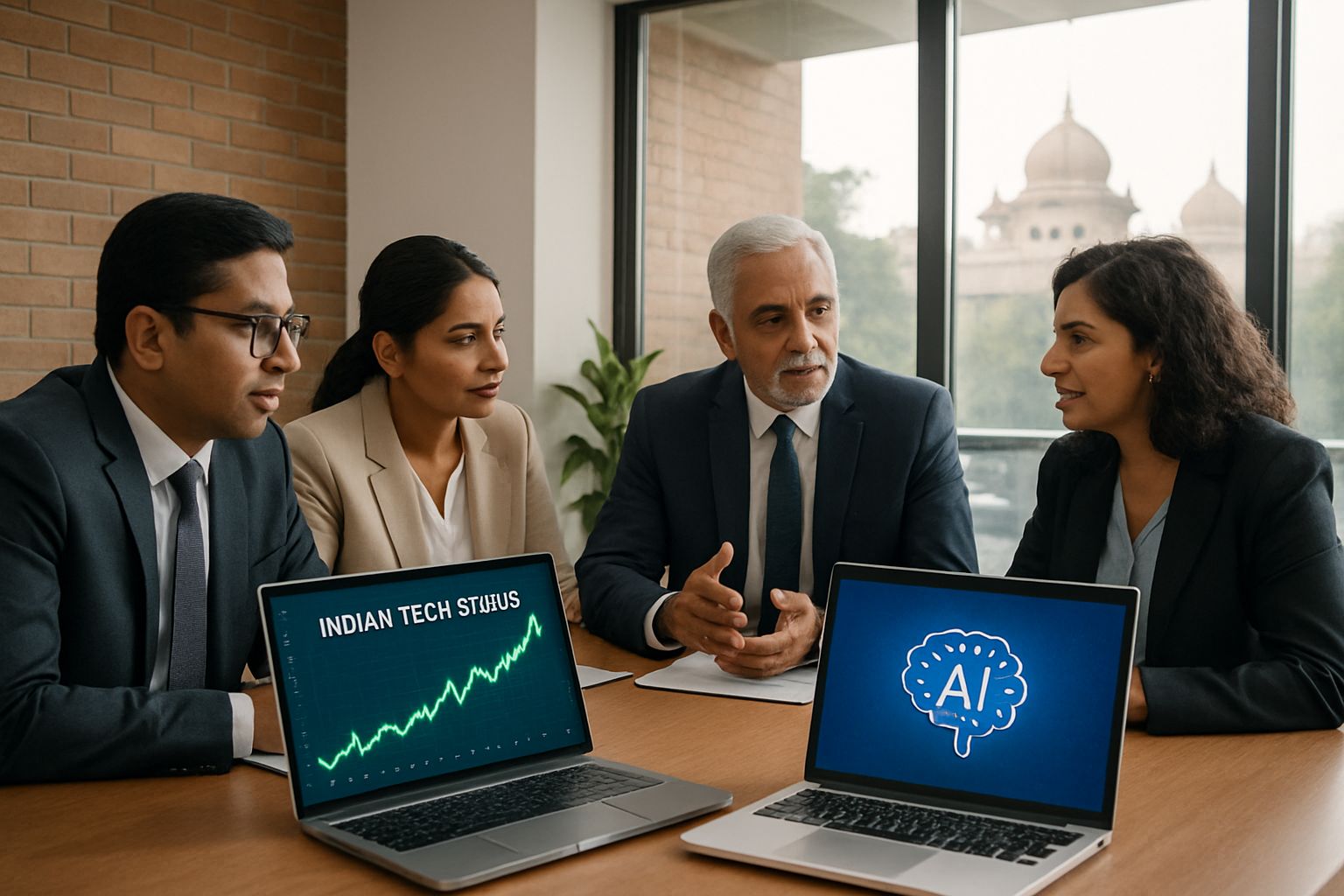
Therefore, sector positioning has shifted, with the Nifty IT index now representing almost 11 percent of the Nifty 50. Additionally, the rupee’s weakness amplifies dollar earnings, making valuations attractive in local terms. These dynamics give Indian Tech Stocks new momentum.
The short-term inflows mark a potential turning point. However, structural challenges still loom for broader equity allocations.
AI Revenue Metrics Impress
Strong quarterly disclosures fueled the sentiment swing. TCS announced an annualised AI services run-rate of $1.8 billion, up 17.3 percent quarter-on-quarter. Meanwhile, HCLTech reported advanced AI revenue near $148 million, reflecting almost 20 percent sequential growth. Furthermore, HCLTech booked $3 billion in AI-led deals for the quarter.
These numbers offer concrete evidence of AI Growth inside service portfolios. Consequently, investors can now model incremental revenue rather than rely solely on narrative. Although the base remains small relative to total sales, rapid expansion suggests rising contribution margins over time.
Such disclosures encourage competition among peers to publish similar metrics. Subsequently, analysts expect greater transparency across the sector, enhancing comparability for Indian Tech Stocks.
Market Drivers And Risks
Several forces underpin current enthusiasm. Firstly, global CIO budgets continue to prioritise automation, cloud migration, and data modernisation. Secondly, a weaker rupee boosts exporters’ pricing power. Thirdly, diversification logic pushes funds to look beyond crowded U.S. semiconductors toward services-oriented plays.
- ₹45 billion FPI net IT purchases in late 2025
- $1.8 billion TCS AI services run-rate
- ~20 percent QoQ growth in HCLTech advanced AI revenue
- Nifty IT weight near 11 percent of benchmark
However, headwinds remain. Macro volatility, labour cost inflation, and uneven demand recovery could undermine earnings. Moreover, the country still lacks deep semiconductor exposure, limiting direct participation in hardware-driven AI Growth. Therefore, sustained foreign interest hinges on consistent execution.
These drivers and obstacles coexist. Consequently, portfolio managers must weigh upside catalysts against persistent uncertainties.
Key Company Highlights 2026
Company releases reveal varying momentum within Indian Tech Stocks. TCS emphasises ambition to become the world’s largest AI-led services provider. Infosys, though quieter on exact numbers, reported increasing generative AI project wins across banking and retail clients. Additionally, HCLTech targets physical and agentic AI, including smart factory deployments.
Mid-tier firms such as LTIMindtree and Coforge also disclosed double-digit AI pipeline growth. Nevertheless, revenue contribution still hovers in low-single digits for most operators. Consequently, management teams face pressure to scale proof-of-concepts rapidly.
The heterogeneity means stock performance will diverge. Therefore, investors need granular diligence rather than blanket exposure.
Strategists Remain Cautious
Global banks urge prudence despite recent inflows. Morgan Stanley warns that the country’s limited hardware footprint could cap long-term AI valuations. Moreover, HSBC highlights currency risk if U.S. rates stay elevated. Meanwhile, domestic reforms, including labour code changes, may compress near-term margins.
Additionally, definitions of “AI revenue” differ among firms. TCS counts consulting, integration, and managed services. HCLTech groups advanced analytics, intelligent automation, and synthetic-data projects. Consequently, cross-company comparisons require careful adjustment.
Such caveats temper exuberance. Nevertheless, many strategists still project gradual capital return, provided earnings surprises skew positive.
Investment Outlook For 2026
Consensus estimates now bake in mid-single-digit revenue acceleration for the sector. Furthermore, deal pipelines indicate continued AI Growth throughout fiscal 2027. In contrast, margin forecasts remain conservative, reflecting wage pressures and higher data-centre costs.
FPIs may adopt a barbell approach. Consequently, they could overweight large-caps with proven client relationships while adding select mid-caps offering niche AI intellectual property. Quantitative screens that integrate AI revenue momentum, booking conversion, and currency sensitivity can support allocation decisions regarding Indian Tech Stocks.
Ultimately, sustained inflows will rely on quarterly confirmation. Therefore, earnings seasons will present recurring litmus tests.
Skills And Certification Edge
Talent depth underpins the sector’s competitiveness. Professionals can enhance their expertise with the AI Developer™ certification. Moreover, clients increasingly request certified practitioners in proposal documents. Consequently, vendors highlight workforce upskilling during analyst calls.
For investors, workforce credentials act as leading indicators of delivery capacity. Additionally, certified staff can command premium bill rates, lifting revenue per employee. Therefore, human-capital metrics deserve attention alongside financial ratios when evaluating Indian Tech Stocks.
Elevated skill levels strengthen execution confidence. Subsequently, foreign allocators may view certified talent pools as a differentiator.
These insights underscore the strategic relevance of capability building. However, continuous learning will remain vital as AI tools evolve.
Conclusion
Foreign investors are cautiously rebuilding positions in Indian Tech Stocks. Furthermore, tangible AI revenue evidence, favourable currency moves, and diversification motives support this rotation. Nevertheless, macro risks, inconsistent definitions, and competitive pressures temper optimism. Consequently, sustained capital inflows will depend on consistent earnings beats and transparent AI reporting. Professionals should, therefore, pursue recognised credentials, such as the linked certification, to boost delivery credibility. Explore skill pathways and monitor quarterly numbers to navigate the sector’s next phase effectively.


