

AI CERTs
2 hours ago
Federal Preemption Fight: White House AI Blueprint
Policy insiders expected tension between Washington and the states over artificial intelligence. However, December 2025 delivered a decisive escalation. The White House issued an executive order targeting state AI statutes. Federal Preemption moved from abstract debate to explicit presidential directive. Consequently, a coordinated, multi-agency campaign now seeks to narrow state authority. Meanwhile, governors and attorneys general have mobilized bipartisan resistance. Billions in broadband grants hang in the balance. Therefore, understanding the legal chessboard has become urgent for technology leaders. This article maps the timeline, concepts, and stakes with clarity. Readers will grasp how Federal Preemption strategy could reshape innovation policy nationwide. Moreover, actionable guidance appears throughout. Let us begin with the key dates.
White House Action Timeline
The administration’s chronology illustrates strategic layering of executive and administrative tools. Consequently, each action builds pressure on states before any courtroom arguments.
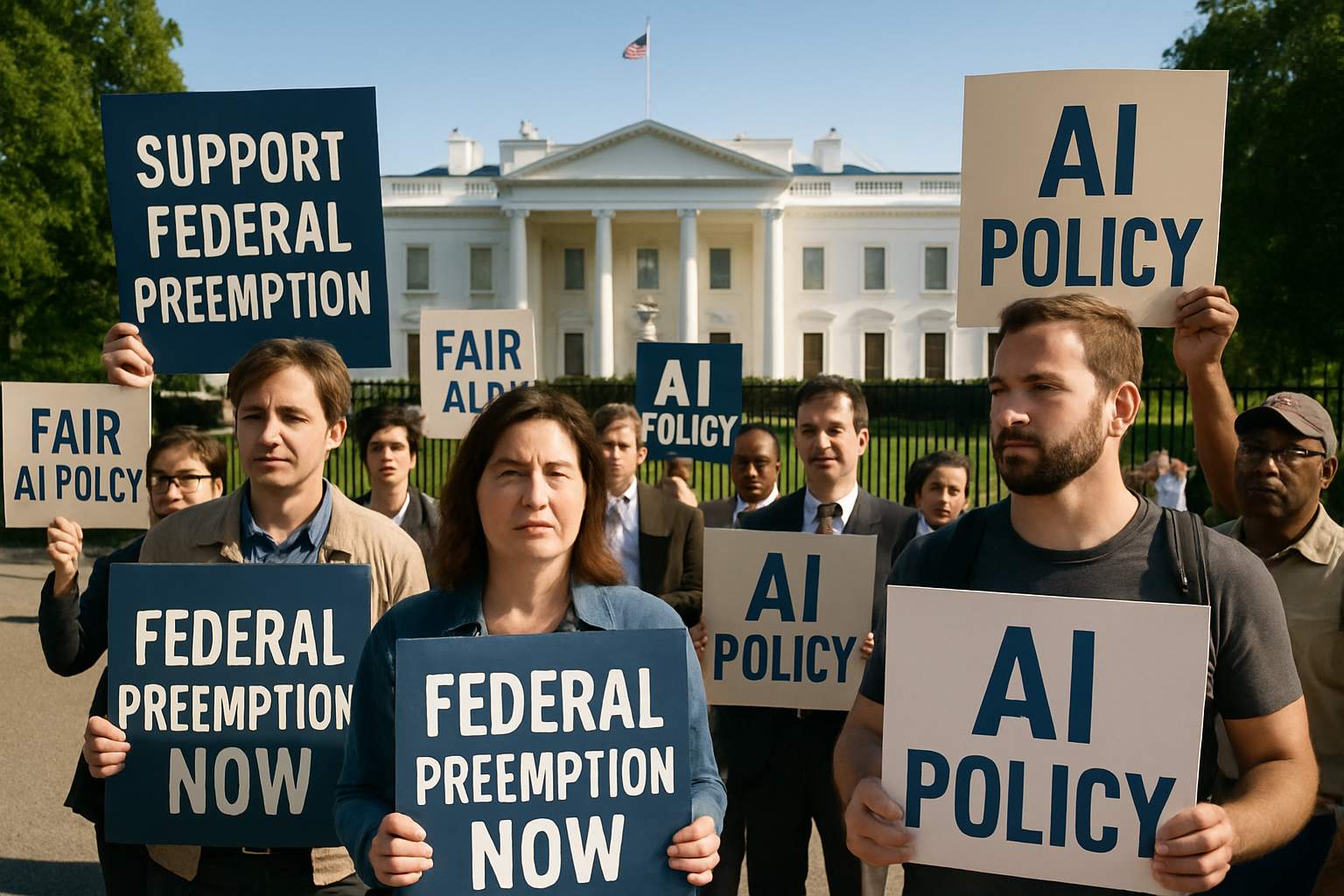
December Order Key Details
On 11 December 2025, President Trump signed the “Ensuring a National Policy Framework for Artificial Intelligence” order. Additionally, the text cites over 1,000 pending state AI bills. The order instructs Commerce to catalogue conflicting statutes within 90 days. It also directs the Attorney General to establish an AI Litigation Task Force. Moreover, BEAD broadband grants worth $42.45 billion may become conditional on compliance.
Litigation Task Force Launch
Subsequently, DOJ formally unveiled the Task Force on 9 January 2026. The unit will target statutes using Dormant Commerce Clause and conflict preemption theories. Furthermore, officials hinted at swift filings once Commerce delivers its survey. Legal observers note that an executive order alone cannot guarantee court victories. Nevertheless, coordinated litigation often shapes the narrative early.
March Legislative Blueprint Summary
On 20 March 2026, the White House released a non-binding Legislative Recommendations document. The blueprint urges Congress to craft express Federal Preemption for “unduly burdensome” state AI laws. However, it preserves limited carve-outs for child safety, permitting, and procurement. Consequently, delicate compromises will emerge during drafting.
These milestones reveal an incremental yet escalating federal strategy. Next, we explore the motivations driving that approach.
Drivers Behind Policy Push
Commercial urgency fuels the federal campaign. Moreover, large AI developers dread a patchwork of fifty separate disclosure regimes. Compliance teams predict spiraling costs if divergent state rules proliferate. Consequently, industry lobbyists praised the executive order within hours. The White House echoed those concerns, citing global competitiveness and national security. In contrast, consumer advocates argue the move sidelines experimentation that sparks local innovation. State officials also value proximity to emerging harms like algorithmic discrimination. Additionally, several governors fear losing leverage over grant conditions.
Stated Administration Core Rationale
- Uniform national standard reduces compliance friction across interstate data flows.
- Consolidated oversight promises faster deployment of defense-critical AI innovation.
- Conditional funding could accelerate broadband and compute infrastructure nationwide.
The March blueprint also stresses global talent pipelines to accelerate responsible deployment. Debate now centers on whether Federal Preemption is the only workable solution. Startups worry the blueprint might entrench heavyweight reporting norms. Collectively, these forces create bipartisan momentum for some federal harmonization. However, momentum differs from guaranteed legislation. Understanding core doctrines clarifies that distinction.
Key Legal Concepts Explained
Effective strategy requires fluency in constitutional vocabulary. Firstly, Federal Preemption derives from the Supremacy Clause. Express, field, and conflict variants develop through statutes and judicial interpretation. Furthermore, agency preemption depends on explicit congressional authorization. Second, the Dormant Commerce Clause forbids laws that burden interstate trade without valid local benefits. Consequently, DOJ expects to wield that doctrine against residency-based data localization mandates. Third, Spending Clause limits constrain punitive grant conditions. Courts ask whether restrictions relate to program purpose and avoid coercion.
Key Doctrinal Flash Points
- Express preemption requires clear congressional text.
- Dormant Commerce tests weigh local interest against interstate burdens.
- Grant conditions must remain germane and non-coercive.
These doctrines define the courtroom battlefield. Next, we examine how states prepare their counters.
State Level Resistance Mobilizes
Within weeks, bipartisan coalitions formed to defend state authority. Attorneys general from at least 30 states signed protest letters to the FCC. Moreover, hundreds of legislators argued that conditional grants threaten democratic accountability. Several letters insist that Congress has never granted blanket Federal Preemption for artificial intelligence. Consequently, states prepare parallel litigation teams to intervene once DOJ files. Meanwhile, state rule-makings continue, especially on algorithmic discrimination and procurement transparency.
Core State Legal Arguments
Firstly, many cite the Tenth Amendment’s reservation of powers. Secondly, they claim the EO lacks statutory grounding for sweeping preemption. Additionally, coercive funding tactics may violate Spending Clause precedent. In contrast, industry briefs stress interstate commerce burdens outweigh local interests.
The clash assures complex, multi-forum litigation. Broader reaction across corporate circles adds further texture. We turn there now.
Broader Industry Stakeholder Reactions
Most large platforms publicly celebrated the possibility of unified compliance. Meta, Google, and several trade groups issued supportive statements within hours. However, small startups voiced anxiety over potential lobbying capture. They fear that strict national rules, shaped by incumbents, could slow grassroots innovation. Consequently, some accelerators urged Congress to condition Federal Preemption on sandbox-style exemptions. Investors also track grant cliff risks linked to BEAD funding holdbacks. Moreover, procurement vendors question whether rapid rule changes create supply-chain uncertainty. Legal analysts advise companies to maintain dual compliance until courts clarify obligations.
Stakeholder views therefore diverge, reflecting size, sector, and risk appetite. Those divisions shape the risk landscape discussed next.
Strategic Major Risks Ahead
Litigation timing represents the first hazard. Courts may grant injunctions that delay national rules for years. Consequently, businesses could face overlapping requirements and uncertainty. Secondly, aggressive grant conditions risk unfavorable Supreme Court scrutiny. In South Dakota v. Dole, coercive funding triggers constitutional alarms. Moreover, failed litigation could weaken the administration’s broader Federal Preemption narrative. Third, election-year politics may stall congressional appetite for sweeping legislation. Nevertheless, industry lobbying budgets continue to expand. If Congress ignores the blueprint, the EO remains vulnerable.
These risks underscore the value of proactive scenario planning. The following guidance offers practical steps.
Practical Guidance Forward Now
Technology executives should map state requirements against internal control catalogs. Meanwhile, track DOJ docket updates through PACER alerts. Furthermore, engage policy counsel to model best-case and worst-case Federal Preemption timelines. Consider joining multi-state coalitions to shape agency comment files. Consequently, companies influence final rules rather than merely reacting. Professionals can enhance expertise with the AI Project Manager™ certification.
Essential Monitoring Checklist Steps
- Review weekly Federal Register entries for FCC and FTC notices.
- Log state bill introductions to anticipate overlapping legislation.
- Update risk registers when Task Force filings emerge.
These actions position organizations to pivot quickly. Finally, we recap the overarching narrative.
The federal campaign has advanced from executive signal to concrete litigation machinery. However, decisive authority still lies with Congress and the courts. States promise robust defense, ensuring prolonged uncertainty. Consequently, leaders must track grant conditions, procedural filings, and pending legislation with equal vigilance. Meanwhile, strategic preparation buys flexibility whatever form Federal Preemption finally assumes. Moreover, targeted learning such as the AI Project Manager™ certification deepens governance competence. Act now to future-proof AI portfolios and maintain compliance advantage. Regular horizon scanning minimizes surprise enforcement actions. Therefore, allocate resources for policy surveillance and coalition engagement. Those efforts sustain competitive momentum in a rapidly evolving regulatory landscape.


