

AI CERTS
2 hours ago
Fal.ai Flux 2 Turbo Slashes Image Generation Costs
Turbo Release Timeline Details
The release shipped under Black Forest’s non-commercial license, yet the weights were openly downloadable. Moreover, developers praised the open-source transparency around training scripts. In contrast, many rivals still hide model internals.
Turbo’s swift publication cadence underscores Fal.ai’s aggressive roadmap. These milestones reveal deliberate timing that leveraged holiday news lulls. Consequently, attention shifted toward pricing potential, the focus of our next section.
Cost Efficiency Math Explained
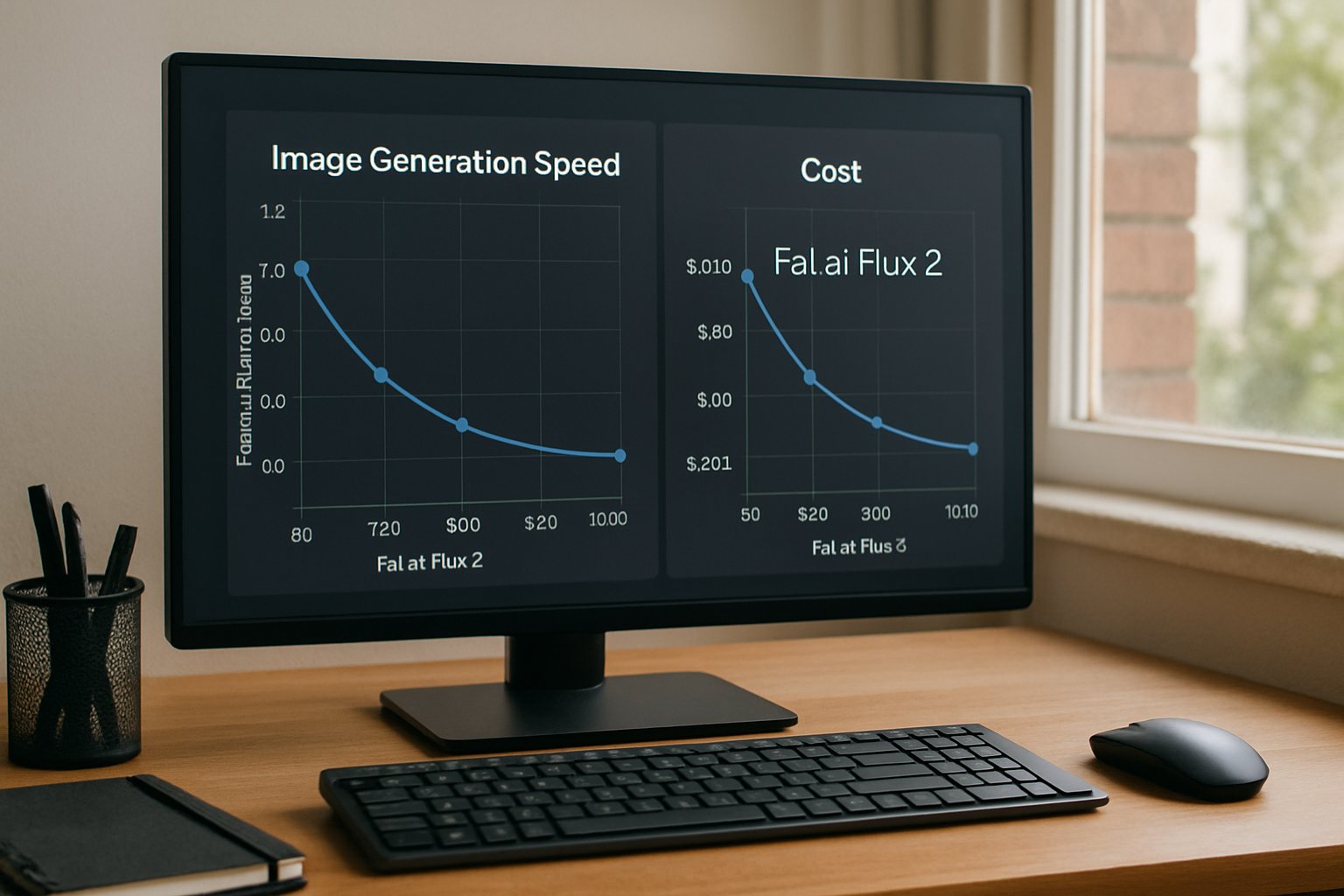
Pricing dominates procurement talks. Fal.ai lists Fal.ai Flux 2 Turbo at US $0.008 per megapixel. Meanwhile, the standard Dev endpoint costs $0.012, and Flex hits $0.06. Therefore, Turbo is roughly 7.5 times cheaper than Flex. The comparison widens against many closed APIs, where rates exceed $0.07 per megapixel. Additionally, Turbo needs only eight inference steps, trimming GPU minutes.
- Turbo: $0.008/MP, 8 steps, ~6.6 seconds
- Dev: $0.012/MP, 50 steps, ~40 seconds
- Flex: $0.06/MP, variable steps, slower
A studio generating one million 1024×1024 images would save about $52,000 monthly by switching from Flex. Furthermore, such savings improve fundraising narratives, showcasing capital-light scale. Cost advantages feed directly into gross margin projections.
These numbers confirm Turbo’s budget appeal. However, performance must also hold, as discussed next.
Key Benchmark Performance Insights
Benchmarks validate marketing claims. Yupp’s leaderboard records Fal.ai Flux 2 Turbo producing 1024×1024 images in 6.6 seconds. The same entry notes the $0.008 cost, leading the affordability chart. Moreover, Artificial Analysis logs an ELO of 1,166, placing Turbo near premium proprietary contenders. Nevertheless, methodology differences warrant caution. For instance, Yupp uses fixed prompts, while Artificial Analysis relies on crowd voting.
Qualitative feedback aligns with data. Testers report crisp textures and faithful style transfer. Additionally, prompt adherence remained stable despite only eight steps. Consequently, the adapter’s efficient design proves effective.
Benchmarks suggest Turbo balances speed, cost, and quality. In contrast, licensing still shapes production choices, explored below.
Licensing And Commercial Caveats
The LoRA inherits the FLUX Dev Non-Commercial License. Therefore, enterprises must secure paid rights for revenue-generating deployments. VentureBeat highlighted this nuance, noting the funnel toward Fal.ai’s hosted APIs. Meanwhile, hobbyists can freely experiment locally. Moreover, the model remains open-source in spirit, promoting research replication. However, legal teams should review output usage clauses carefully.
Professionals can enhance their expertise with the AI Network Security™ certification. This credential clarifies compliance when integrating restricted weights.
Licensing sets clear guardrails while encouraging platform adoption. Consequently, attention shifts toward the technical innovations enabling Turbo’s speed.
Technical Innovations Underlying Speed
Turbo employs LoRA distillation and scheduler reduction. The approach trains low-rank matrices that approximate full-weight shifts. Additionally, timestep distillation compresses 50 diffusion iterations into eight without quality loss. Consequently, compute demands plummet. The architecture remains compatible with popular inference engines, including ComfyUI. Furthermore, the adapter’s small file size accelerates cold starts.
Engineers label the design efficient because it maximizes GPU throughput. In contrast, monolithic checkpoints often strain memory, hindering scale. Moreover, open-source release ensures community audits and rapid bug fixes.
These innovations explain performance gains. However, broader market effects deserve equal analysis.
Market Impact And Outlook
Turbo’s economics pressure incumbents. Startups can now prototype high-resolution assets at marginal cost. Consequently, fundraising pitches can highlight lean burn rates. Established SaaS players may renegotiate cloud budgets. Furthermore, agencies gain an Image generator that avoids creative bottlenecks. The broader open-source ecosystem benefits from transparent weights and public benchmarks.
Nevertheless, closed providers will likely answer with tiered plans or bundled services. Meanwhile, Fal.ai might expand the Fal.ai Flux 2 range, introducing commercial LoRAs. Additionally, partner marketplaces could integrate Turbo, amplifying reach.
Market forces will keep accelerating. Therefore, leaders should monitor pricing updates and community sentiment.
Conclusion And Next Steps
Fal.ai Flux 2 Turbo pairs dramatic cost cuts with reliable quality. Benchmarks show six-second renders at unrivaled prices. Licensing remains non-commercial, yet hosted endpoints simplify compliance. Technical advances in LoRA distillation drive the gains. Consequently, teams can stretch budgets and quicken creative cycles.
Prospective adopters should pilot workloads, validate quality on edge prompts, and track licensing terms. Moreover, consider pursuing the linked certification to strengthen governance. Act now to determine whether Turbo fits your 2026 production roadmap.


