

AI CERTs
2 hours ago
Export License Framework reshapes global chip sales
High-end AI chips now sit at the center of strategic geopolitics. Licensing rules shift monthly, unsettling suppliers, cloud operators, and investors. On 15 January 2026, Commerce finalized a pivotal update for China-bound accelerators. The rule moved certain NVIDIA H200 and AMD MI325X exports from presumed denial to case-specific review. Consequently, companies gained a narrow yet critical path to apply under the Export License Framework. However, strict supply, security, and third-party testing certifications accompany that pathway. Meanwhile, earlier packages had already tightened HBM, FDP, and equipment controls. These overlapping measures create a dense compliance maze for global chip Hardware chains. Therefore, executives need clear timelines, performance thresholds, and risk signals. This article unpacks the legal milestones, industry responses, and practical steps professionals should follow. Readers will also find skill resources, including a linked AI ethics certification, strengthening governance programs.
Global Chip Control Timeline
Timeline clarity helps teams plan. Dec 2 2024 marked the Interim Final Rule that broadened ECCNs and the FDP reach. Moreover, high-bandwidth memory exceeding 2 GB/s per mm² fell under immediate licensing. Commerce simultaneously added almost 140 entities, escalating global Trade tensions.
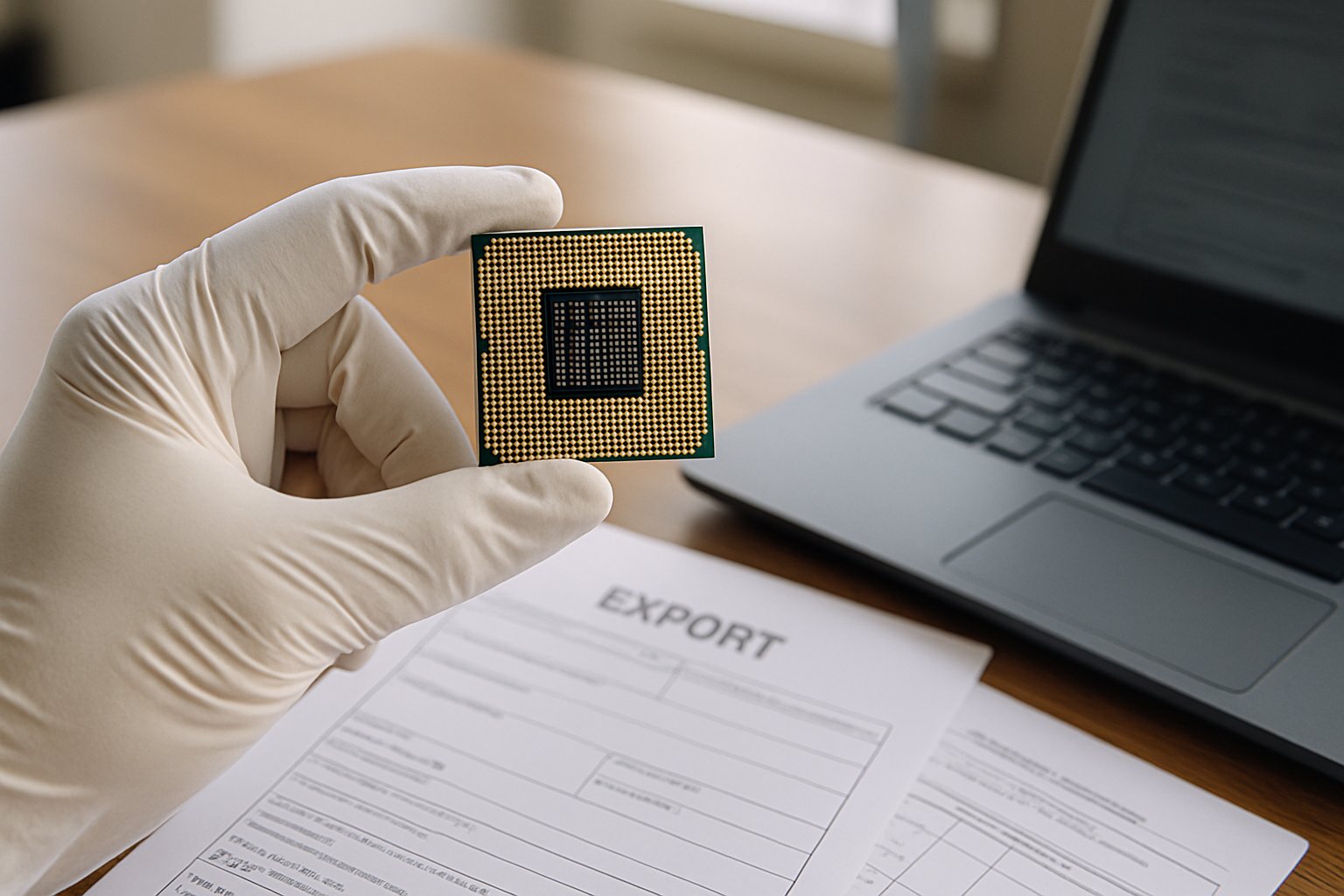
Subsequently, January 15 2025 saw Dutch authorities align equipment controls, affecting ASML lithography deliveries. Japan mirrored that stance later in spring. Consequently, multi-jurisdiction coordination became essential within every Export License Framework submission. Meanwhile, China counter-ed with restrictions on gallium and germanium, crucial for advanced Hardware manufacturing.
These dates illustrate an accelerating regulatory drumbeat. However, the newest case-by-case channel shifts the narrative, as the next section explains.
Case-by-Case License Pathway
The 2026 final rule introduced quantitative performance metrics called Total Processing Performance and DRAM bandwidth. Exports qualify when TPP remains below 21,000 and total bandwidth stays under 6,500 GB/s. Consequently, NVIDIA H200 and AMD MI325X fit squarely inside the new bracket. However, applicants must file detailed supply attestations within the Export License Framework. They also agree to independent US testing that verifies non-diversion to embargoed end users.
Moreover, recipients inside China or Macau must demonstrate secure datacenter protocols preventing cluster aggregation above threshold. Commerce reserves authority to inspect documents and facilities without prior notice. In contrast, earlier policy assumed almost automatic denial, limiting predictability for Hardware sellers. Therefore, the recent shift has triggered cautious optimism across Trade compliance teams.
Strict metrics improve transparency yet raise reporting cost. Subsequently, attention turns to companion rules governing HBM and the broader FDP scope.
HBM And FDP Expansion
HBM stacks remain vital for accelerator throughput, which prompted December 2024 controls on memory bandwidth density. Any stack above 2 GB/s per mm² now needs Commerce approval under ECCN 3A090.c. Consequently, practically every modern AI module qualifies. The Export License Framework therefore intersects with these HBM thresholds during each filing. Furthermore, the Foreign-Produced Direct Product rule extends US jurisdiction to offshore wafers built with American EDA tools.
Compliance officers must calculate whether overseas fabs trigger FDP coverage before shipping. Nevertheless, some suppliers try routing wafers through intermediate plants, adding multilayer risk. Therefore, BIS added new Entity List entries to deter those channels. Hardware integrators now monitor component country-of-origin almost daily.
These additions close many loopholes yet complicate forecasting. Next, we examine how allied equipment controls overlay the semiconductor Trade environment.
Equipment Export Alignment Moves
Dutch, Japanese, and US policymakers synchronized restrictions on critical lithography and deposition machines. ASML estimated China sales would still reach roughly 20 percent of 2025 revenue, about €7 billion. However, licenses after April 1 2025 require Hague approval before any Commerce documentation proceeds. Moreover, case reviews demand end-use statements ensuring systems support civilian workloads only.
Tokyo Electron and Nikon issued similar compliance notes, citing alignment with the Export License Framework during joint projects. Consequently, multinational fabs must map tool serial numbers against both national and BIS control lists. In contrast, smaller vendors face proportionally higher audit burdens.
Aligned equipment rules tighten supply at the tool source. Subsequently, market players voiced worry about revenue drag, an issue explored in the next section.
Industry Reactions And Risks
NVIDIA welcomed clearer guidance yet warned that licence queues could delay quarterly bookings. AMD echoed similar sentiments, emphasising the need for predictable Commerce timelines. Meanwhile, legal advisers flagged extensive document retention duties embedded in the Export License Framework. Corporate Trade officers must coordinate engineering, sales, and security teams to gather evidence swiftly.
Moreover, investor analysts fear lost market share should China accelerate indigenous accelerator Hardware. Some reports suggest Chinese cloud buyers already budget for alternative designs to hedge. Nevertheless, many expect US value propositions in software ecosystems will preserve competitiveness.
Risk perceptions vary but converge on one theme: compliance professionalism. Therefore, the following section outlines strategic steps companies should prioritise.
Strategic Compliance Key Considerations
First, create an internal dashboard tracking TPP, bandwidth, and HBM density for each product. Additionally, link that dashboard to license expiration dates and Commerce guidance updates. Second, draft supply sufficiency statements early, using audit trails from distributors. Consequently, the Export License Framework filing becomes faster and less error-prone.
- Maintain real-time chip inventory snapshots.
- Document US supply reserve percentages.
- Secure third-party testing contracts.
- Archive recipient security certifications.
Professionals can enhance their expertise with the AI Ethics certification required for responsible governance. Furthermore, maintain transparent documentation to support potential US on-site inspections.
These measures build a defensible compliance posture. Finally, we assess future outlook and immediate actions.
Forward Outlook And Actions
Policy volatility will likely persist through the election cycle and beyond. However, modular controls such as performance thresholds create measurable guardrails for Trade planning. Industry coalitions may lobby Commerce for periodic threshold reviews reflecting Moore’s law advances. Meanwhile, China’s material counter-measures could influence Hardware prices, pressuring global margins.
Consequently, executives should prepare contingency roadmaps covering supply, licensing, and diplomatic scenarios. The Export License Framework will remain a central reference during any forecast. Therefore, continuous monitoring of Federal Register notices and allied gazettes is mandatory.
Outlook uncertainty rewards agile governance. In contrast, static policies risk surprise denials.
Conclusion
Advanced chips drive economic growth and national security alike. Consequently, Washington and allied capitals intend to refine controls rather than retreat. The Export License Framework now offers a structured yet demanding route for high-end accelerator sales. However, strict performance limits, HBM rules, and equipment harmonisation elevate compliance stakes. US and foreign Commerce teams must coordinate real-time data, secure testing, and airtight documentation. Moreover, proactive training, such as the linked AI ethics credential, strengthens organisational resilience. Therefore, executives should bookmark Federal Register feeds and update dashboards whenever the Export License Framework evolves. Follow these steps today, and your business will navigate tomorrow’s chip Trade landscape with confidence.


