

AI CERTs
2 months ago
ERNIE-5.0 cracks global top-10 leaderboard
Baidu’s newest foundation model, ERNIE-5.0, just became the only Chinese system inside the global top ten of the crowd-sourced LMSYS Leaderboard. Consequently, the debut signals growing parity with US giants and highlights the shifting competitive landscape. Moreover, LMArena voters elevated the model to eighth place overall and second place in the Math arena, according to the Jan. 12 snapshot. These numbers excite analysts because human preference scores often map closer to user satisfaction than purely synthetic benchmarks.
However, preference rankings are volatile, and confidence intervals illustrate possible movement. Nevertheless, the achievement draws attention to Baidu’s aggressive research pace and its claimed mixture-of-experts architecture. Therefore, enterprises evaluating large-language-model options should watch the newcomer closely. Meanwhile, developers can already test the public demo hosted by LMArena and compare outputs against established incumbents.
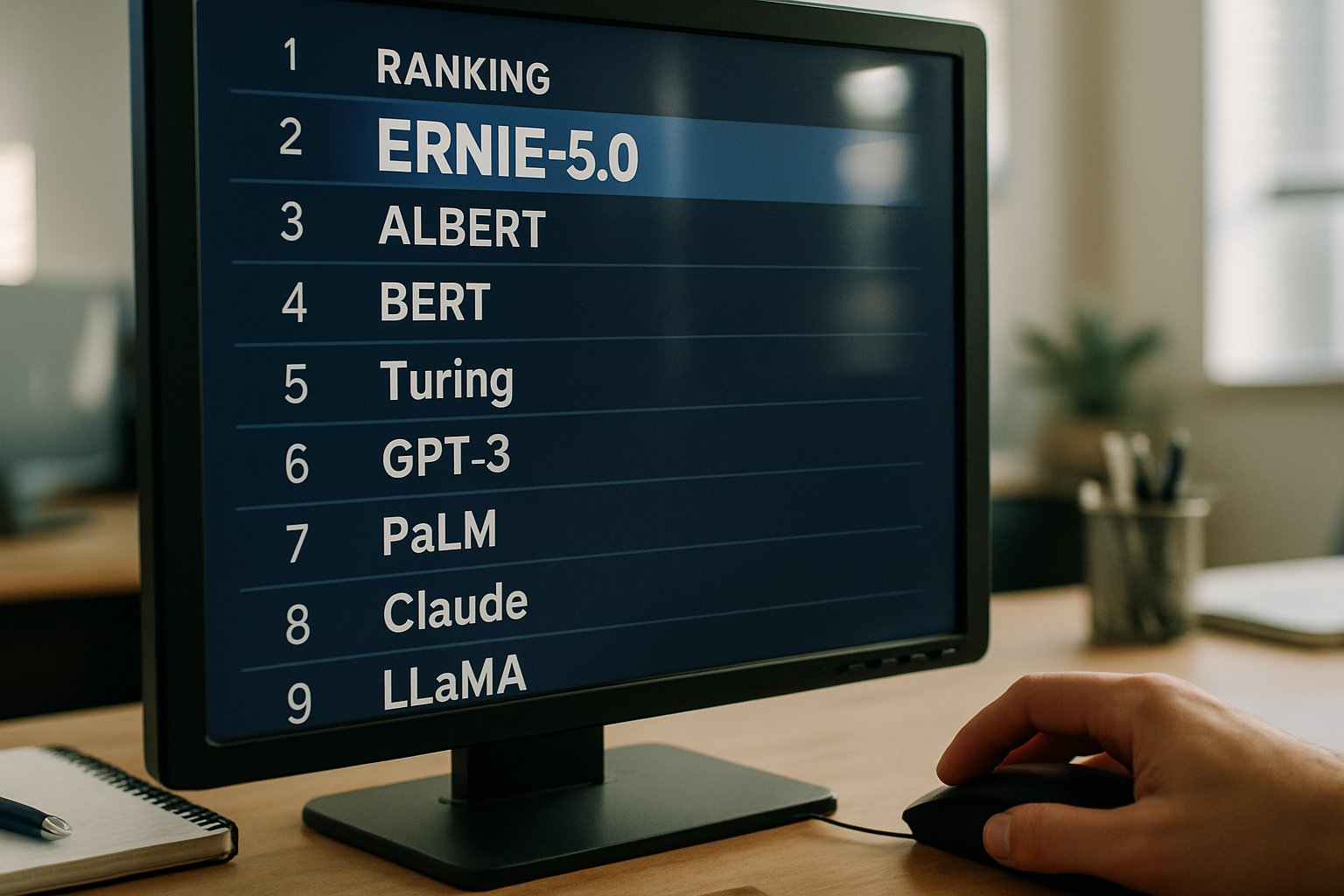
This article unpacks the milestone, explores technical claims, and outlines practical implications for engineering teams. Furthermore, it reviews caveats around crowd voting and offers next steps for decision-makers. By the end, readers will understand where ERNIE-5.0 truly stands today and how the ranking might influence procurement, strategy, and research roadmaps.
ERNIE-5.0 Claims Leaderboard Milestone
On Jan. 12, LMArena listed ERNIE-5.0 with an Elo-style score of 1,460. In contrast, Google’s Gemini Ultra recorded 1,497, while OpenAI’s GPT-5.2-High topped the table at 1,534. The placement earned Baidu rank eight overall and first among Chinese entries. Additionally, the listing accumulated 4,813 blind votes, giving a ±9 confidence interval.
Industry outlets such as Yahoo Tech and Decrypt quickly amplified the result. Consequently, social media chatter portrayed the climb as evidence of a closing East-West capability gap. However, leaderboard maintainers warned that scores shift as votes grow and new versions arrive.
These dynamics underscore the board’s living nature. Yet, reaching the top tier delivers reputational capital and signals technical maturity. Therefore, procurement officers now include ERNIE-5.0 in shortlists once reserved for US labs.
The milestone demonstrates measurable preference traction. However, deeper performance nuances appear in the Math arena, which the next section explores.
Math Arena Performance Spotlight
ERNIE-5.0 scored 1,487 in the specialized Math sub-arena, placing second behind GPT-5.2-High. Meanwhile, other challengers like DeepSeek-Math landed lower with 1,408. Moreover, only 315 votes back the math figure, producing a wider ±32 interval. Nevertheless, observers view the showing as a breakthrough because reasoning tasks often expose brittle edges.
Furthermore, math competence matters for finance, engineering, and scientific workloads, where hallucination tolerance is low. Consequently, Baidu’s rank may accelerate partnerships in quantitative sectors. Independent quant funds already report pilot testing the model for derivative pricing notebooks.
However, experts urge caution. Academic papers, including WIMHF, reveal preference panels can favor verbose derivations over concise proofs, skewing results. Therefore, structured benchmarks such as GSM-Hard still complement crowd feedback.
Still, the strong Math arena score strengthens ERNIE-5.0’s technical narrative. Subsequently, curiosity about its underlying architecture has grown.
MoE Architecture Under Review
Baidu claims ERNIE-5.0 uses a two-trillion-parameter Mixture-of-Experts design with less than three percent active experts per token. Additionally, the company advertises native multi-modal capability, though LMArena currently evaluates text responses only. Moreover, sparse activation enables massive parameter counts without linear compute cost.
In contrast, rivals pursue dense Transformers or hybrid routing. Consequently, observers debate whether MoE delivers sustainable quality advantages or mainly marketing optics. Nevertheless, scaling laws suggest sparse gates can widen effective capacity when routing precision remains high.
Independent audits have not yet verified Baidu’s parameter figures. Therefore, analysts advise requesting an official model card before integrating the system into regulated pipelines. Professionals can enhance evaluation skills through the AI Prompt Engineer™ certification, which teaches prompt calibration and model interrogation.
The architectural discussion feeds into broader questions about what crowd scores truly measure. Consequently, understanding voting mechanics is essential.
Interpreting Crowd Preference Scores
LMArena, the engine behind the LMSYS Leaderboard, pairs anonymized outputs and invites humans to pick winners. Subsequently, an Elo-like algorithm converts pairwise results into rankings. Furthermore, the platform publishes vote counts and confidence intervals for transparency.
However, researchers highlight sampling bias. Voter demographics, prompt genres, and cultural norms can tilt outcomes. Moreover, refusal behavior and politeness levels influence perceived helpfulness. WIMHF authors note systematic preference patterns that differ from deterministic benchmarks.
Therefore, enterprises must triangulate these scores with domain-specific evaluations, red-team audits, and cost analyses. Nevertheless, the LMSYS Leaderboard remains valuable for tracking general-purpose perception and spotting inflection points quickly.
Appreciating these nuances informs strategic interpretation. Consequently, we turn to market implications and competitive responses.
Market Impact And Competition
ERNIE-5.0’s ascent reshapes vendor comparisons. Moreover, Chinese tech firms gain a persuasive reference when pitching domestic solutions to global clients. Consequently, procurement teams balancing sovereignty, latency, and cost considerations now weigh Baidu’s offering against OpenAI, Google, Anthropic, and xAI.
Additionally, the model’s performance may pressure Western labs to accelerate releases or expand free usage tiers. Meanwhile, regional regulators observe whether diversified supply increases resilience against single-vendor concentration.
Investors respond, too. Baidu’s Hong Kong shares rose three percent following the leaderboard news, outperforming the broader tech index that day. Furthermore, analysts at CITIC forecast incremental cloud revenue from ERNIE API contracts.
These shifts illustrate the ranking’s commercial ripple effects. However, practical guidance helps engineering teams translate hype into action, which the next section provides.
Practical Takeaways For Teams
Decision-makers evaluating ERNIE-5.0 should:
- Benchmark critical workloads using controlled prompt suites alongside Arena snapshots.
- Monitor the LMSYS Leaderboard weekly for volatility indicators and confidence interval changes.
- Request Baidu’s model card, pricing, and region availability details.
- Compare latency and cost per thousand tokens against existing suppliers.
- Train staff through the AI Prompt Engineer™ program to maximize prompt efficiency.
Furthermore, teams should sandbox the model under real traffic loads to expose throttling or rate limits. Additionally, legal officers must review licensing clauses, because LMArena uses a proprietary endpoint distinct from any commercial SLA.
These tactical steps convert leaderboard curiosity into informed procurement. Consequently, attention shifts toward future trajectory.
Conclusion And Future Outlook
ERNIE-5.0 now sits among elite systems on the LMSYS Leaderboard, validating Baidu’s rapid iteration strategy. Moreover, its Math arena ranking hints at robust reasoning skills, while the MoE design promises scalable capacity. However, confidence intervals, sampling bias, and unverified parameter claims require careful scrutiny.
Nevertheless, the achievement signals intensifying global competition and offers enterprises another viable supplier. Therefore, leaders should combine controlled tests, cost analyses, and talent upskilling to make balanced adoption choices. Finally, explore the linked certification to deepen model evaluation expertise and stay ahead in the evolving AI landscape.


