

AI CERTs
2 months ago
Enterprise Knowledge Copilot Frameworks Overtake Intranets
Over two years, enterprise intranets have quietly changed shape. Conversational copilots now deliver instant answers, summaries, and actions. Consequently, static portals feel outdated beside dynamic assistants. This article examines how enterprise knowledge copilot frameworks displace traditional intranet experiences. Moreover, we highlight architectures, benefits, and risks behind the transition. Data from Microsoft, LangChain, and LlamaIndex illustrate accelerating momentum. Additionally, market forecasts show multi-billion growth for AI-driven knowledge management. Yet governance, security, and content hygiene remain pressing challenges. Therefore, CIOs need clear guidance for safe implementation. Finally, we suggest certifications and next steps for ambitious leaders. Meanwhile, employee AI usage already tops seventy percent in some surveys. Such grassroots demand further accelerates adoption inside every enterprise function.
Market Shift Accelerates Rapidly
Forrester and Microsoft both signal a decisive market pivot. Consequently, budgets move from pilots to production knowledge agents. Grand View Research values knowledge management software at about twenty billion dollars for 2024. Analysts project compound growth exceeding thirty percent in AI-focused segments.
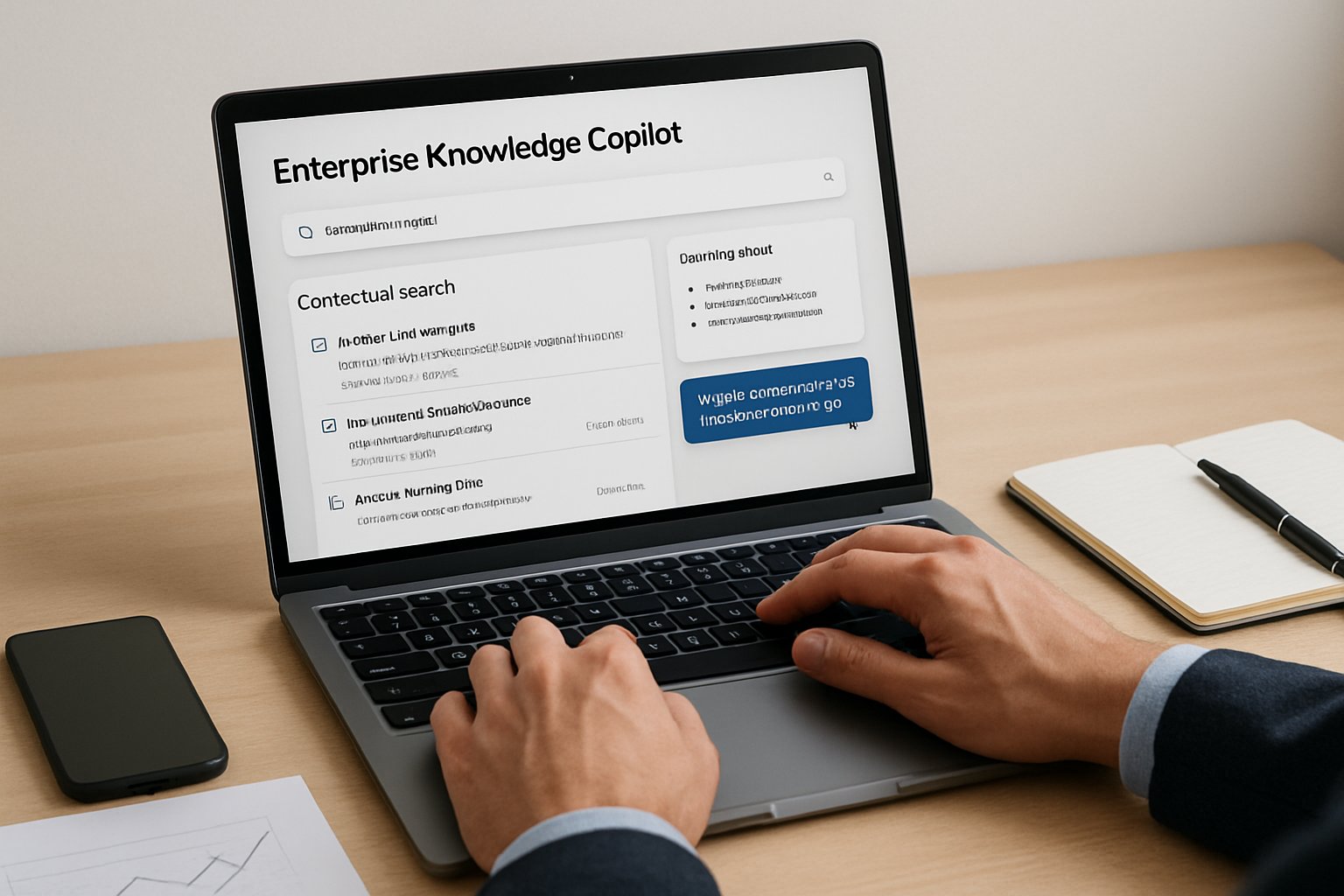
Meanwhile, Microsoft positions Copilot as the preferred enterprise interface. Satya Nadella recently described Copilot as a new organizational knowledge membrane. Framework vendors respond quickly. Therefore, LangChain tightens Azure integrations while LlamaIndex launches managed ingestion services. These signals confirm sustained velocity. In contrast, legacy intranet usage steadily declines, steering focus toward new architectures. Enterprise knowledge copilot frameworks now appear in nearly every vendor keynote.
Core Architecture Elements
Successful deployments share repeatable technical blueprints. Firstly, enterprises maintain an authoritative content layer, often SharePoint, with strict permissions. Secondly, ingestion pipelines parse documents, chunk text, and generate embeddings. Subsequently, vector databases enable lightning-fast contextual search.
RAG then retrieves passages and grounds large language model responses. Moreover, agent frameworks coordinate multi-step reasoning, tool calls, and memory. Consequently, employees receive permission-aware answers with reliable citations. Our research shows enterprise knowledge copilot frameworks embed these components by default. Without robust retrieval, enterprise knowledge copilot frameworks can mislead users. Additionally, workflow augmentation hooks trigger approvals inside Teams.
Architecture choices directly influence adoption speed. However, benefits matter little without clear user value, discussed next.
Benefits Drive Adoption
Organizations adopt Copilots for tangible productivity gains. Microsoft partner studies report double-digit time savings on knowledge queries. Furthermore, users experience fewer context switches between portals, mail, and chat. Personalized recommendations surface relevant content proactively.
- Consequently, contextual search delivers precise answers within seconds, trimming research cycles.
- Moreover, workflow augmentation triggers automatic ticket creation, reducing manual effort.
- Additionally, enterprise knowledge copilot frameworks personalize learning resources for new hires.
- Nevertheless, managers maintain oversight through transparent citations and feedback loops.
These benefits create compelling executive narratives. Yet risks can derail momentum, as the following section explains. Executives highlight enterprise knowledge copilot frameworks during earnings calls to justify AI spending.
Risks And Key Mitigations
Hallucinations remain the most cited concern. If retrieval quality falters, answers may fabricate nonexistent policies. Therefore, teams must monitor output and refine prompts continuously. LangSmith and LlamaCloud now provide traceability dashboards for this purpose.
Security adds another layer of complexity. Permission-aware connectors restrict exposure of sensitive content during contextual search. Moreover, administrators enforce sensitivity labels, DLP rules, and audit logs. Vendor lock-in also worries architecture leads.
In contrast, open frameworks enable migration across clouds when needed. Nevertheless, enterprises should evaluate exit strategies during procurement. These mitigations preserve trust and flexibility. Subsequently, attention shifts toward practical implementation guidance. Consequently, secure enterprise knowledge copilot frameworks build confidence among risk committees.
Implementation Playbook Essentials Guide
Effective rollouts follow a staged playbook. First, curate and tag authoritative intranet content rigorously. Second, choose ingestion tooling that supports incremental updates and binary files. LlamaIndex with LlamaParse handles complex PDFs and images reliably.
Third, deploy retrieval pipelines to a scalable vector store. Pinecone, Weaviate, or Postgres extensions suit most mid-size workloads. Fourth, orchestrate agents with LangChain or Microsoft Copilot Studio. Moreover, integrate workflow augmentation that triggers service tickets or CRM updates.
Finally, establish monitoring, governance, and user feedback loops. Consequently, performance, cost, and trust metrics remain visible to stakeholders. Professionals can deepen expertise through the Chief AI Officer™ certification. These disciplined practices underpin reliable enterprise knowledge copilot frameworks.
Sequential steps de-risk complex launches. The final section explores future outlook and strategic moves.
Outlook And Next Steps
Industry signals suggest continued acceleration through 2030. Investors recently injected nineteen million dollars into LlamaIndex, validating demand. Meanwhile, LangChain reports soaring enterprise downloads and expanding Azure partnerships. Consequently, supplier ecosystems mature rapidly, offering packaged Copilot enablement services.
Organizations should track three priorities moving forward:
- Moreover, scale contextual search to all departments while preserving access controls.
- Furthermore, extend workflow augmentation into finance, sales, and operations systems.
- Finally, revisit governance models quarterly to reflect evolving regulations and models.
Executed well, enterprise knowledge copilot frameworks will become the universal work starting point. In contrast, organizations that delay risk fragmented knowledge silos and employee frustration.
Enterprise knowledge copilot frameworks mark a definitive evolution rather than a fleeting trend. They fuse contextual search and workflow augmentation into a single conversational canvas. Moreover, robust architectures, governance, and certification-backed skills ensure sustainable impact. Nevertheless, organizations must address hallucinations, security, and change management proactively. Consequently, leaders should pilot quickly, measure rigorously, and iterate responsibly. Start preparing today by exploring the linked Chief AI Officer™ certification and advance your Copilot strategy.


