

AI CERTS
1 month ago
Digital Connectivity Expansion: Google’s New India-US Subsea Push
However, serious challenges around security, regulation, and timelines still loom. This article unpacks the strategy, risks, and market impact behind the forthcoming cables. Readers will learn why the project matters, how capacity grows, and where opportunities emerge. Consequently, decision makers can refine investment roadmaps and talent plans. Professionals may enhance domain expertise through the linked certification offered later. Meanwhile, governments gain insights for resilient digital policy. In contrast, India stands to diversify traffic away from congested Mumbai landings.
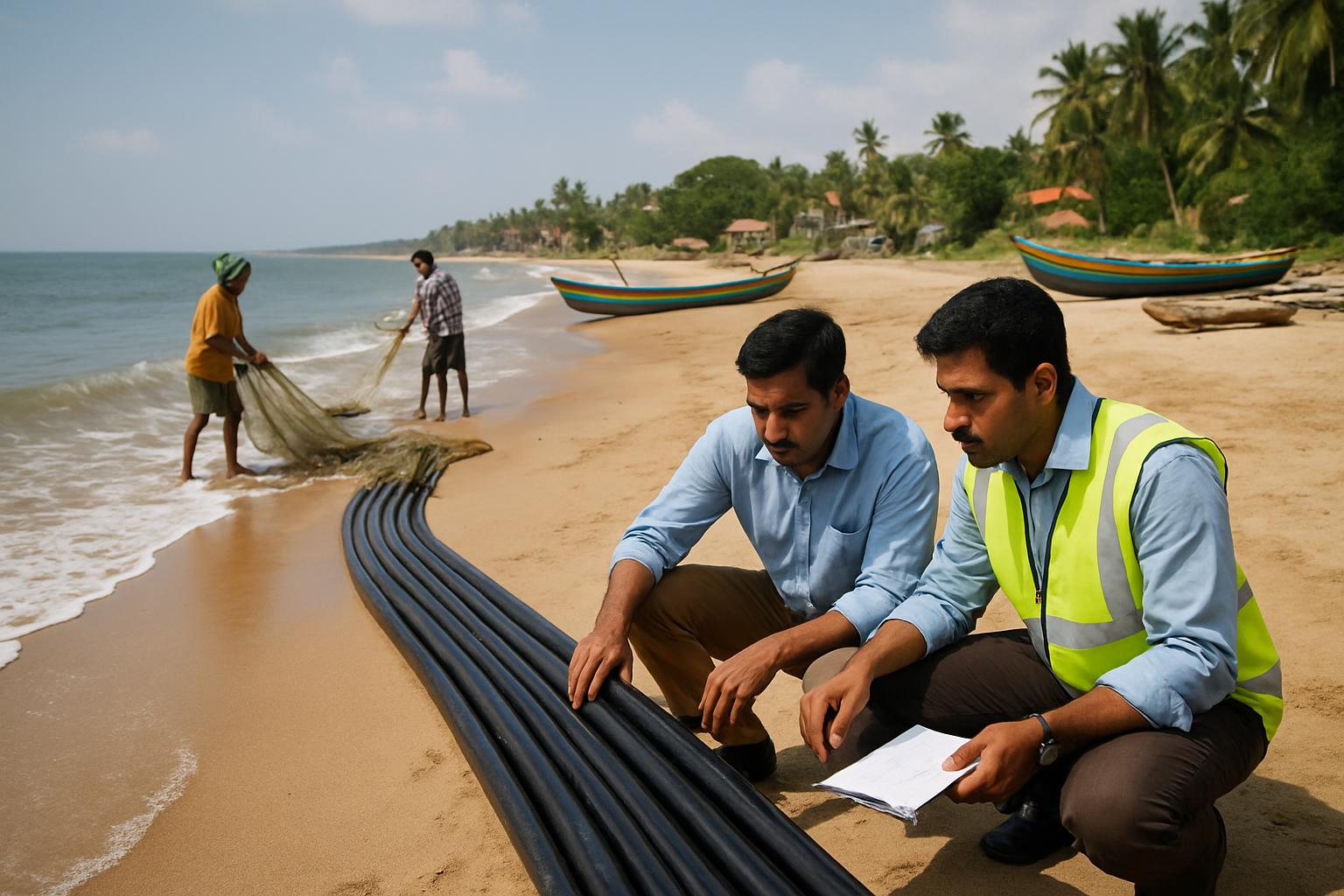
Google Cable Project Overview
America-India Connect targets four high-capacity subsea systems that bypass traditional choke points. Each route will stretch tens of thousands of kilometres under multiple oceans. Moreover, the blueprint includes a brand-new international gateway at Vizag on India’s eastern coast. That landing reduces reliance on western clusters while creating fresh redundancy.
Google states that construction aligns with its $15 billion local compute investments and carbon-aware design principles. Consequently, the company links fiber capacity to future AI model training in regional data centres. Project engineers plan to light only the capacity needed first, then scale through faster optics.
Industry trackers estimate design throughput could exceed 250 Tbps across the combined paths. Meanwhile, blueprints cite sixteen fibre pairs per cable, matching hyperscaler best practice. Such specifications illustrate the scale of this Digital Connectivity Expansion initiative.
Altogether, the project blends fresh geography and leading optical technology. These elements position the network for long-term scalability. However, location strategy deserves closer attention next.
Strategic Vizag Gateway Significance
Vizag becomes India’s first east-coast international cable landing with hyperscaler backing. Therefore, traffic to Southeast Asia travels shorter routes, cutting latency by dozens of milliseconds. Local firms gain an alternative to congested Mumbai stations, improving fault tolerance.
Analysts from ORF argue geographic spread reduces simultaneous outages from accidental anchor damage. In contrast, concentration at single beaches magnifies risk during earthquakes or sabotage. Vizag also links directly into inland fibre corridors reaching Hyderabad’s growing cloud zone.
Consequently, policy makers welcome the Digital Connectivity Expansion as a catalyst for balanced regional growth. Early land acquisition and environmental clearance processes reportedly advanced without major objections. Regulators still must finalise improved security rules for the new station.
Vizag promises latency gains and resilience benefits. Yet, capacity alone cannot guarantee performance. The actual throughput increases are explored below.
Capacity And Latency Gains
Four announced systems add direct US–India fibres, bypassing intermediate hubs. Additionally, planners route one path through the Southern Hemisphere to avoid the Red Sea. That design skirts regions affected by recent security incidents and insurance hikes.
Published specifications suggest each cable holds 16 pairs operating at 20 Tbps per pair. Therefore, gross design capacity reaches roughly 320 Tbps, eclipsing current lit supply several times. Only incremental lighting will occur, matching demand and controlling energy consumption.
- Latency between Bengaluru, India and Bay Area could drop by 30 ms on direct US path.
- Redundancy rises because east and west coast subsea landings split traffic loads.
- Digital Connectivity Expansion supports larger AI datasets, enabling multi-regional model checkpoints.
Meanwhile, lower jitter benefits time-critical fintech and telemedicine services. Consequently, enterprises may shift latency-sensitive workloads into regional cloud zones more confidently.
The raw numbers reveal dramatic headroom for growth. However, several external challenges could dampen that promise. Key obstacles appear in regulatory and security domains.
Risks And Regulatory Hurdles
Red Sea unrest has already delayed the Raman segment of the Blue-Raman subsea system. Nevertheless, America-India Connect may reroute one strand south of that corridor to mitigate exposure. Maritime insurers still charge premium rates, inflating project budgets.
Domestic licensing under India’s DoT requires multiple clearances for each cable landing station. Furthermore, operators must satisfy security audits covering subsea equipment supply chains and on-shore monitoring. Analysts worry that lengthy permitting could offset schedule gains from modular cable manufacturing.
Local fishing unions also negotiate compensation for restricted coastal zones during shore pulls. Consequently, community engagement plans become critical path items, not mere afterthoughts. Compliance efforts extend the Digital Connectivity Expansion timeline if not proactively managed.
Hurdles span geopolitical, regulatory, and social spheres. Yet, proactive governance can reduce delays. Economic implications now come into focus.
Market And Economic Impacts
International transit costs often drop once fresh capacity floods the market. Moreover, competitive pricing encourages local data centre build-outs in tier-two cities. New market research from Google Cloud suggests compound annual growth of 17% for Indian cloud revenue through 2029.
Telcos like Jio and Airtel will lease spectrum on new fibres instead of installing parallel systems. Consequently, capital efficiency improves across the ecosystem, freeing funds for edge deployments. SaaS exporters benefit because reduced latency elevates user experience in North American markets.
The Digital Connectivity Expansion also intersects with workforce development initiatives. Professionals may validate skills through the AI+ Human Resources™ certification. Such credentials help enterprises manage talent for future connectivity projects.
Lower costs and skilled talent reinforce competitive advantage. However, execution timelines influence realisation of these gains. A forward-looking roadmap clarifies what to expect next.
Roadmap And Next Steps
Current timelines place the first new cable ready for service in late 2028. Subsequently, remaining systems stagger activation over 18-month intervals to balance investment and demand. Project managers intend to publish detailed charts once partner contracts finalise.
TeleGeography will monitor permit filings to refine live deployment trackers. Meanwhile, TRAI plans to release updated lit capacity statistics each fiscal quarter. Stakeholders should watch for confirmation of Vizag station testing milestones.
Therefore, investors can model cash flows with increasing accuracy as milestones emerge. The Digital Connectivity Expansion can stay on schedule if early tasks finish by Q2 2027. Continued transparency will ease coordination among suppliers and regulators.
Clear communication underpins timely delivery. Consequently, informed observers will track forthcoming tender releases. The final section distills essential insights.
Conclusion
Collectively, the Digital Connectivity Expansion signals a new era of efficient, resilient global traffic. Stakeholders across India, the US, and beyond gain lower latency and higher capacity. Furthermore, Google reinforces its regional cloud strategy while diversifying landing geography. Nevertheless, the Digital Connectivity Expansion will succeed only if security and licensing challenges receive early attention. Therefore, policymakers must streamline processes that support the Digital Connectivity Expansion without compromising oversight. Professionals seeking to contribute can start by earning the certification highlighted above and staying alert for tender announcements. Act now to align skill paths with the Digital Connectivity Expansion and capture the next wave of opportunity.


