

AI CERTS
3 months ago
Dell Revamps AI Server Hardware With XE9680 Updates
However, revisions extend beyond incremental tweaks. Dell added liquid options, broader GPU menus, and blueprint services. Moreover, analysts credit these moves for a 23 percent sequential jump in infrastructure revenue. This article unpacks the key changes and explains what they mean for builders, operators, and strategists.
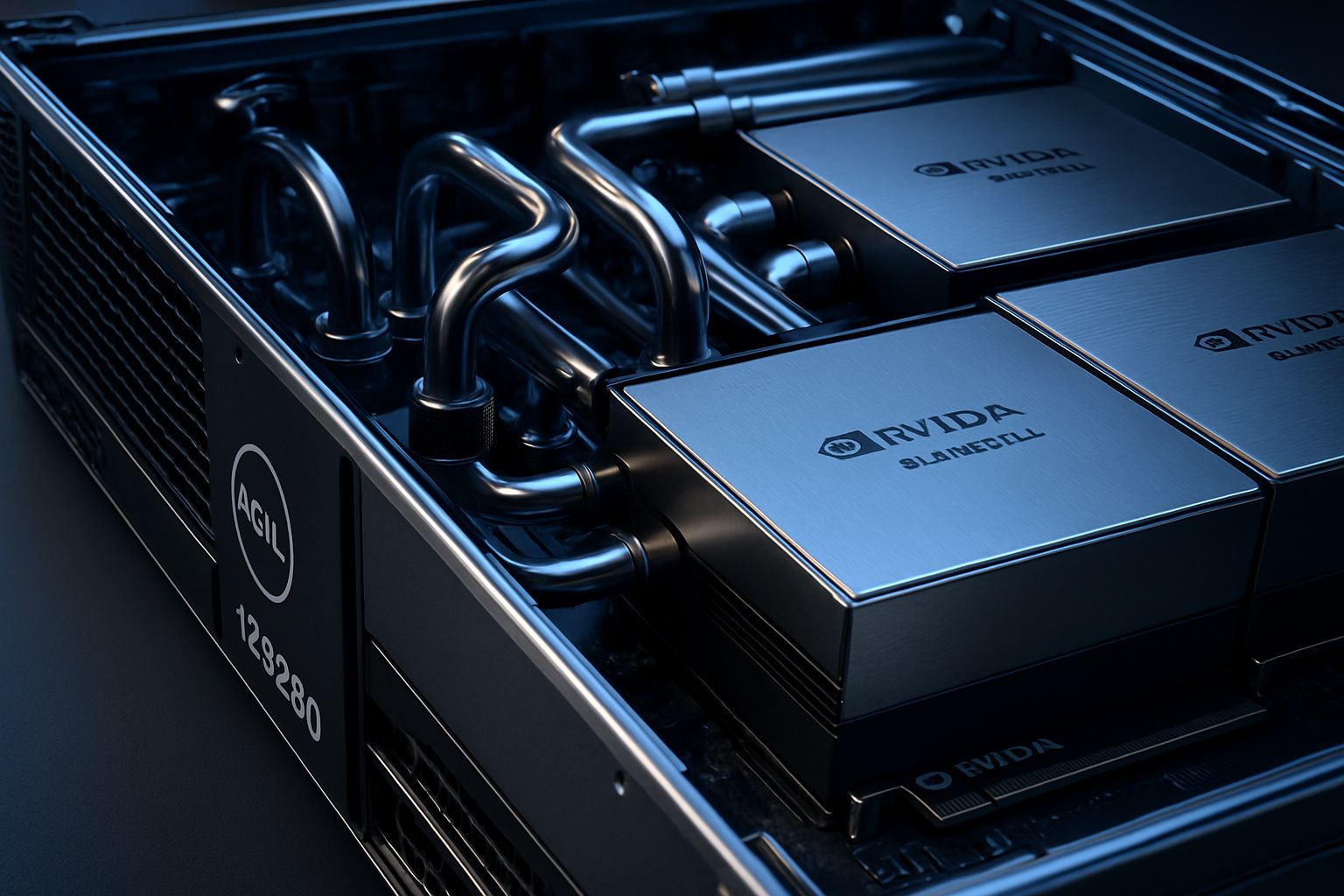
Dell XE9680 System Overview
The base XE9680 occupies six rack units and holds eight high-power accelerators. Two Intel Xeon Scalable CPUs coordinate up to 4 TB of DDR5 memory. Additionally, ten PCIe Gen5 slots support high-speed networking or storage adapters.
Meanwhile, Dell ships redundant power supplies and a multi-fan array to handle 700 W GPUs. Consequently, a single chassis can deliver exceptional density for AI Server Hardware deployments. Engineers appreciate factory integration that reduces on-site wiring time.
These specifications set the baseline. Yet Dell’s 2024 roadmap adds notable twists, which the next section details. Hence, organizations should revisit capacity plans soon.
Key XE9680 Hardware Advancements
May 2024 brought the XE9680L, a 4U direct-liquid-cooled sibling. Dell claims 33 percent more GPU density per node than the air-cooled model. Furthermore, the variant frees extra PCIe lanes for east–west fabrics.
The tighter footprint benefits data center designs where floor space is scarce. In contrast, older 6U nodes limited rack counts. Liquid loops remove hot-air constraints while lowering fan noise, improving workplace comfort.
Importantly, shelf availability begins H2 2024. Dell’s early pilot customers report smoother provisioning of AI Server Hardware pods under strict power envelopes.
GPU Accelerator Options Explained
Dell validates diverse silicon. Customers can choose nvidia h100, H200, or forthcoming Blackwell units in SXM form. Additionally, AMD Instinct MI300X arrives for memory-bound models, while Intel Gaudi3 covers budget-focused inference.
Each accelerator links through NVLink, NVSwitch, or OAM backplanes. Therefore, intra-node latency stays low even during billion-parameter gradient updates. Independent testers saw strong performance parity between nvidia h100 and MI300X in synthetic workloads.
Professionals can enhance their expertise with the AI+ Quantum™ certification, aligning skills with multi-vendor AI Server Hardware purchases.
Overall, flexible GPU menus protect buyers from single-supplier risks. Consequently, procurement officers gain leverage during contract negotiations.
Implications For Data Center
Density improvements ripple through facility design. Fewer chassis mean lighter floors, shorter switch trunks, and smaller battery strings. Moreover, direct liquid loops reclaim megawatts once lost to chillers.
Operators can run 64-72 GPUs per rack, depending on chosen coolant and breaker limits. As a result, total data center footprint drops by double digits versus legacy clusters.
The following list summarizes infrastructure benefits:
- 33 percent node density gain with XE9680L
- Up to ten PCIe Gen5 slots for high-speed fabrics
- Redundant six-pack power supplies supporting 700 W GPUs
- Factory-built racks accelerating deployment timelines
These points highlight why analysts link Dell’s AI Server Hardware to rising capital efficiency. Consequently, colocation providers also show interest.
Power And Cooling Strategies
Running eight HGX boards demands careful airflow or fluid routing. However, Dell pairs thermal sensors with dynamic fan curves to curb noise and energy wastage.
Liquid versions cut exhaust temperatures by 15 °C, improving seasonal PUE scores. Furthermore, coolant manifolds simplify service, letting technicians swap GPUs without draining loops.
The word cooling appears often because it decides uptime. In contrast, ignoring thermal math invites throttling and wrecked performance. Dell’s design supports rear-door heat exchangers for retrofit sites.
Ultimately, thoughtful cooling safeguards investments in premium AI Server Hardware. Therefore, facility teams must engage early when scoping deployments.
Market Demand And Performance
Reuters noted a 23 percent sequential rise in Dell AI-optimized server revenue, hitting $3.2 billion. Moreover, Bernstein analysts said upside was “entirely due to AI servers.”
Clients choose XE9680 for predictable performance scaling. Meanwhile, nvidia h100 supply constraints eased during 2024, shortening lead times.
Consequently, enterprises accelerated LLM projects, citing strong time-to-accuracy curves. Independent labs still await MLPerf scores, yet early field tests show promising throughput per watt.
Such metrics reinforce confidence in Dell’s AI Server Hardware roadmap. Furthermore, partners bundle managed services, easing operational overhead.
Planning Next Generation Moves
Dell previewed XE9780 families as eventual successors. However, current XE9680 investments remain safe because firmware roadmaps guarantee GPU interchangeability.
Organizations should draft three-year rollouts that balance cooling retrofits and software modernization. Additionally, multi-cloud strategies may off-load burst workloads while keeping core data on-prem.
Meanwhile, continued performance tuning around BF16 kernels and flash-based checkpoints will unlock further efficiency. In contrast, delaying action risks competitive disadvantage.
Therefore, reviewing funding windows alongside AI Server Hardware lifecycles is prudent. A structured decision matrix helps prioritize racks, power paths, and GPU variants.
These strategic considerations close our exploration. The next paragraphs summarize essential insights.
Conclusion And Call-To-Action
Dell’s XE9680 updates deliver higher density, diverse GPU options, and advanced cooling methods. Consequently, operators can shrink data center footprints while boosting sustained performance. Market response suggests robust momentum for this AI Server Hardware line.
Nevertheless, success depends on precise planning across power, firmware, and supply chains. Professionals can deepen expertise through the linked AI+ Quantum™ program. Act now to align skills and infrastructure, and position your organization for competitive AI leadership.


