

AI CERTS
5 hours ago
DeepSeek R1 Impact Reshapes AI Economics
This article dissects the technological choices, economic claims, and looming risks behind the sensation. Moreover, it highlights practical deployment steps and professional upskilling opportunities. By the end, you will grasp the strategic relevance of DeepSeek R1 Impact for your roadmap. Additionally, we examine how Mixture-of-Experts, or MoE, reshapes inference economics.
In contrast, we scrutinize allegations surrounding training data provenance and security gaps. Finally, actionable insights support executives deciding whether to adopt, wait, or hedge. Nevertheless, the story remains fluid, with new benchmarks and patches arriving monthly. Therefore, keeping pace with verified metrics and vendor guidance is crucial. Subsequently, we explore how certification pathways can future-proof stakeholder skills.
DeepSeek R1 Market Shock
Reuters reported a near record single-day $500 billion swing in Nvidia’s valuation after the announcement. Altman’s endorsement further amplified attention, yet investors focused on the promised inference savings. Consequently, the DeepSeek R1 Impact narrative overshadowed other earnings news that week.
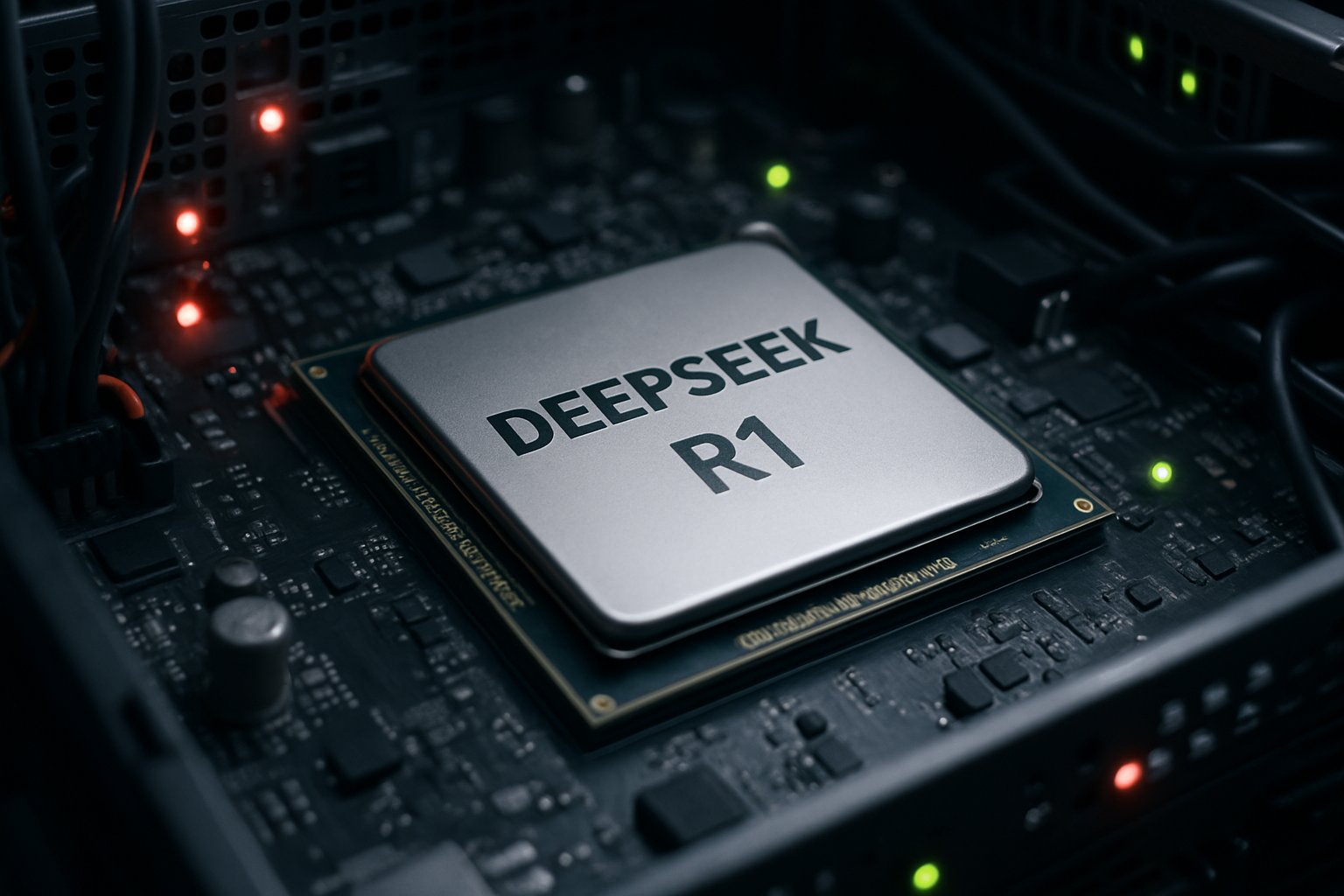
Microsoft reacted quickly, listing the weights on Azure AI Foundry within 48 hours. Meanwhile, AWS added marketplace entries and published instance guidance using H200 GPUs. Furthermore, early adopters observed stable throughput when routing traffic through Bedrock’s multi-model endpoints.
Analysts see parallels with previous open-source inflection points like Stable Diffusion. Nevertheless, some argue hardware demand remains robust because production inference still needs substantial HBM. In contrast, hedge funds trimmed positions in chip makers, citing potential pricing pressure.
Market reactions reveal both excitement and uncertainty. However, deeper technical choices explain why savings are plausible, leading us next to architecture.
Architecture Driving MoE Efficiency
At the heart lies a 671-billion-parameter MoE design with only 37 billion activated per token. Therefore, compute intensity falls close to a 40-billion dense model while capacity remains huge. This sparse routing underpins many claimed efficiency gains.
Additionally, DeepSeek applied reinforcement learning rewards that favor multi-step reasoning and self-verification. Test-time scaling then allocates extra thinking loops only when questions demand rigor. Consequently, latency increases modestly, yet answer quality rises sharply on math benchmarks.
MLA accelerators, still experimental, were also explored in lab settings for specialized matrix operations. Moreover, the team claims MLA boards can compress memory requirements for MoE token routing. Independent replication remains limited because MLA hardware is scarce outside research sites.
Distillation closes the loop by transferring teacher behaviors into 1.5B to 70B dense siblings. These children inherit reasoning while shedding routing overhead, making downstream deployments more cost-effective. Researchers appreciate the MIT license, which simplifies corporate compliance.
Architecture choices blend MoE scale, RL sophistication, and clever distillation. Next, we evaluate whether training budgets match the headline savings.
Examining Training Cost Claims
DeepSeek’s paper states total pretraining compute cost stayed below six million dollars using 2,048 H800 GPUs. Furthermore, researchers compared logs with public OpenAI cost disclosures to contextualize the figure. Nevertheless, some skeptics question accounting assumptions, including power, staffing, and reinforcement fine-tuning cycles.
The DeepSeek R1 Impact surfaces again during inference discussions, with claims of twenty-to-fifty-fold cheaper queries. In contrast, Nvidia contends that large deployment clusters still consume many premium GPUs. Moreover, AWS guidance advises customers to reserve eight H200 cards per full model instance.
Distillation shifts the equation by allowing mid-tier GPUs to host 14-billion or 32-billion versions. Consequently, smaller teams can prototype complex reasoning applications without prohibitive bills. However, replication data remains sparse, so audited benchmarks would strengthen the cost-effective narrative.
Cost figures look promising yet require independent verification. Therefore, enterprises should weigh deployment options carefully, which we explore in the next section.
Practical Enterprise Deployment Paths
Enterprises face three main choices when integrating R1 models. Firstly, cloud marketplaces offer managed endpoints with automatic scaling and guardrails. AWS Bedrock and Azure AI Foundry listed DeepSeek R1 Impact within days, easing pilot launches.
Secondly, self-hosting the distilled 70B variant on ml.g5 instances delivers reasonable latency for internal workloads. Moreover, smaller 7B siblings can run on a single A100, enabling edge experimentation. Nevertheless, teams must implement robust tokenizer caching and sharding strategies.
- Verify instance quotas and incoming bandwidth limits before production traffic.
- Encrypt prompt logs because security researchers reported elevated jailbreak success.
- Integrate vendor guardrails that block disallowed content automatically.
- Monitor GPU utilization closely; expert routing spikes can impair multi-tenant clusters.
Additionally, professionals can enhance sales enablement careers with the AI for Sales™ certification. Deployment flexibility empowers teams to match latency, budget, and governance needs. However, those freedoms come with new security and legal concerns, discussed next.
Ongoing Risks And Controversies
Provenance questions dominate recent community forums. Investigators noticed abnormal spikes in OpenAI developer API traffic during DeepSeek pretraining windows. Consequently, rumors emerged that undocumented distillation from competitor outputs occurred.
DeepSeek denies wrongdoing, but regulators demand auditable dataset disclosures. Meanwhile, security labs published jailbreak suites showing higher prompt-injection success relative to o1. In contrast, Microsoft states Azure guardrails mitigate most demonstrated exploits.
MLA hardware adds another unknown, because supply chain scrutiny remains superficial. Moreover, open weights permit hostile actors to fine-tune disinformation agents rapidly. Nevertheless, community red teams propose layered sandboxing and content filters.
The unresolved issues create legal and reputational exposure. Therefore, strategic planning must balance innovation with ongoing risk assessments before scaling adoption.
Key Strategic Takeaways Ahead
Executives should frame the DeepSeek R1 Impact within a three-horizon roadmap. Firstly, run low-risk pilots with distilled models to validate metrics on your data. Secondly, monitor kernel improvements that may unlock truly cost-effective large-scale inference.
Thirdly, allocate research budget toward MLA explorations, ensuring future hardware optionality. Moreover, invest in staff training, because talent scarcity outlasts any single framework. DeepSeek R1 Impact also signals the need for rigorous vendor neutrality clauses.
These takeaways align ambition with prudence. Subsequently, the conclusion distills actionable next steps.
Conclusion And Future Outlook
DeepSeek R1 Impact has redefined open-source ambition and pressed incumbents to accelerate efficiency research. Nevertheless, unanswered provenance and safety concerns temper immediate enterprise enthusiasm. Therefore, leaders should pilot distilled variants, monitor kernel updates, and budget for MLA experimentation.
DeepSeek R1 Impact will remain a headline metric for cost benchmarking throughout 2025. Moreover, integrating staff credentials, such as the AI for Sales™ certification, strengthens execution capacity. Consequently, your organization can capture competitive gains while mitigating risk. Act now, study the DeepSeek R1 Impact roadmap, and upskill teams before rivals claim the advantage.


