

AI CERTS
3 months ago
Deepfake Detection Claims: Separating Hype From Reality
Entrust reported deepfake attacks rising to one every five minutes during 2024. Consequently, media platforms scramble for trustworthy safeguards. Accurate tools protect Media Integrity and consumer trust alike. Furthermore, regulators demand transparent metrics before approving nationwide deployments. This article dissects the claims, datasets, and operational realities behind contemporary detection systems. Readers will gain clear guidance for evaluating vendors and improving Security postures.
Accuracy Claims Explained Clearly
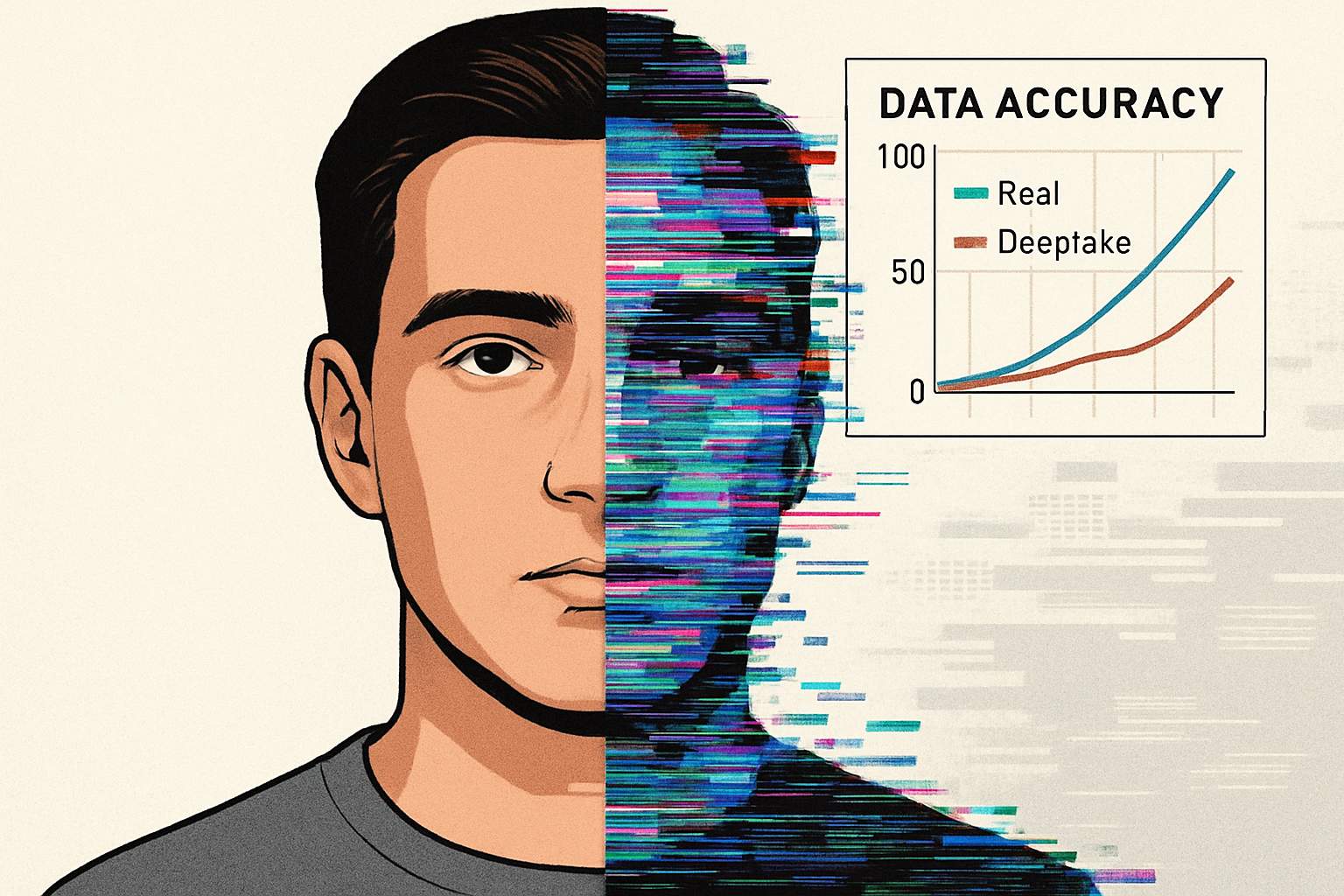
Researchers from Czech Technical University adapted CLIP to detect manipulated faces. Moreover, they reported a 99.7% AUC on the Celeb-DF test split. AUC measures area under the ROC curve, not simple accuracy. Therefore, the figure represents class separability across thresholds rather than an operating point. Vendors including Facia echoed comparable percentages within glossy brochures. Nevertheless, marketing often swaps AUC, F1, and accuracy without clarification. In contrast, RawNetLite achieved 99.7% F1 on an audio dataset but dropped to 83% out-of-distribution. Such swings reveal how metric choice masks vulnerability. Specialists must always request metric definitions before endorsing a solution. Deepfake Detection credibility starts with precise language. These examples confirm that numbers alone mislead stakeholders. Subsequently, understanding dataset context becomes paramount.
Benchmark Context Truly Matters
Every benchmark embodies specific compression levels, resolutions, and actor demographics. Consequently, a detector optimized for Celeb-DF may falter on TikTok clips. Celeb-DF++ emerged in 2025 to stress diverse manipulation types. Moreover, cross-dataset evaluations reveal striking variance across algorithms. The CLIP paper reported strong transfer, yet still lost roughly five AUC points on DFDC. Meanwhile, RawNetLite’s audio score plunged sixteen points on a harder mix. Therefore, Media Integrity auditors should demand cross-dataset tables before procurement. Listing only in-domain metrics hides generalization risk. Deepfake Detection tools must survive distribution shift to protect Security teams in production. Researchers now release code and seeds to encourage transparent replication. Nevertheless, vendor press releases rarely include such artifacts. These realities illustrate why benchmarks require scrutiny. Consequently, the next section explores generalization gaps in depth.
Cross Dataset Generalization Gap
Generalization represents the field’s toughest challenge. In contrast, attackers innovate with unseen face reenactment pipelines daily. Compression, lighting, and demographics further widen gaps. Moreover, adversarial training can intentionally fool detectors. The CLIP team mitigated this issue using parameter-efficient fine-tuning. However, their own paper admits residual vulnerability to low-resolution fakes. On the audio side, researchers observed similar fragility when sampling rates changed. Therefore, independent labs propose larger, open benchmarks spanning many modalities. Media Integrity advocates welcome that transparency, yet funding remains limited. Deepfake Detection still needs community-driven red teaming to stress models. Security officers should monitor NIST’s upcoming evaluations for credible progress. These observations underscore that no detector is infallible. Subsequently, we scrutinize industry marketing claims.
Industry Hype Versus Proof
Press releases often trumpet flawless accuracy. For instance, Facia proclaimed near-perfect video fraud detection during May 2025. Moreover, several biometric vendors echoed identical figures without revealing test datasets. Gartner analysts caution that such numbers demand external validation. Therefore, buyers should seek third-party audits similar to TÜV’s liveness evaluations. Nevertheless, few Deepfake Detection products have undergone certified scrutiny to date. Audit teams should request confusion matrices at operating thresholds. Meanwhile, independent academics encourage sharing pretrained weights for replication. Security leaders can also inspect bug bounty disclosures for exploited weaknesses. These considerations highlight the gap between hype and evidence. Consequently, operational and policy effects deserve equal attention. Next, we explore those impacts on everyday workflows.
Operational And Policy Implications
Running real-time detectors across uploads imposes heavy compute budgets. Consequently, platforms must balance latency, cost, and false positive rates. False alarms frustrate creators and may erode Media Integrity over time. Moreover, privacy regulators scrutinize any automatic biometric analysis. The Frontiers policy paper urges combined approaches: detection, provenance, and user disclosure labels. In contrast, some lawmakers propose aggressive takedown mandates without technical nuance. Therefore, Security officers should collaborate with legal counsel before scaling deployments. Deepfake Detection guidelines from NIST, ENISA, and ISO are still evolving. Meanwhile, third-party certifications help organizations prove due diligence. Professionals can enhance expertise through the AI Security Level-2 certification. These factors show operational complexity beyond headline metrics. Subsequently, we discuss practical evaluation steps for technical teams.
Practical Steps For Teams
Technical buyers can follow a structured checklist.
- Ask vendors which dataset produced each Deepfake Detection figure.
- Request cross-dataset scores that demonstrate Deepfake Detection robustness.
- Evaluate thresholded confusion matrices reflecting your acceptable risk.
Moreover, simulate your own content pipeline to benchmark latency. Furthermore, identity teams should include red-teaming scenarios with adversarial examples. Consequently, measure detection drift weekly to catch model degradation. Compliance officers can then present clear evidence to executives. Finally, integrate continuous retraining pipelines once new deepfake styles appear. These steps turn headline numbers into actionable governance. Nevertheless, the journey requires ongoing investment. Deepfake Detection success ultimately depends on rigorous process, not single statistics. Therefore, teams that master disciplined Deepfake Detection reviews will safeguard brand trust. These recommendations conclude the operational roadmap. Subsequently, the article closes with key takeaways.
Conclusion And Next Steps
Recent advances showcase impressive technical progress. However, context, metrics, and independent validation still dictate real-world value. Furthermore, dataset diversity and ongoing retraining remain non-negotiable. Consequently, organizations must ask precise questions before deploying any detector. Meanwhile, certified professionals provide the expertise to navigate evolving threats. Readers seeking deeper skills can explore the AI Security Level-2 program. Such learning empowers teams to translate research breakthroughs into resilient operations. Act now and strengthen your defenses against tomorrow’s synthetic media challenges.


