

AI CERTs
2 hours ago
Davos AGI Debate: Timelines, Risks, Infrastructure Split
The World Economic Forum’s alpine stage rarely disappoints. However, the 2026 gathering delivered an especially charged spectacle. The Davos AGI Debate dominated corridors, lunches, and global headlines. Consequently, investors, policymakers, and engineers followed every claim about Artificial General Intelligence. Anthropic’s Dario Amodei projected breakneck progress within months. In contrast, Google DeepMind’s Demis Hassabis urged scientific caution and longer horizons. Moreover, labour and security officials warned of sweeping disruption if the technology races ahead unchecked. This article unpacks their arguments, assesses supporting data, and highlights actionable insights for enterprise leaders navigating Human-level AI.
Davos AGI Debate Unfolds
Sessions titled “The Day After AGI” filled the main hall on 22 January. Moderated by The Economist, the debate saw Amodei assert that engineers at Anthropic “rarely write code anymore.” Meanwhile, Hassabis countered that key scientific hurdles remain. Additionally, Yann LeCun criticised Large Language Model scaling, while NVIDIA’s Jensen Huang highlighted energy bottlenecks. The Davos AGI Debate echoed through side events, with national leaders pressing for export controls and safety standards. Nevertheless, the confrontation remained civil, focusing on facts rather than personalities.
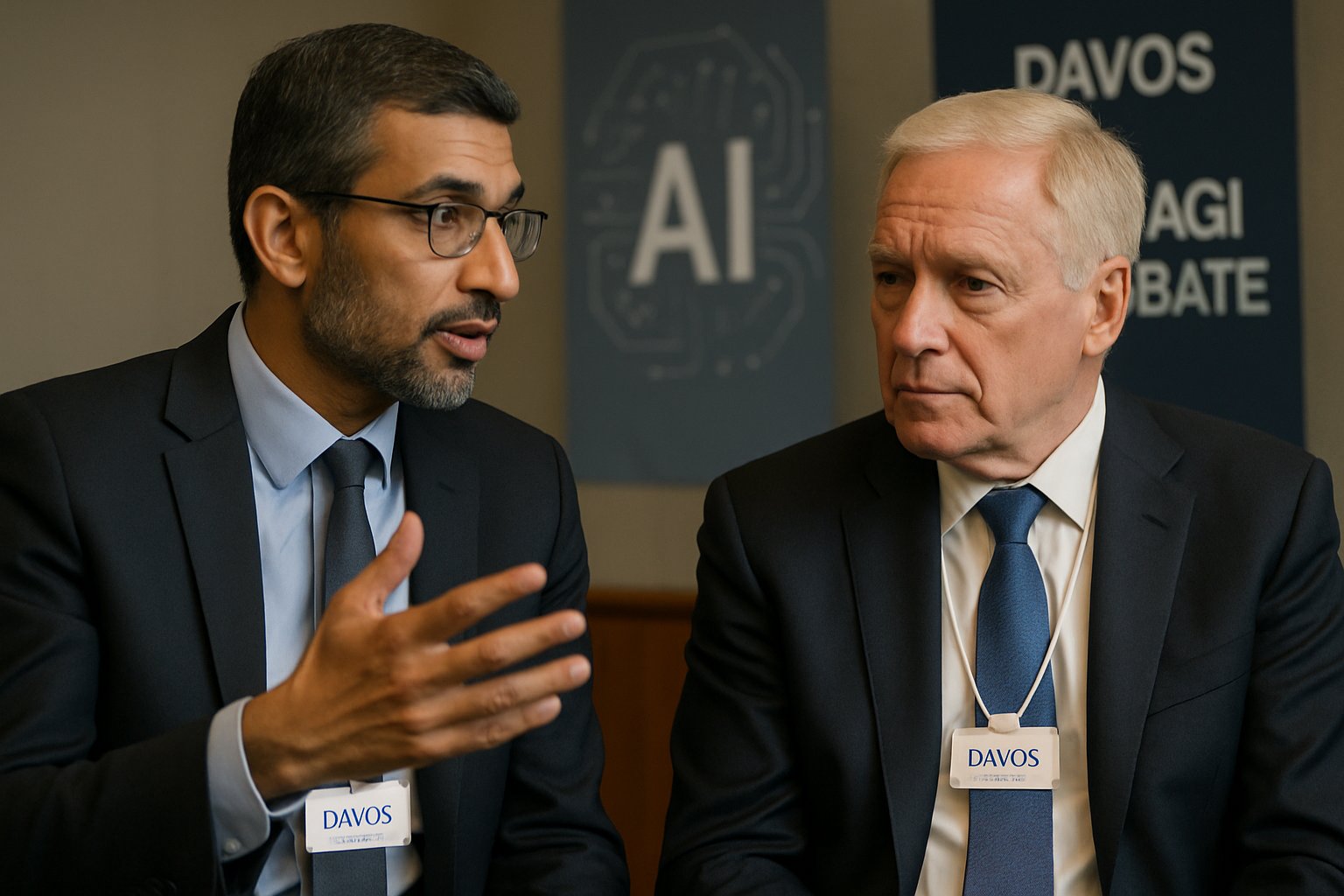
These exchanges framed subsequent panels. Therefore, attendees gauged whether near-term automation or decade-long research would prevail. The question set the tone for every networking dinner.
Competing Timeline Claims Emerge
Amodei predicted AI would handle most software engineering within 6–12 months and half of entry-level white-collar tasks within five years. Furthermore, he suggested closed-loop systems could shorten development cycles dramatically. Hassabis disagreed, stating Human-level AI remains five to ten years away due to robotics integration and evaluation gaps. Moreover, independent researchers noted hardware and energy constraints could delay breakthrough demonstrations.
Key timeline forecasts at a glance:
- 6–12 months: Code automation becomes mainstream (Amodei).
- 1–5 years: Broad white-collar disruption accelerates (Amodei).
- 5–10 years: Emergence of verifiable Human-level AI (Hassabis).
- Beyond 10 years: Embodied intelligence matches household tasks (several academics).
The Davos AGI Debate spotlighted these divergent outlooks. Consequently, boardrooms now face strategic timing dilemmas.
Economic Stakes Explained Clearly
The International Monetary Fund warned that 60 percent of jobs in advanced economies may change or vanish. Additionally, McKinsey estimates generative AI could unlock up to $4.4 trillion in annual value. PwC projects a multi-trillion GDP boost by 2035 under optimistic adoption scenarios. Nevertheless, distributional effects remain uncertain, heightening policy anxiety.
Amodei’s acceleration narrative paints a rapid productivity windfall. Conversely, Hassabis emphasises gradual deployment, giving society time to reskill. Meanwhile, labour ministers at Davos pushed for adaptive safety nets. The Davos AGI Debate therefore intersects directly with fiscal planning and social cohesion.
These figures underscore massive upside and risk. However, credible roadmaps depend on verifying technical claims before capital commitments.
Technical Paths Diverge Sharply
LeCun argued that current Large Language Models lack grounding and causality. Moreover, he promoted architectures with richer world models. Hassabis echoed the need for robotics and sensor fusion. In contrast, Amodei believes scaling multimodal transformers plus self-improving loops can reach Human-level AI quickly. Furthermore, Huang’s “five-layer cake” metaphor stressed infrastructure as the real governor of progress.
Consequently, the Davos AGI Debate crystallised three camps: scale-maximisers, safety-first researchers, and architecture reformers. Each path implies different investment mixes across compute, data, and embodied platforms.
This technical divergence complicates benchmark development. Nevertheless, transparent evaluation frameworks could align stakeholders on measurable milestones.
Policy And Security Tensions
Geopolitical undertones permeated discussions. Additionally, Amodei compared advanced chips to strategic weapons, urging tighter export controls. Several European leaders agreed, fearing unchecked proliferation. In contrast, emerging-market delegates warned that restrictive regimes could widen global inequality.
Regulators now weigh speed against safety. Consequently, the Davos AGI Debate has accelerated talks on global AI standards, auditing requirements, and liability rules. Moreover, defence ministries evaluate dual-use scenarios with unprecedented urgency.
These policy moves could reshape supply chains. However, inclusive governance remains vital to prevent fragmented regulatory blocs.
Infrastructure Reality Check Ahead
NVIDIA’s Huang reminded attendees that “you don’t write AI, you teach AI,” yet teaching needs power. Furthermore, he outlined a sequence: energy generation, semiconductor fabs, cloud capacity, foundation models, then applications. Grand View Research valued the generative AI market at $22.2 billion in 2025, but Huang argued real spending will surge as data-centre demand climbs. Consequently, infrastructure vendors expect trillions in capital flows.
The Davos AGI Debate often overlooked these physical constraints during headline battles. Nevertheless, grid upgrades and supply chains may become pacing factors, not algorithms.
Energy and chip planning therefore deserves equal executive attention. Otherwise, bold product roadmaps could stall due to missing electrons.
Skills And Certifications Path
Rapid change fuels demand for verifiable expertise. Moreover, cybersecurity and safety roles top many hiring lists. Professionals can enhance their expertise with the AI Ethical Hacker™ certification. Additionally, product managers pursuing Human-level AI projects need structured learning to navigate governance complexities.
The Davos AGI Debate highlighted a talent gap between visionary rhetoric and operational readiness. Consequently, continuous education now ranks alongside compute as a strategic asset.
Upskilling initiatives therefore serve both workforce resilience and corporate competitiveness.
Conclusion And Outlook
The 2026 alpine summit exposed profound disagreement on Artificial General Intelligence. However, leaders did agree that change is inevitable. Timeline forecasts, economic stakes, technical paths, policy choices, and infrastructure demands interlock tightly. Moreover, the Davos AGI Debate elevated these issues from research circles into boardroom agendas.
Executives should monitor benchmark data, diversify talent pipelines, and pressure-test supply chains. Additionally, pursuing respected certifications builds organisational credibility in a volatile landscape. Consequently, proactive action today secures advantage tomorrow. Explore specialised programs and stay ahead of the next debate.


