

AI CERTS
3 months ago
Datature Pushes Computer Vision Ops Frontier With Nexus
Its promise centres on no-code workflows, integrated MLOps tooling, and rapid edge deployment. Moreover, new features and partnerships during 2025 widen Nexus’s enterprise appeal. This article unpacks the market context, product capabilities, and strategic implications. Technical managers will gain clarity on benefits, risks, and next steps. Meanwhile, investors will see how vision platforms monetise growing demand. Every insight adheres to strict journalistic fact checking from primary sources. Transition sections summarise takeaways for readers needing rapid comprehension. Consequently, you can benchmark Datature against rivals with confidence. Let’s begin by sizing the computer-vision opportunity driving this surge.
Market Forces Shaping Vision
Statista pegs global computer-vision revenues at nearly $29.9 billion for 2025. Furthermore, analysts project mid-teen compound growth through 2031. Momentum arises from manufacturing safety, smart retail, and precision agriculture use cases. However, talent shortages impede many pilots. No-code solutions reduce that barrier by abstracting model engineering and infrastructure. Additionally, enterprises demand rigorous Computer Vision Ops to govern datasets and experiments. Therefore, integrated MLOps platforms gain traction, promising faster production releases.
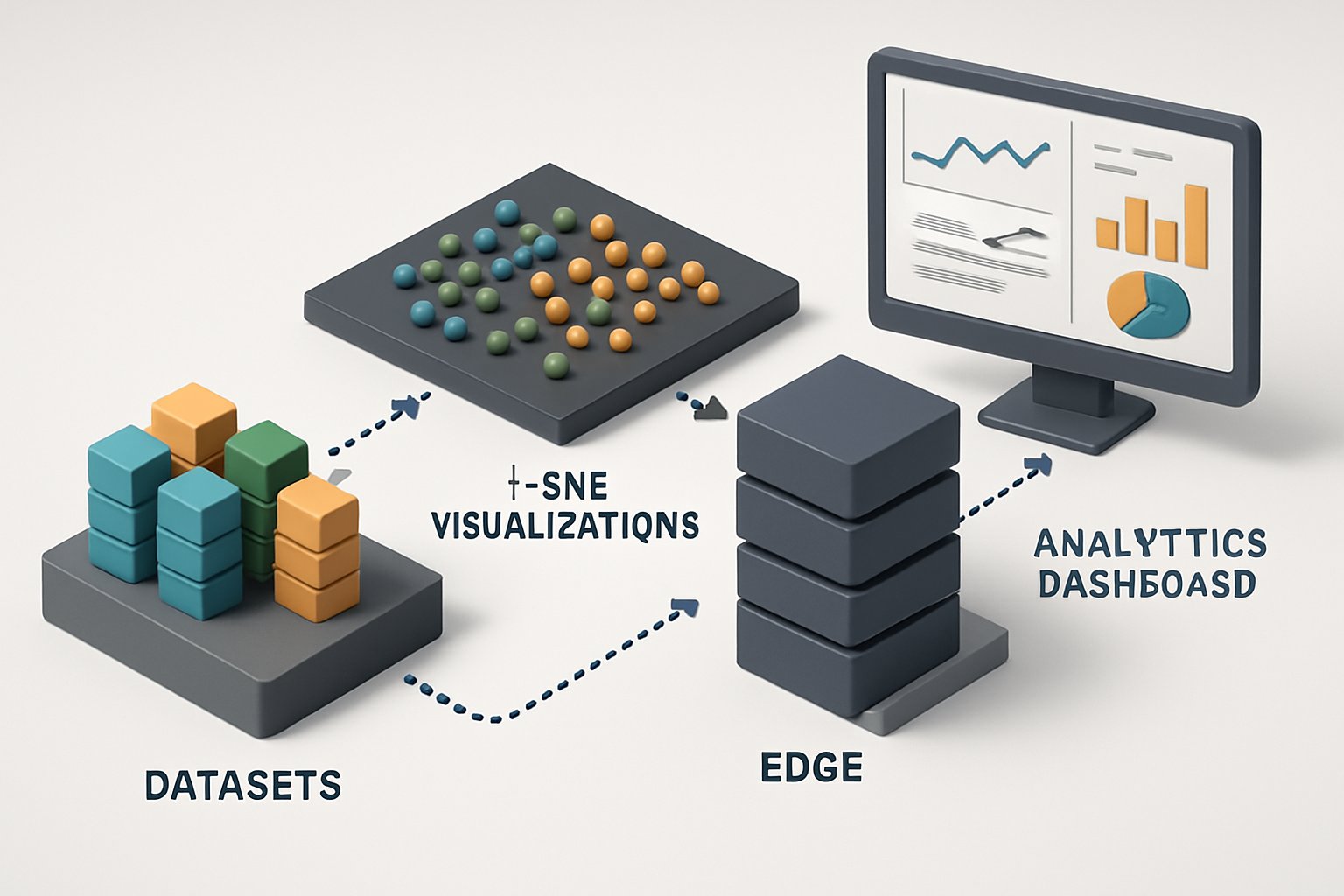
Edge inference also grows because latency and privacy constraints limit cloud processing. Consequently, vendors partner with hardware makers to simplify on-site deployment. MemryX reports rising demand for energy-efficient accelerators in rugged environments. In contrast, software vendors must certify workloads across diverse devices. Datature’s recent ARBOR agreement positions Nexus inside that emerging edge stack. The following section explores Nexus’s architecture, addressing these pressures.
Key drivers include market growth, talent gaps, and edge constraints. Tools combining code-free simplicity with Computer Vision Ops governance address them. The next section explains how Nexus embodies that convergence.
Inside The Nexus Platform
Nexus positions itself as an end-to-end, no-code Vision AI workbench. Users upload images or videos into managed asset buckets. IntelliBrush and AI-Assist accelerate polygon and mask annotations. Moreover, integrated versioning tracks dataset evolution across experiments. Training triggers largely require no scripting, employing prebuilt models and hyperparameter presets. Consequently, teams iterate rapidly without standing up separate MLOps pipelines. That cohesion anchors effective Computer Vision Ops for non-specialist teams.
End-to-End Feature Stack
The stack spans annotation, experiment management, model registry, and flexible deployment. Supported export formats include ONNX, TensorFlow, and PyTorch for downstream customization. Additionally, Nexus offers REST and WebSocket APIs for automated batch processes. SOC-2 and HIPAA claims target healthcare and regulated industries. Meanwhile, a free Developer tier provides 3,000 GPU minutes for trials. Professional plans start at $299 monthly when billed annually. These options cater to startups while scaling toward enterprise rollouts.
Nexus bundles tools traditionally spread across multiple vendors. This consolidation underpins the wider Computer Vision Ops narrative. Recent feature releases illustrate Datature’s iterative approach.
Recent Feature Releases 2025
August 2025 introduced an interactive t-SNE Embedding Projector for dataset curation. Furthermore, the tool reveals duplicates, outliers, and semantic clusters visually. This capability improves image recognition accuracy by pruning noisy samples early. Keechin Goh wrote that the projector helps users “discover patterns instantly.” Consequently, annotation effort drops and model quality rises simultaneously.
Embedding Visualizer Explained Simply
t-SNE compresses high-dimensional embeddings into a two-dimensional map. In contrast, numeric tables hide such relationships. Users lasso clusters, then push those selections back into annotation queues. Moreover, color coding highlights label distribution and confidence. This interactive loop exemplifies continuous Computer Vision Ops feedback cycles. June 2025 also showcased Qwen2.5-VL fine-tuning for multimodal tasks. Therefore, Nexus broadens support beyond pure image recognition workflows.
Feature velocity signals Datature’s commitment to rapid innovation. The next partnership section shows similar momentum on the hardware front.
Edge Partnership Business Impact
On 29 October 2025, Datature allied with ARBOR Technology and MemryX. The trio markets pre-validated bundles that marry software and edge devices. Keith Kressin of MemryX said the collaboration “brings vision intelligence to the edge.” Brandon Neustadter echoed that customers gain faster, cheaper deployment pipelines. Moreover, ARBOR’s rugged PCs target factories, kiosks, and transportation fleets. Consequently, latency-sensitive scenarios avoid round-trip cloud costs.
Hardware Synergy Details Unpacked
MemryX MX3 accelerators deliver up to 80 TOPS at low watts. Additionally, Datature exports ONNX binaries optimized for those chips through AutoML presets. ARBOR handles remote device management with secure OTA updates. Therefore, practitioners avoid bespoke integration code. This alignment strengthens Datature’s Computer Vision Ops positioning in edge verticals. Meanwhile, rival platforms like Roboflow rely on third-party scripts for deployment. Clients seeking validated stacks may prefer the integrated option.
The partnership expands market reach and deepens hardware differentiation. Next, we evaluate benefits and limitations shaping adoption.
Prospects And Ongoing Challenges
Datature touts 10x faster annotation and streamlined model governance. Independent benchmarks, however, remain scarce. Analysts warn no-code abstractions eventually limit deep architectural customisation. Nevertheless, Nexus supports model export for external fine-tuning when ceilings appear. Security also matters, especially under HIPAA. Enterprises should request SOC-2 reports before scaling further. Therefore, due diligence remains essential despite platform assurances.
Cost may pose another hurdle. Professional plans suit SMBs, yet enterprise quotes can escalate. Consequently, buyers must quantify ROI using pilot metrics. Additionally, teams should test image recognition precision across representative samples. Vendor lock-in risks decline when exports function reliably. Nevertheless, migration still consumes time and verification.
Balancing speed against control defines Nexus adoption calculus. Clear governance processes keep Computer Vision Ops sustainable long term. Finally, we consolidate strategic insights for 2025 planning.
Key Strategic Takeaways 2025
Technology executives require concise guidance amid platform proliferation. The list below summarizes critical insights.
- Growing market rewards early Computer Vision Ops investments.
- No-code acceleration shortens proof-of-concept timelines drastically.
- Edge partnership simplifies hardware rollouts for harsh environments.
- Embedding visualizer boosts image recognition curation efficiency.
- Governance and security checks safeguard MLOps pipelines.
Collectively, these points highlight Datature’s evolving competitiveness. Moreover, decision makers can match priorities against roadmap disclosures. Professionals can deepen skills via the AI Cloud Professional™ certification. This credential validates cloud fluency for production vision workloads. Consequently, combined training and tooling accelerate competitive advantage.
Vision AI adoption continues climbing across industries and geographies. Datature’s Nexus addresses critical gaps by uniting annotation, training, and delivery. Furthermore, its edge partnership underscores commitment to low-latency operations. Recent releases, especially the embedding projector, improve image recognition workflows measurably. Nevertheless, buyers must interrogate security evidence, cost models, and portability claims. When managed carefully, Computer Vision Ops maturity drives faster ROI and safer rollouts. Therefore, consider trialing the free Developer tier while building internal governance playbooks. Act now to pair platform evaluation with certification training and secure your advantage.


