

AI CERTS
10 hours ago
D-Link boosts Network Connectivity with Wi-Fi 7 push
Therefore, this article examines the market context, product specifics, and strategic implications behind the releases. Readers will learn how each element aligns with broader Wireless refresh cycles and upcoming adoption curves. Moreover, expert insights from Dell’Oro Group and the Wi-Fi Alliance ground vendor claims. Subsequently, planners can benchmark their budgets against projected market growth worth $45.1 billion by 2029.
Market Trends Driving Demand
Analysts report enterprise WLAN revenues rebounded during 2025 after an inventory correction. Meanwhile, Wi-Fi 7 shipments reached 11 percent of indoor units by late 2024. Furthermore, Dell’Oro forecasts that Wi-Fi 7 volumes will eclipse Wi-Fi 6E by mid-2025. Kevin Robinson notes that Multi-Link Operation delivers deterministic latency, a prized feature for collaboration workloads. Consequently, procurement teams prioritize future-proof radios and scalable management when evaluating Network Connectivity upgrades.
The data confirms strong momentum toward higher throughput and simpler operations. Therefore, vendors racing to satisfy that appetite gain a critical advantage.
D-Link Portfolio Expansion Details
D-Link announced two complementary devices on 18 December 2025 alongside its Nuclias Unity platform. The launch pairs a high-density Ceiling-Mount unit with an in-room wall-plate model. Moreover, positioning both under one cloud reduces integration friction for resellers serving hospitality, education, and multi-dwelling sites. Additionally, the vendor emphasises cost parity with Wi-Fi 6 incumbents to accelerate Network Connectivity transitions.
This twin-device strategy covers shared spaces and private rooms. Subsequently, each model deserves a closer technical review.
Spotlight Wi-Fi 7 BE9500
The DAP-E9560, branded BE9500, headlines the refresh. It is a tri-band Ceiling-Mount AP delivering 4096-QAM and 320 MHz channels. Furthermore, Multi-Link Operation allows simultaneous traffic across 6 GHz and 5 GHz bands. A 10 GbE uplink plus 802.3bt PoE ensures wired bandwidth never bottlenecks Wireless performance. Security features include WPA3 Enterprise, VLAN segmentation, and policy templates inherited from Nuclias Unity. Nevertheless, early adopters must confirm client compatibility and regional 6 GHz regulations before mass deployment.
- Tri-band Wi-Fi 7 radio, 2.4/5/6 GHz
- 10 GbE plus 2.5 GbE ports
- 802.3bt power draw under 30 W
- MLO for sub-5 ms latency targets
These specifications suggest robust headroom for dense lecture theatres or exhibition halls. However, independent labs have not published throughput figures for BE9500 in mixed-client scenarios.
The BE9500 Ceiling-Mount AP targets high-density spaces with ambitious silicon. Consequently, D-Link also released a model optimized for individual rooms.
Wall-Plate AP For Rooms
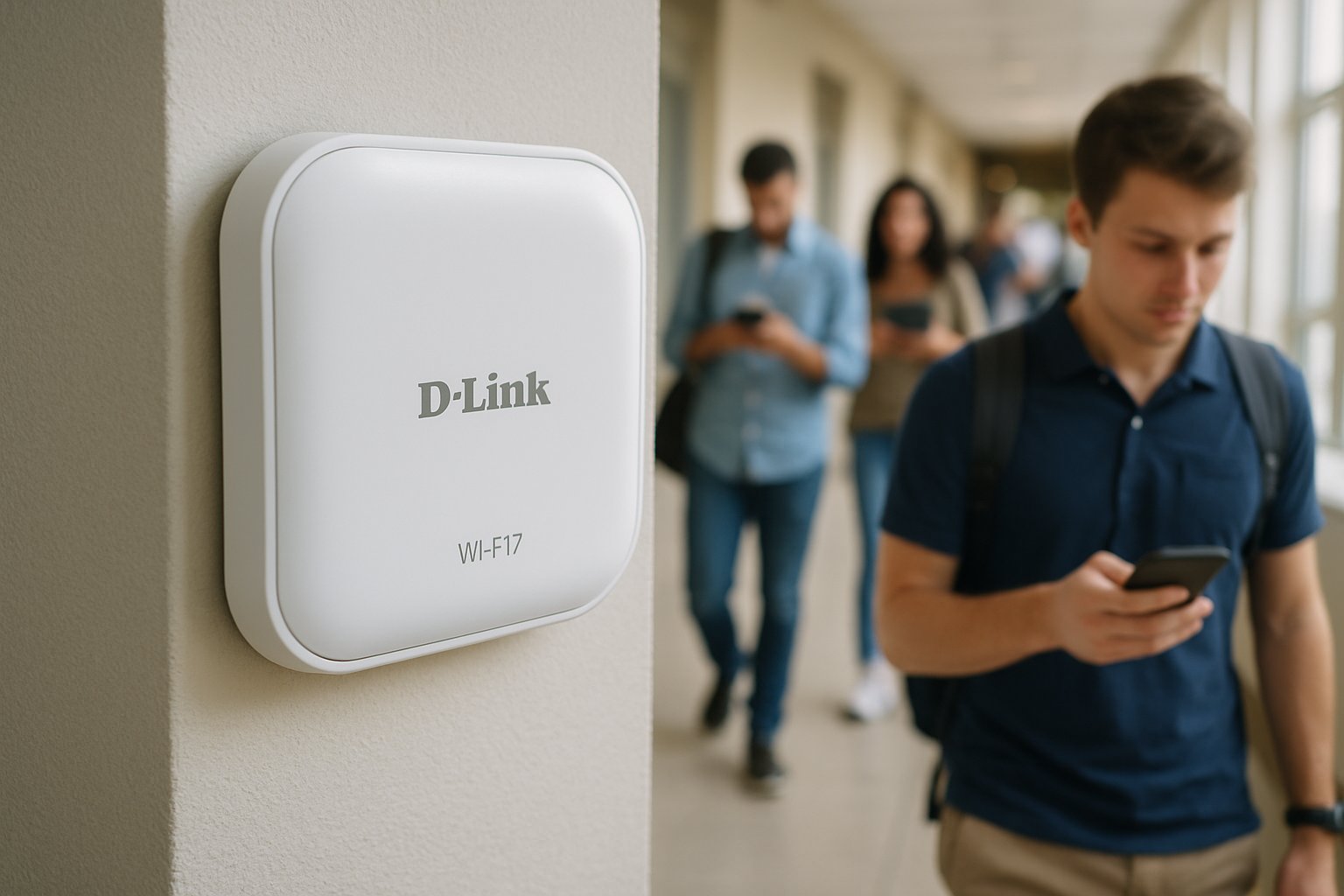
The DAP-X3060W brings AX3000 performance to guestrooms and dormitory walls. Its wall-plate form factor hides cabling and offers additional Gigabit ports for wired Access devices. Moreover, PoE simplifies installation without electricians entering occupied rooms. VLAN segmentation enables staff networks to coexist with guest Wireless traffic securely. In contrast, antenna gain suits shorter ranges, keeping interference low across adjacent spaces. Dell’Oro expects hospitality refreshes to fuel significant Network Connectivity spending through 2026.
Overall, the wall-plate unit complements the Ceiling-Mount flagship by serving discrete micro-cells. Meanwhile, control of both hardware families converges inside Nuclias Unity.
Nuclias Unity Cloud Management
Nuclias Unity consolidates wired and Wireless monitoring into a single HTML5 console. Additionally, D-Link promotes a license-free model covering topology views, RBAC, and bulk firmware pushes. Therefore, administrators avoid unpredictable subscription renewals that often accompany Network Connectivity platforms. Role-based dashboards grant granular access while helping service providers separate tenants and maintain global alarms. Subsequently, AI analytics inside Unity score client health and recommend radio optimizations. Professionals can strengthen expertise through the AI Network Security™ certification.
Unity’s promise of zero licenses could shift TCO calculations for budget owners. Nevertheless, fierce competition shapes how much share D-Link can capture.
Competitive Landscape Analysis Today
Cisco, Aruba, Juniper, and Extreme already ship Wi-Fi 7 radios backed by AI engines. Furthermore, recent Cisco price cuts accelerated adoption, according to Dell’Oro. In contrast, D-Link positions itself on operational simplicity and lower list pricing. Ubiquiti and TP-Link also chase cost-sensitive segments with cloud-managed AP portfolios. Consequently, margin pressure persists, yet market growth still rewards differentiated Network Connectivity strategies. Lower list pricing widens Access to next-gen radios for midsize campuses. MarketsandMarkets pegs overall Wi-Fi revenues at $45.1 billion by 2029, indicating sustained budget pools.
Competitive forces will favor vendors who integrate management, spectrum agility, and fair pricing. Accordingly, planners should evaluate deployment prerequisites before committing budgets.
Key Takeaways And Planning
Backhaul capacity remains a fundamental prerequisite for Wi-Fi 7. Therefore, engineers must verify switch stacks offer 10 GbE and 802.3bt power budgets. Moreover, RF surveys should confirm 6 GHz availability and potential DFS restrictions. Teams also need staged firmware testing to validate BE9500 MLO behaviour alongside legacy clients. Suggested rollout checklist:
- Audit cabling for 10 GbE readiness
- Map room counts against wall-plate AP density
- Forecast license costs, even if Unity is free today
- Train staff via certification programs
Subsequently, adoption plans should align with device refresh cycles to maximize budget efficiency. These steps ensure resilient Network Connectivity while unlocking advanced Wireless experiences for end users. In summary, D-Link’s Ceiling-Mount BE9500 and its wall-plate sibling address complementary coverage needs. Nuclias Unity lowers operational barriers, yet careful site preparation still dictates project success. Consequently, enterprises evaluating Network Connectivity upgrades should pilot both models under realistic traffic profiles. Meanwhile, staff may broaden skills through the linked AI Network Security credential for holistic insight. Act now to pilot, measure, and refine before competitors secure tomorrow’s airwaves. Ultimately, robust Network Connectivity enables digital strategies that elevate customer satisfaction and employee productivity.


