

AI CERTs
2 hours ago
Crescendo’s AI Maturity Model Reshapes Contact-Center Strategy
Contact-center leaders feel growing pressure to translate AI hype into measurable value. However, many programs stall after isolated pilots. Consequently, Crescendo’s new AI Maturity Model arrives at a pivotal moment. The 30-page framework, released on 4 February 2026, benchmarks current capabilities and prescribes clear next steps. Moreover, it confronts what Boston Consulting Group calls the “AI Performance Gap,” where 74% of firms fail to scale value. Gartner adds that half the organizations planning massive agent cuts will abandon those goals by 2027. Therefore, a structured roadmap now appears essential.
Adrian Swinscoe, a noted CX advisor, states, “Many organizations are struggling to harness the potential of AI, not because the technology doesn’t work, but because they lack clarity about what AI maturity looks like and what it entails.” Crescendo’s CEO, Matt Price, argues the framework offers that clarity. Importantly, the company backs its guidance with product claims, including 99.8% accuracy and a multi-provider architecture designed for resilience. The following analysis dissects the report and explains how leaders can apply its lessons.
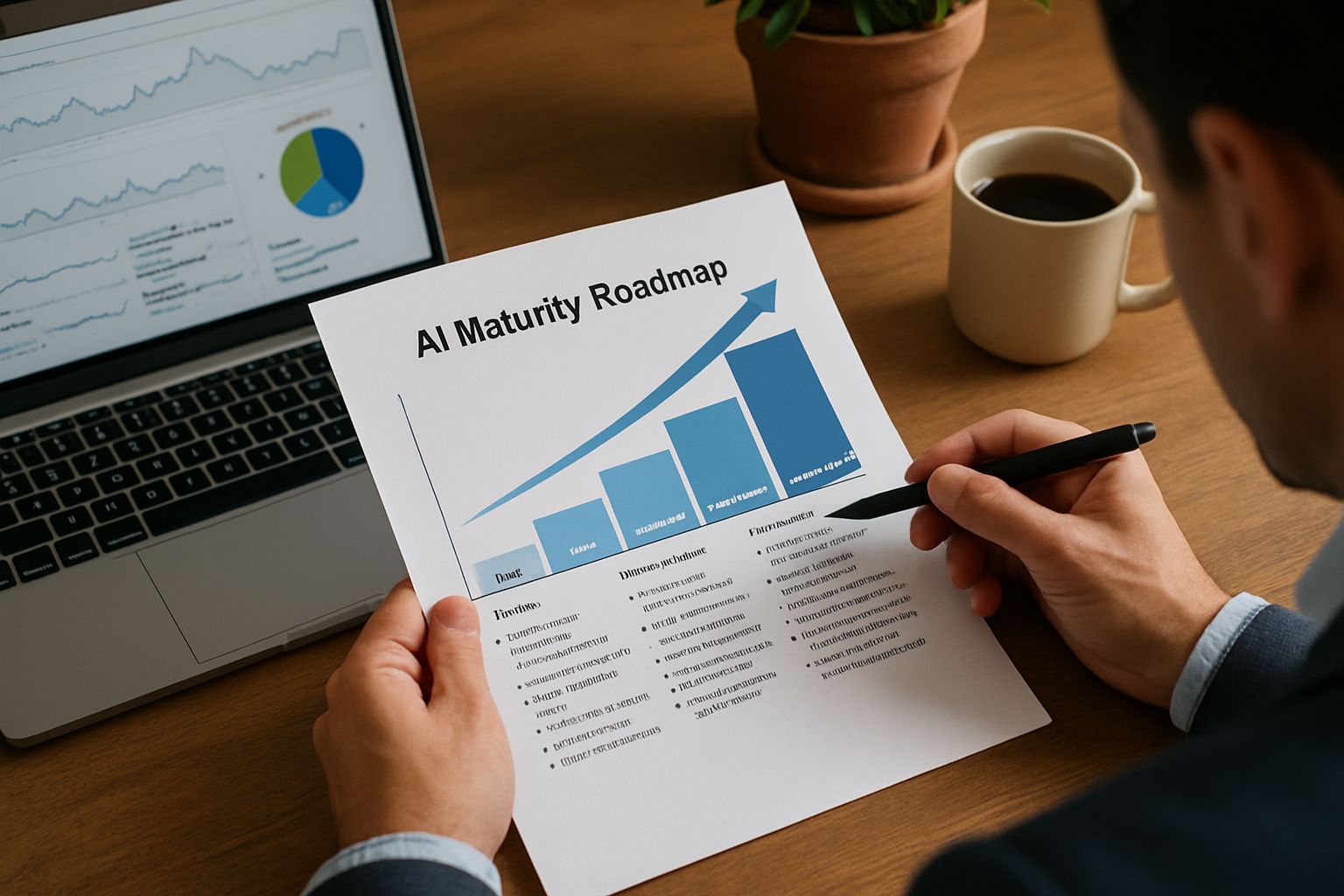
Widening AI Performance Gap
The model begins by quantifying stalled performance. BCG research shows firms that master CX generate 50% higher revenue growth. However, only 26% have the people and processes to reach that level. Gartner data similarly warns that aggressive agent-removal plans will likely fail. In contrast, Crescendo positions integrated human-AI workflows as the antidote. Subsequently, the vendor outlines four maturity tiers that map to rising business impact.
Furthermore, Crescendo presents hard numbers. Leaders operating at the top tier report double-digit margin gains and 60% higher total shareholder returns. Yet most enterprises remain stuck in fragmented automation. Consequently, a structured path becomes crucial. Throughout the report, the phrase AI Maturity Model appears as a constant checkpoint, reminding executives to benchmark progress at every stage.
These statistics expose widening gaps between promise and reality. Nevertheless, the data also signals opportunity. Forward-looking teams can close the divide by following disciplined roadmaps.
The gap underscores why static dashboards no longer suffice. Instead, adaptive metrics that reflect each maturity stage must guide investment decisions.
Four Maturity Levels Explained
Crescendo’s AI Maturity Model defines four discrete levels. Level 1, “Workflow,” uses basic macros and scripts. Level 2, labeled “AI Bolt-On,” adds chatbots but keeps them siloed. Level 3, “AI-Native,” merges human agents, data, and models into one learning system. Finally, Level 4, “AI-Driven,” reaches predictive autonomy where AI orchestrates end-to-end journeys.
Each level aligns with specific technology, governance, and talent attributes. For example, Level 3 requires unified knowledge graphs and continuous reinforcement learning. Meanwhile, Level 4 demands autonomous routing and agentic AI that can complete multi-step tasks. Consequently, contact-center teams gain a clear checklist for graduation.
Moreover, Crescendo couples each tier with outcome benchmarks. Response times, resolution rates, and customer effort scores improve sequentially. Notably, the company claims Level 3 adopters achieve 99.8% accuracy in production deployments. Independent validation remains pending; however, early pilots suggest meaningful lifts.
This staged design helps leaders avoid “big-bang” bets. Instead, incremental milestones de-risk transformation and align budgets with measurable returns.
Drivers Behind Rapid Adoption
Multiple forces accelerate AI adoption. Rising customer expectations pressure service desks to deliver 24/7 support. Additionally, labor shortages and wage inflation strain contact-center budgets. Therefore, leaders pursue automation that enhances efficiency without degrading experience.
Furthermore, cloud platforms now provide scalable large-language models on demand. Crescendo’s own multi-provider architecture routes requests across several LLMs, ensuring uptime and compliance. Consequently, reliability concerns that once blocked rollouts fade.
Regulatory clarity also expands. Data-protection laws now outline acceptable AI governance. Subsequently, legal teams feel safer green-lighting pilots. These tailwinds collectively push organizations deeper into the AI Maturity Model journey.
Yet, as BCG notes, technology explains only 10% of success. People and process decisions still dictate outcomes. Therefore, cultural change initiatives must proceed in parallel with tooling upgrades.
Benefits For Modern CX
Mature programs deliver concrete CX gains. First, resolution speed increases as AI surfaces next-best actions instantly. Moreover, predictive models pre-empt common issues, lowering inbound volume. Consequently, customer satisfaction rises while costs fall.
Secondly, unified context eliminates channel silos. Agents view the full journey, enabling consistent communication. Therefore, brand perception improves. In contrast, bolt-on bots often repeat questions, frustrating users.
Third, continuous learning loops foster relentless performance improvements. Feedback cycles retrain models weekly, not yearly. Subsequently, accuracy compounds over time.
- 50% higher revenue growth for CX leaders (BCG)
- 40% higher returns on invested capital
- 60% higher total shareholder returns
These numbers illustrate why climbing the AI Maturity Model ladder matters. However, benefits only materialize when technology, data, and talent mature together.
The gains provide a powerful business case. Nevertheless, executives must weigh them against the challenges discussed next.
Obstacles Contact-Center Teams Face
Several barriers impede progress. Legacy systems often lack APIs, blocking real-time data sharing. Additionally, fragmented ownership muddies accountability. Consequently, pilots languish without executive sponsorship.
Moreover, overhyped ROI promises spark skepticism. Gartner’s Kathy Ross warns that many agentless projects underestimate complexity. Therefore, robust change management becomes essential. Security concerns also arise because sensitive transcripts feed language models. In contrast, Crescendo’s multi-provider design offers encryption and regional routing.
Finally, talent shortages cripple scaling. Teams need prompt engineers, data scientists, and CX strategists. Professionals can enhance their expertise with the AI Learning & Development™ certification.
These hurdles may appear daunting. However, a disciplined roadmap can mitigate each risk while sustaining momentum.
The next section details practical steps that convert vision into executable plans.
Strategic Roadmap And Recommendations
Successful programs share five strategic pillars. First, establish a cross-functional steering committee to align goals. Secondly, perform a candid maturity assessment using Crescendo’s diagnostic. Subsequently, prioritize gaps with the greatest customer impact.
Third, adopt an agile delivery cadence. Short sprints produce quick wins, building credibility. Moreover, continuous experimentation feeds data back into models, accelerating learning. Fourth, invest in robust governance covering ethics, security, and compliance. BCG advocates a 70/20/10 resource split across people, process, and technology.
Fifth, measure outcomes obsessively. Key indicators should include cost-per-resolution, net promoter score, and agent turnover. Consequently, decision makers can validate ROI and secure further funding.
- Define clear use-case priorities
- Upgrade data infrastructure early
- Upskill staff with targeted courses
- Deploy sandbox environments for safe testing
- Scale proven workflows incrementally
This roadmap aligns with the AI Maturity Model checkpoints. Moreover, it embeds strategy into day-to-day rituals, ensuring sustained progress.
Structured action plans close the gap between aspiration and execution. Consequently, leaders can demonstrate tangible value within quarters, not years.
Next Steps And Certifications
Executives ready to advance should download Crescendo’s full report and run the embedded assessment. Additionally, they should brief governance boards on identified risks and resource needs. Meanwhile, operational managers can pilot Level 2 bots targeting low-complexity inquiries.
Furthermore, ongoing learning remains vital. The earlier referenced AI Learning & Development™ certification equips practitioners with advanced prompt-engineering and data-governance skills. Consequently, teams gain confidence to push toward AI-Native operations.
Finally, leaders should establish peer communities to share lessons. In contrast to isolated efforts, collaborative networks accelerate collective adoption and drive industry-wide performance gains.
These actions will embed the AI Maturity Model into organizational DNA. Subsequently, contact-center units can evolve from reactive service desks to predictive experience hubs.
Continuous learning and structured strategy sustain competitive advantage. Therefore, start your maturity journey today.


