

AI CERTS
2 hours ago
Corporate Financial Intelligence: AI Earnings Call Summaries Boom
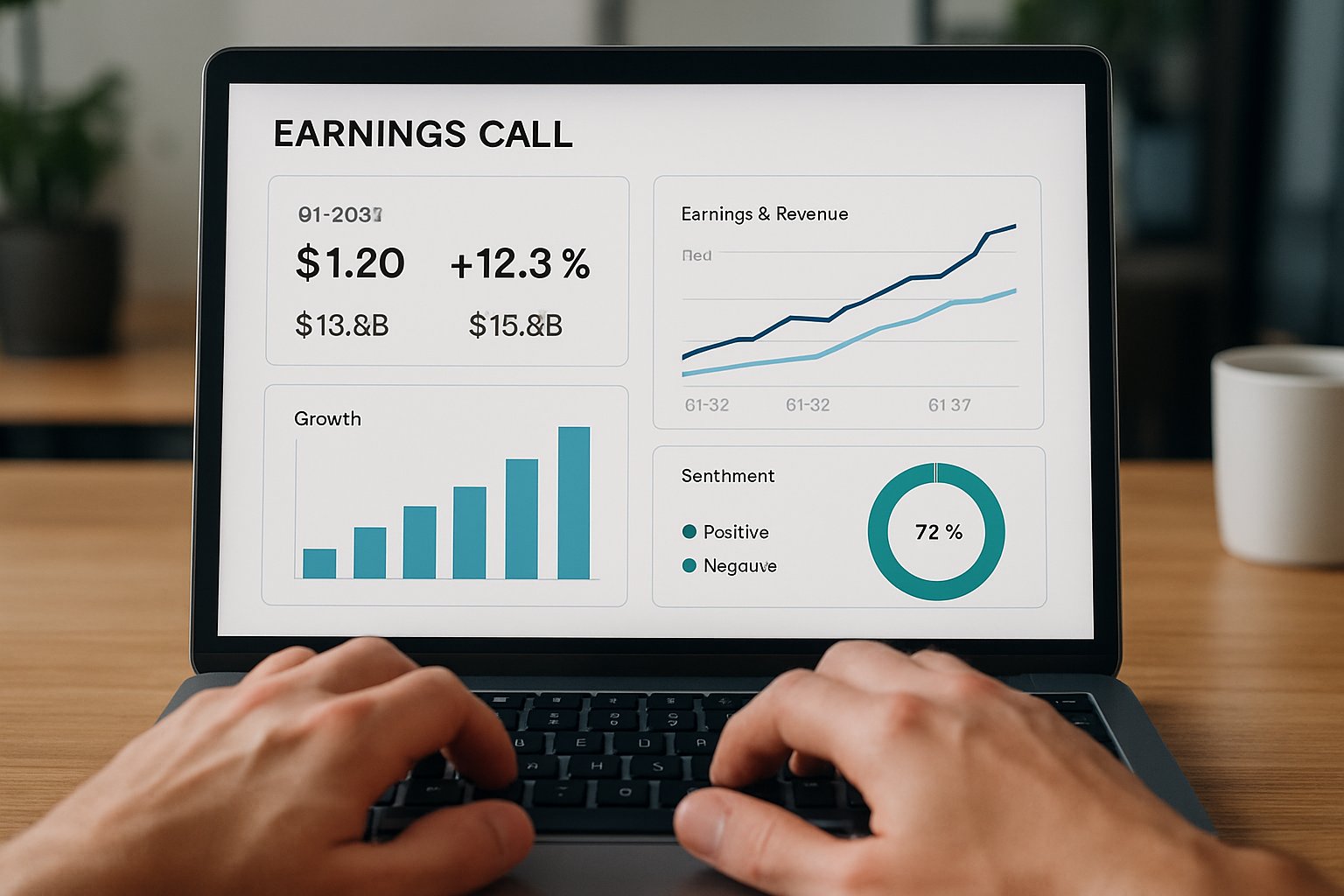
However, accuracy, governance, and competitive dynamics still spark debate.
Bloomberg Terminal subscribers first saw AI powered call bullets in January 2024.
Subsequently, S&P Global, FactSet, AlphaSense, and many startups followed.
Therefore, what began as pilots has become a full product race.
IDC estimates that US firms spent $86 billion on AI last year, underscoring demand.
Investors ask management about AI on calls more than ever, with 306 S&P 500 mentions logged in late 2025.
Consequently, summarization tools now shape how traders, portfolio managers, and compliance staff digest information.
Earnings Summary Market Momentum
Demand for lightning summaries rose as peak season compressed decision windows.
Moreover, Corporate Financial Intelligence players now deliver bullets within minutes of a call ending.
Bloomberg Terminal users click a bullet and jump to the original transcript line.
Independent analysis by Fortune noted 306 AI mentions on calls.
FactSet Mercury, S&P ChatIQ, and AlphaSense Generative Search all promise similar speed.
However, each vendor highlights unique models, data coverage, and interface nuances.
Consequently, buyers compare latency, topic granularity, and cost before standardizing workflows.
Startups such as EarningsCall.ai target boutique funds with simplified APIs and competitive pricing.
In contrast, incumbents bundle summarization with broader data packages to defend share.
Therefore, analysts confront an expanding menu rather than a single dominant option.
Summaries now arrive faster than portfolio rebalancing orders.
Nevertheless, understanding feature depth requires deeper vendor scrutiny.
The next section dissects those underlying technologies.
Key Vendors And Features
Bloomberg Terminal launched AI-Powered Earnings Call Summaries on 22 January 2024.
Furthermore, the tool anchors each takeaway to a transcript snippet, reducing hallucination exposure.
Bloomberg states that domain tuning with Bloomberg Intelligence experts underpins the pipeline.
S&P Global released Document Intelligence and ChatIQ in November 2024.
Additionally, Kensho language models tag Sentiment, guidance, and capital expenditure topics automatically.
Consequently, Capital IQ Pro subscribers can ask natural questions and receive grounded responses.
FactSet introduced Transcript Assistant inside its workstation in April 2024.
It stresses that customer prompts never retrain models, addressing data governance fears.
Meanwhile, AlphaSense claims more than 6,000 customers and $400 million ARR after its generative push.
LSEG and Refinitiv add similar assistants within Workspace as integration continues post merger.
Startups innovate rapidly yet still lack depth of historical datasets held by incumbents.
Therefore, enterprise buyers often pilot two platforms before committing budgets.
Each vendor differentiates on speed, traceability, and dataset breadth.
However, technology design choices ultimately drive reliability.
Consequently, we turn to the architectures beneath the user interface.
Technology Under The Hood
Most systems blend extractive retrieval with abstractive generation in a Retrieval-Augmented Generation loop.
Moreover, chunks pulled from the transcript ground the model and provide click-through evidence.
Therefore, users can audit any bullet against authoritative text instantly.
Vendors balance precision and fluency by tuning temperature, context windows, and post-processing filters.
In contrast, pure extractive approaches avoid hallucination yet read less coherently.
Consequently, hybrid pipelines dominate production rollouts across Corporate Financial Intelligence platforms.
Bloomberg Terminal implementations reportedly refresh summaries within five minutes after call end.
S&P Global targets similar timing, while startups claim near real-time streaming during live audio.
Latency depends on speech-to-text accuracy, GPU availability, and vendor caching strategies.
- Bloomberg launch date: 22 Jan 2024
- Document Intelligence debut: 12 Nov 2024
- AlphaSense ARR: $400M, 6,000 clients
- 306 S&P 500 calls cited AI in late 2025
- IDC: $86B US corporate AI spend in 2025
Sentence-level Sentiment scores feed dashboards that flag bullish or cautious commentary.
These metrics illustrate scale and velocity of adoption.
Nevertheless, engineering trade-offs still influence day-to-day trust.
The following section explores why buyers accept those trade-offs.
Opportunities Driving Rapid Adoption
Time savings headline every marketing brochure.
Furthermore, analysts save thirty minutes per transcript, a dramatic efficiency during crowded quarters.
Consequently, coverage expands to smaller cap firms once ignored due to bandwidth.
Structured tags feed quant screens that detect guidance changes or unexpected supply chain remarks.
Moreover, integrated Q&A bots accelerate scenario modeling inside spreadsheet add-ins.
Corporate Financial Intelligence managers emphasize that this speed supports intraday decision making rather than replacing diligence.
Positive Sentiment spikes can trigger automated trade heuristics.
Democratization represents another upside.
In contrast, legacy workflows demanded costly data feeds and dedicated support desks.
Now, startups offer API access at prices reachable by university funds and retail aggregators.
Adoption accelerates because value propositions align with concrete pain points.
However, risks could undermine that momentum if left unchecked.
The next section dissects those hazards.
Risks That Temper Enthusiasm
Hallucination remains the loudest concern among compliance officers.
Moreover, abstractive models sometimes merge separate management quotes, distorting context.
Consequently, vendors highlight click-through evidence and optional human review workflows.
Regulatory scrutiny intensifies as the SEC targets AI washing and disclosure quality.
Therefore, registered advisers must document model governance and error remediation.
Firms that distribute public notes based on AI summaries face additional liability.
Data ownership questions also surface.
In contrast to FactSet, some providers reuse customer prompts for tuning, raising confidentiality issues.
Buy-side legal teams increasingly request contractual carve-outs before purchase.
Overreliance is another human factor risk.
Junior analysts may skip full transcripts, missing vocal cues or hedged statements.
Nevertheless, many desks train staff to validate bullets against audio during critical trades.
Combined, these risks could erode trust and slow integration.
Consequently, governance frameworks now rank beside latency in RFP checklists.
Compliance dynamics deepen that focus, as explored next.
Compliance And Governance Pressures
SEC examinations increasingly request documentation of model training data, versioning, and bias tests.
Furthermore, several global banks established AI oversight committees that include front office stakeholders.
As a result, Corporate Financial Intelligence rollouts now involve legal, risk, and IT simultaneously.
Professionals can enhance their expertise with the AI-Powered Business Writer™ certification.
Moreover, many firms now require yearly continuing education credits focused on AI governance.
Consequently, knowledge of retrieval architectures and prompt engineering becomes a résumé differentiator.
Industry groups propose voluntary labeling of summaries that meet specific traceability standards.
Nevertheless, mandatory regulation may follow if error rates remain opaque.
Governance structures add cost yet improve trustworthiness.
Therefore, strategic planning must weigh investment against reputational risk.
A forward-looking outlook closes our review.
Strategic Outlook For 2026
Experts expect continuous model refinement and broader language coverage during 2026.
Furthermore, audio streaming summaries may arrive mid call, enabling real time alerts.
Corporate Financial Intelligence vendors also explore multimodal dashboards mixing tone heat maps and macro indicators.
Bloomberg Terminal already pilots Vision Pro visualizations, hinting at spatial research interfaces.
In contrast, smaller providers may differentiate through specialized sector models rather than platform breadth.
Consequently, competitive dynamics could mirror the database wars of earlier decades.
Buy-side leaders will prioritize accuracy metrics, governance attestations, and seamless API integration.
Analysis firms forecast continued double digit growth for generative summarization revenues, albeit from a small base.
Therefore, early adopters may secure efficiency advantages that compound over time.
2026 will test which pipelines scale without compromising oversight.
Nevertheless, disciplined implementation positions teams to capture alpha faster.
The final section synthesizes key lessons and next steps.
Conclusion And Next Steps
AI summarizers now stand at the center of Corporate Financial Intelligence workflows.
Moreover, rapid market momentum, proven time savings, and widening data coverage drive adoption.
Nevertheless, hallucination, regulatory scrutiny, and skill erosion demand vigilant governance.
Organizations that pair robust oversight with ongoing education will convert technology gains into lasting edge.
Therefore, start now by auditing vendor pipelines and drafting clear governance policies.
Finally, pursue credentials like the AI-Powered Business Writer™ certification to strengthen mastery.


