

AI CERTs
2 months ago
Clinical Inference Automation Speeds Hospital Diagnostics
Imaging departments face ballooning volumes and shrinking reimbursement. Consequently, administrators seek technology that delivers faster, safer diagnoses. At the center of that search sits clinical inference automation, the runtime brain of healthcare AI. This emerging stack runs trained models on images the instant they arrive. Therefore, radiologists receive prioritized alerts while scanners keep moving patients through. Hospitals deploying the approach already report shorter turnaround times and higher room throughput. Nevertheless, peer-reviewed data remains mixed, and integration hurdles still slow progress. This article examines momentum, technology, evidence, risks, and practical steps for leaders evaluating clinical inference automation. Additionally, the piece outlines certification paths for teams seeking deeper technical skill. Read on to learn how automated inference can turn imaging bottlenecks into capacity gains. In contrast to speculative promises, every claim cited here links to verifiable vendor or academic sources. Consequently, readers can benchmark their own roadmaps against transparent performance numbers.
Market Momentum Builds Rapidly
Recent announcements underscore that adoption has left the pilot phase. NVIDIA and GE HealthCare joined forces in 2025 to prototype autonomous imaging tasks on Holoscan hardware. Moreover, Philips gained FDA clearance for SmartSpeed Precise, claiming threefold faster MR scans. Meanwhile, platforms such as Aidoc and Viz.ai processed millions of studies, reshaping radiology AI workflows each month. Consequently, hospital CIOs now evaluate full stack offerings rather than single algorithms.
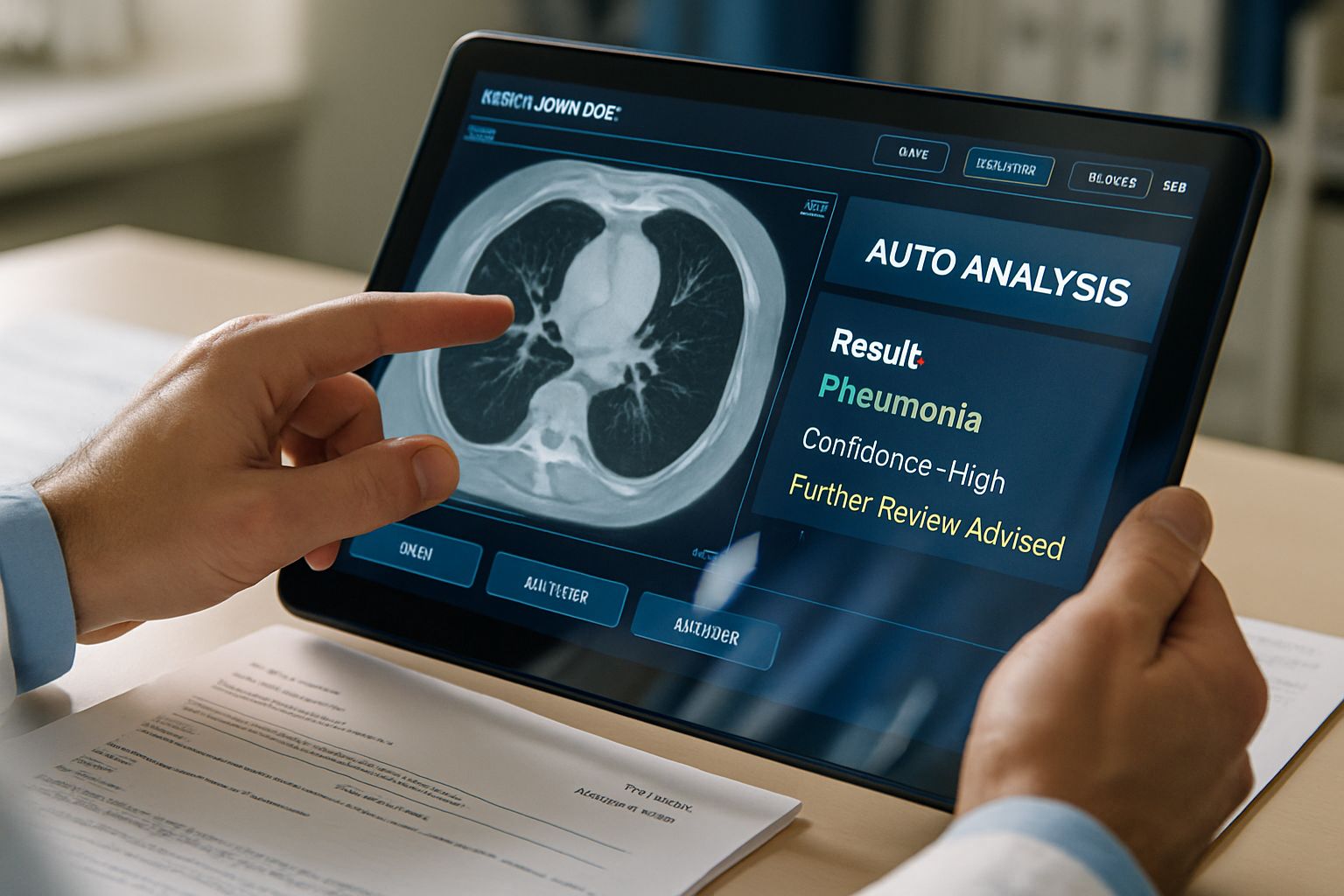
This surge reflects market belief that clinical inference automation can deliver operational ROI today. Nevertheless, evidence remains heterogeneous across settings and pathologies. Vendor momentum signals clear commercial confidence. However, hard proof must still match the hype, as the next section explains.
Technology Stack Essentials Explained
Every deployment relies on three layers: data ingest, model runtime, and orchestration. Edge accelerators from NVIDIA or Intel run time-critical inference near the scanner to minimize decision latency. Cloud clusters handle compute-heavy workloads and aggregate results across sites. Hybrid routing chooses the optimal location based on bandwidth, urgency, and data sensitivity.
Workflow orchestration platforms then insert findings into radiology AI workflows, automatically reprioritizing worklists and alerting care teams. Therefore, clinicians engage earlier, and scanners return to service faster. Clinical inference automation succeeds only when these layers communicate with negligible friction. A resilient stack cuts seconds at each step. Subsequently, measurable gains appear in real patient flow, as our evidence review will show.
Evidence From Deployments Worldwide
Public results highlight both striking successes and sobering caveats. Aidoc dashboards show turnaround time cuts of up to sixty percent for acute bleeds. Viz.ai published a multi-site stroke study with a four-minute faster door-to-needle time. Moreover, Philips customers gained two extra MRI slots per day after SmartSpeed Precise integration.
- University Hospital: 61% median TAT drop for intracranial hemorrhage
- Regional Network: threefold MRI throughput increase on selected protocols
- Stroke Center: 4-minute faster door-to-needle time with AI alerts
Nevertheless, a prospective single-center ICH study reported minimal benefit without worklist prioritization. Researchers concluded that decision latency savings evaporate when notifications fail to reach on-call staff. Therefore, numbers vary and must be interpreted in workflow context. Clinical inference automation can move the needle, yet only under disciplined integration. Evidence is strongest for focused triage scenarios. In contrast, broad claims need deeper scrutiny, addressed in the following section.
Integration Determines Impact Scale
Successful sites treat integration as an operations project, not a software install. First, triage outputs must elevate urgent studies inside radiology AI workflows automatically. Additionally, escalation channels must notify stroke or trauma teams within seconds to cut decision latency further. Hospitals that only tag studies without reprioritizing see little improvement.
Change management also matters. Radiologists need transparent performance dashboards to trust clinical inference automation outputs. Moreover, IT teams must monitor version updates and cybersecurity patches. Consequently, multidisciplinary governance committees now supervise AI orchestration in leading centers. Worklist integration and clear alerts create real throughput gains. Subsequently, we examine the remaining obstacles that threaten those gains.
Risks And Limitations Persist
Automation introduces fresh risks alongside benefits. False positives can flood inboxes and extend decision latency rather than reduce it. Alert fatigue erodes trust and slows clinical inference automation adoption. In contrast, inadequate bias monitoring can amplify disparities if models underperform in specific demographics. Furthermore, capital costs for GPUs, networking, and vendor fees challenge thin operating margins. Regulators now demand post-market oversight and cybersecurity hardening. These issues remind leaders that due diligence never ends. Nevertheless, practical guidance exists, as the next section details.
Implementation Best Practices 2026
Leading hospitals follow a structured playbook when launching new models. First, they define metrics such as scan-to-report time, decision latency, and scanner utilization. Second, they pilot within a single radiology AI workflows cluster before scaling enterprise-wide. Third, governance committees apply continuous performance and bias audits. Clinical inference automation success also hinges on staff training and clear escalation scripts. Professionals can enhance their expertise with the AI Developer™ certification. Moreover, vendors should provide dashboards that visualize real-time accuracy and downtime events. Executing this checklist de-risks scale-up and preserves ROI. Therefore, strategic planning leads naturally into long-term outlook, explored next.
Strategic Takeaways And Outlook
Clinical inference automation has progressed from isolated pilots to platform-scale deployments in major systems. Consequently, documented gains include faster reporting, reduced decision latency, and higher scanner throughput. Nevertheless, outcomes remain uneven when integration, governance, or staffing falter. Leaders should demand site-specific baselines, transparent dashboards, and rigorous post-market monitoring. Moreover, edge-cloud architecture must align with workload urgency and data-sharing constraints. When these pillars align, clinical inference automation unlocks sustainable capacity gains and competitive advantage. Explore certifications and vendor partnerships now to position your enterprise for the next wave.


