

AI CERTs
2 hours ago
Cisco Rankings Expose Adversarial Security Readiness Gaps
Tech headlines often focus on zero-day exploits. However, the deeper issue involves persistent readiness gaps. Consequently, Cisco’s newest benchmark reports offer an urgent wake-up call. The research highlights only 4% of firms reaching mature preparedness across key pillars. Moreover, Adversarial Security weaknesses dominate executive concerns, especially as threat actors refine AI-driven tactics. This article unpacks the data, explains the evolving landscape, and outlines practical next moves for security leaders.
Patch News Signals Risk
January headlines warned that Chinese hackers targeted an unpatched Cisco firewall flaw. Nevertheless, Cisco released fixes quickly after the disclosure. Such episodes illustrate shrinking response windows and rising public scrutiny. Importantly, Adversarial Security failures often begin with delayed patching and weak asset visibility. Furthermore, encrypted traffic analysis from the RSA Conference showed 40% of encrypted flows used weak ciphers, underscoring operational gaps. These challenges spotlight immediate hygiene issues that precede sophisticated attacks. The section underscores why foundational controls remain non-negotiable. However, broader readiness metrics reveal even tougher problems ahead.
Readiness Index Core Findings
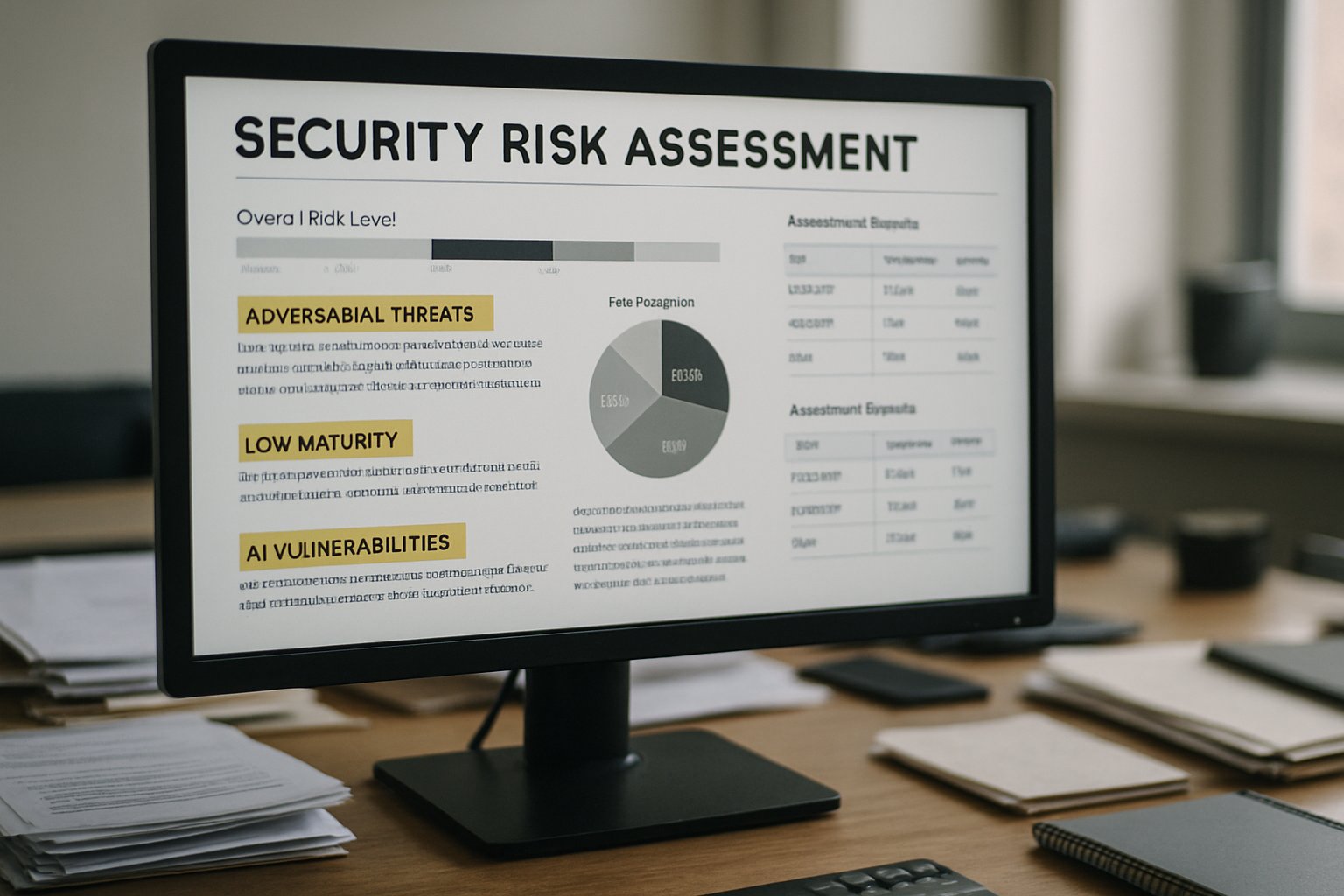
The 2025 Cisco Cybersecurity Readiness Index surveyed 8,000 global decision makers. Subsequently, the study ranked organizations across four tiers: Mature, Progressive, Formative, and Beginner. Only 4% achieved the top status, while nearly 70% clustered in the bottom two tiers. Moreover, 49% of respondents suffered at least one cyberattack during the past year. Meanwhile, 71% expect business disruption within 24 months. Jeetu Patel, Cisco’s CPO, warned, “Organizations must rethink strategies now or risk irrelevance in the AI era.”
- Machine Trustworthiness and AI Fortification scored the lowest average readiness.
- Identity Intelligence improved slightly yet still lagged behind network resilience.
- Budget allocation did not correlate strongly with maturity ranking progress.
These numbers confirm a widespread readiness deficit. Consequently, executives require clearer roadmaps for rapid capability gains.
AI Adversarial Security Landscape
The State of AI Security 2026 report expands the narrative. It details prompt-injection exploits, model theft cases, and agentic AI misfires. Additionally, 83% of surveyed leaders plan autonomous agent deployment, yet only 29% feel prepared for secure rollout. In contrast, adversaries iterate faster, weaponizing large language models for phishing and reconnaissance. Therefore, Adversarial Security now extends beyond network boundaries into data, model, and supply-chain layers.
Cisco’s researchers released open-source model fuzzers to stress-test generative systems. Furthermore, they encouraged defenders to adopt continuous red-teaming against AI pipelines. Emile Antone noted, “The landscape is expanding faster than defenders can react.” Nevertheless, proactive validation helps narrow the gap. These insights prove that defensive innovation must match attacker velocity. Consequently, strategic investments in specialized skills become vital.
Professionals can enhance their expertise with the AI Researcher™ certification. The program emphasizes threat modeling and testing of Adversarial Security scenarios for machine-learning assets.
Event SOC Lessons Learned
Real-world evidence emerges from the joint Cisco, Endace, and Splunk Security Operations Center at RSA 2025. Analysts observed encrypted traffic dipping to 74%, with weak algorithms present in 40% of flows. Moreover, cross-vendor XDR integration reduced investigation time by 37%. However, manual misconfigurations still created blind spots. Consequently, live event telemetry validates many readiness findings. The SOC data suggests technical tooling excels, yet process discipline lags. Therefore, continuous monitoring and configuration validation remain essential alongside flashy analytics.
These operational insights reinforce earlier survey trends. Meanwhile, they provide concrete performance baselines for future ranking comparisons.
Enterprise Ranking Implications Ahead
Stakeholders often treat benchmarks as public scorecards. Indeed, competitive ranking pressure can accelerate board level funding. However, the data also reveals uneven progress between sectors. Financial services improved identity controls fastest, while manufacturing struggled with cloud reinforcement. Additionally, regional differences surfaced; Asia-Pacific firms gained ground, surpassing some European peers in machine trust metrics. Consequently, organizations must contextualize their ranking positions rather than chase vanity status.
Effective use of benchmarks demands actionable mapping. Therefore, leaders should translate pillar scores into specific project charters, timelines, and accountability matrices. This disciplined approach converts ranking insights into measurable outcomes. Moreover, sharing progress transparently nurtures stakeholder confidence.
Bridging Critical Capability Gaps
Closing readiness gaps starts with prioritized roadmaps. Firstly, fortify identity layers through multifactor authentication and just-in-time privilege. Secondly, adopt continuous validation against Adversarial Security patterns, including model inversion attempts. Moreover, integrate network and endpoint data into unified detection stacks to boost mean-time-to-respond metrics. Budget constraints demand phased execution; therefore, start with highest risk-to-value ratios.
Collaboration also matters. Consequently, cross-functional fusion centers that merge IT, security, and data science can accelerate learning loops. Additionally, leveraging simulation platforms helps teams rehearse uncommon adversarial tactics safely. Over time, these practices uplift maturity scores while preparing organizations for evolving AI threats.
Incremental wins fuel cultural momentum. However, sustained executive sponsorship ensures lasting transformation.
Strategic Security Actions Forward
Security leaders should translate today’s research into tomorrow’s resilience. Establish clear metrics aligned with Cisco’s pillars and monitor monthly trendlines. Furthermore, embed Adversarial Security testing within every development sprint. Leverage community tools and certifications to maintain current knowledge. Meanwhile, coordinate with industry peers to share anonymized telemetry and collective defense strategies. Consequently, collective intelligence amplifies individual investments.
Regulators are also watching readiness indicators. Therefore, proactive disclosure of improvement plans can pre-empt compliance surprises. Moreover, transparent communication supports customer trust, especially after high-profile incidents.
In summary, Cisco’s reports reveal sobering yet actionable truths. Only a small fraction of enterprises reach mature readiness, and AI risks grow exponentially. Nevertheless, disciplined roadmaps, continuous testing, and collaborative learning can reverse these trends. Consequently, now is the time to act decisively. Explore advanced training paths and consider earning the AI Researcher™ certification to deepen practical skills against rising Adversarial Security challenges.


