

AI CERTS
2 hours ago
China’s Industrial Robotics Revolution Reshapes Manufacturing
Meanwhile, investors pore over growth curves once reserved for consumer electronics. However, the most compelling story unfolds inside mainland factories and testing tracks. Beijing planners call the momentum essential to national resilience amid demographic headwinds and global tension.
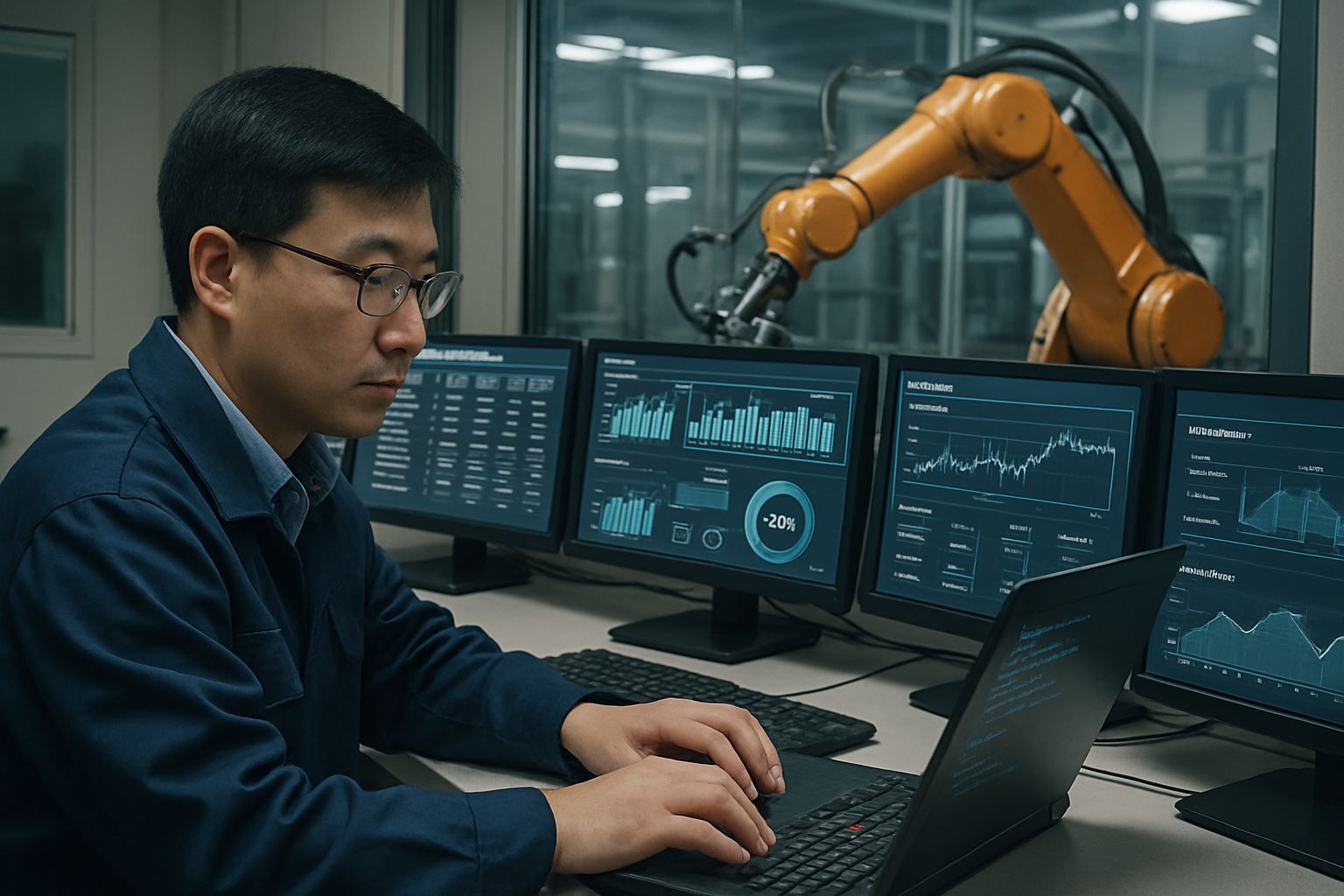
In contrast, workers negotiate a delicate labor shift as collaborative machines share soldering stations. Guardian journalists recently chronicled humanoids sprinting through half-marathons, exposing both promise and fragility. Therefore, the Industrial Robotics Revolution now stretches beyond factory gates into logistics, retail, and spectacle arenas. This article maps the forces behind that expansion and clarifies what professionals should anticipate next.
China Leads Robot Surge
Official IFR data show 295,000 new units installed across China during 2024. Moreover, that figure represented 54 percent of global deployments, doubling the country's tally from 2019. Domestic vendors captured roughly 57 percent of those sales, up ten points from the previous year.
Consequently, leadership once held by Japanese and European giants has narrowed rapidly. Robot density also climbed to about 470 units per 10,000 manufacturing employees, ranking third worldwide. Analysts link the surge to electric-vehicle, battery, and smartphone assembly lines hungry for greater throughput.
Meanwhile, policy incentives slashed capex payback periods to fewer than three years for many adopters. The Industrial Robotics Revolution therefore benefits from synchronized demand, supply, and supportive regulation.
Collectively, the numbers confirm the momentum's depth. Consequently, we now examine how floors are reorganising to exploit that hardware.
Factory Floors Transform Fast
Walk into an EV welding bay and you meet collaborative arms paired with mobile carts guided by lidar. Additionally, cobots now handle screw-driving and inspection, reducing human microtasks through smart automation. Supervisors say one cell can swap between eight models without pausing for re-tooling.
In contrast, legacy lines required overnight changeovers and extensive safety fencing. Labor shift dynamics arise here, not from mass layoffs but from reallocating technicians toward quality analytics. Consequently, average hourly output per worker has risen even as headcounts remain stable in many plants.
Engineers credit predictive maintenance dashboards fed by robot telemetry for minimizing unexpected stoppages. Moreover, energy consumption dips because precise motion planning avoids wasteful idle cycles. The Industrial Robotics Revolution thus reinforces both efficiency and sustainability KPIs at the shop-floor level.
- 295,000 robots installed nationwide during 2024, per IFR.
- Robot density reached 470 units per 10,000 workers.
- Domestic suppliers held 57 percent of sales.
- Industry revenue estimated at US$47 billion in 2024.
These figures contextualize factory transformation. However, innovation now moves from arms to full humanoid bodies.
Humanoids Enter Public Trials
Guardian coverage captured marathon-running robots, football matches, and campus delivery pilots across several cities. Nevertheless, most prototypes still rely on remote supervisors who intervene during balance failures or vision glitches. Start-ups like Unitree and UBTech promise sub-$30,000 price tags once volumes reach tens of thousands.
Furthermore, Morgan Stanley projects a potential five-trillion-dollar global humanoid market by 2050 under aggressive adoption scenarios. Adam Jonas cautions that meaningful scale likely arrives after 2035 when regulations stabilize and costs fall. Meanwhile, state fairs and tech festivals provide invaluable testbeds for sensors, drives, and human acceptance research.
The Industrial Robotics Revolution here intersects consumer spectacle, venture capital, and strategic signalling. Demonstrations excite citizens and investors. Consequently, policy architects accelerate incentive packages, which we examine next.
Policy Fuels Rapid Scale
Beijing's Robot+ action plan bundles subsidies, procurement guarantees, and standards into one coherent framework. Additionally, municipal governments like Guangzhou and Tianjin top up national grants with local tax rebates. State-owned enterprises sign forward contracts that anchor factory utilization for emerging vendors.
Therefore, lenders perceive lower risk and extend working capital for large-scale automation. Analysts from CSIS warn inflated order books sometimes mask limited true demand. Nevertheless, the Industrial Robotics Revolution benefits because even pilot programs stimulate component ecosystems.
Patenting data also spike, reflecting both genuine innovation and defensive filings. Policy thus compresses learning cycles. In contrast, technical gaps still constrain universal deployment, as detailed below.
Winners And Remaining Gaps
Chinese incumbents Siasun and Estun gained volume, yet precision welding remains dominated by FANUC and ABB. Meanwhile, young humanoid firms race to master dexterous hands and long-lasting batteries. Technical hurdles include real-time perception, compliant actuation, and physical commonsense reasoning.
Consequently, Guardian reporters found hidden joystick operators during several public demos. Labor shift anxiety persists among assembly workers, though retraining programs emphasize higher-value troubleshooting skills. Moreover, social scientists study regional wage dispersion to detect emerging inequities.
The Industrial Robotics Revolution will stall without credible safety, ethics, and privacy frameworks. Benefits remain real yet uneven. Therefore, global stakeholders monitor market ripple effects.
Global Market Implications Rise
International Federation of Robotics President Takayuki Ito notes Asia owned 74 percent of 2024 installations. Subsequently, Western policymakers debate tariffs, friend-shoring, and automation tax credits. Competitors fear price wars as China’s suppliers export low-cost six-axis arms into Southeast Asia.
Furthermore, supply-chain security conversations now include motors, reducers, and servo controllers once viewed as commodities. Geopolitical analysts warn that dual-use mobile platforms could alter deterrence dynamics. Nevertheless, the Industrial Robotics Revolution encourages shared standards around safety and interoperability.
- Cheaper robots compress global production costs.
- Supply chains pivot toward Asian motor makers.
- Policy tension rises over data security.
Stakeholders brace for turbulent competition. Consequently, individual careers must adapt through continued learning.
Strategic Skills For Professionals
Engineers, project managers, and policymakers all need fluency across mechanics, AI, and regulatory strategy. Therefore, professionals may boost expertise through the AI Project Manager™ certification. Additionally, fluency in safety standards such as ISO 10218 will distinguish future leaders.
Soft skills remain vital because cross-disciplinary teams must translate technical possibility into factory value. Consequently, reskilling budgets are rising inside many multinationals. The Industrial Robotics Revolution offers upward mobility to those who anticipate converging trends.
Career growth now favors adaptability. In contrast, stagnant skill sets risk obsolescence.
The past three years rewrote global production playbooks. Moreover, China’s scale, policy muscle, and talent pipeline anchor the momentum. Factories, logistics corridors, and public plazas now showcase tangible benefits yet expose technical and ethical tests.
Nevertheless, the Industrial Robotics Revolution remains midway through its trajectory, not near completion. Consequently, stakeholders must track breakthroughs in perception, batteries, and governance. Therefore, invest in learning, pursue certifications, and join pilot projects before disruption outpaces preparation. Act now to convert uncertainty into opportunity.


