

AI CERTS
2 hours ago
China Robot Schools Speed Physical AI Development
These facilities feed vast sensorimotor streams into models, speeding Physical AI Development. Moreover, analysts now argue that the country has fused hardware manufacturing, data pipelines, and policy support into a repeatable system. Industry leaders must understand how this pipeline works, where the limits remain, and which opportunities surface next. The following report distills data, expert views, and strategic implications for professionals evaluating Robotics adoption, investment, or regulation.
China's Robot School Surge
Wuhan’s Motphys Training base opened last October. Consequently, the site delivers continuous simulation on MotrixLab and logs terabytes daily, powering Physical AI Development. Meanwhile, physical halls replicate homes, warehouses, and factory lines for real-world sampling. Trainers steer prototypes through corridors using headsets and haptic gloves. The humanoid units mirror every gesture, producing labeled trajectories that later seed reinforcement loops. Additionally, sister centers in Hefei, Jinan, and Zhejiang follow similar blueprints.
Local governments subsidize rent, energy, and cloud storage, lowering entry barriers for startups. Morgan Stanley counts more than 140 Chinese humanoid manufacturers competing for those slots. In contrast, United States figures remain below 30. Therefore, much of the world’s fresh embodied data originates inside these regional clusters, not elite academic labs. This scale matters because larger corpora shorten iteration cycles and reduce costly bench failures.
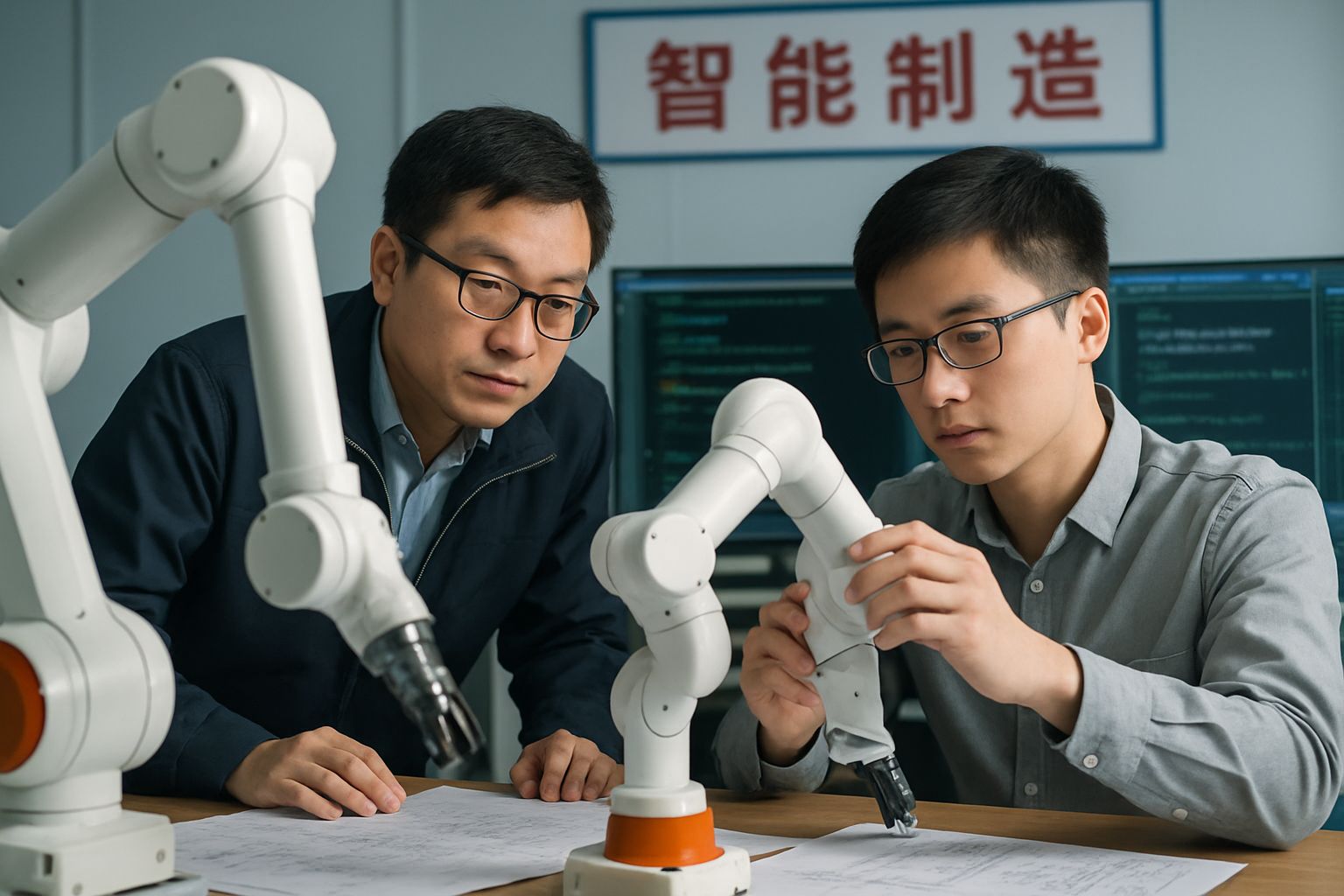
Robot schools convert raw space and subsidies into accelerating feedback. However, simulation remains the other critical accelerator addressed next.
Simulation Enhances Rapid Iteration
High-fidelity physics engines compress calendar time. Moreover, a virtual minute can equal hours of risky hardware wear. Motphys claims that its sim cluster runs 8,000 scenarios before breakfast. Similarly, NVIDIA’s Isaac stack provides transfer-learning toolkits used by many Chinese labs. Researchers randomize friction, lighting, and sensor noise, then measure policy robustness.
Consequently, algorithms arriving on lab floors already survived thousands of edge cases. Physical AI Development therefore absorbs failures in silicon instead of carbon fiber. Still, analysts warn that sim-to-real gaps persist for contact-rich manipulation. Nevertheless, data suggest progress. Halldale reporters observed robots practicing 200 action sequences daily in combined pipelines. That cadence would overwhelm purely physical tracks.
Virtual grindstones now forge useful policies with fewer broken bolts. The next link is VR teleoperation, where humans teach dexterity directly.
VR Teleoperation Teaching Pipeline
Inside many robot schools, instructors wear consumer VR headsets. Their arms control actuators in real time. Consequently, each recorded frame pairs proprioceptive signals with high-resolution point clouds. Training datasets balloon quickly, satisfying hungry transformer policies. Moreover, the approach sidesteps sparse reward engineering because robots imitate successful human trajectories.
Euronews quoted trainer Qu Qiongbin saying, “We wear VR glasses…it will learn our postures.” Physical AI Development leverages this low-latency feedback to refine balance and grasping. Humanoid platforms therefore graduate from simple walking to complex household Tasks within weeks. Additionally, cloud servers aggregate demonstrations, making skills portable across brands.
However, experts note that teleoperation can bake in human error biases. In contrast, algorithmic oversight layers are emerging to flag inconsistent force profiles. Consequently, the pipeline now blends imitation with reinforcement, delivering safer convergence.
VR teaching accelerates dexterity yet introduces data-quality questions. Manufacturing scale and patent depth provide another competitive shield.
Manufacturing Scale And Patents
China installs over half the world’s industrial robots, according to the International Federation of Robotics. Consequently, supply chains for servomotors, reducers, and battery packs already operate at commodity pricing. Moreover, Morgan Stanley reports 7,705 humanoid-related patents filed in China over five years. That number is roughly five times United States filings.
Physical AI Development thrives when component costs fall and intellectual property circulates regionally. Additionally, local governments offer expedited certification pathways, shaving months off compliance. Startups therefore iterate hardware revisions three or four times annually. Such velocity keeps failure lessons affordable.
However, dependence on Chinese parts worries Western integrators. Therefore, alternative suppliers in South Korea and Germany now court buyers, though at higher prices.
Scale and patents translate vision into discounted bill of materials. Market forecasts reveal how investors price that momentum.
Market Forecasts And Reality
Morgan Stanley’s headline number grabs attention: a US$5 trillion humanoid market by 2050. Consequently, analysts model nearly one billion deployed units, 90% in industrial or commercial roles. Price curves start near US$200,000 today and fall to “family-car” range by 2050. Nevertheless, such scenarios assume sustained Physical AI Development and unbroken supply access. Frontline engineers remain cautious.
Moreover, stage choreography at the Spring Festival Gala masked teleoperation fallback modes. Researchers interviewed by Frontiers in Robotics highlight deficits in tactile sensing and open-world perception. Therefore, deployment will likely follow narrow domains first, including sorting, inspection, and eldercare Tasks.
Investors hunting quick returns should examine milestone metrics rather than viral videos. For instance, Motphys tracks sim-to-real transfer error percentages monthly. Additionally, Leju publishes mean time between failure for warehouse pickers. These KPIs predict revenue better than showroom flips.
Forecasts inspire vision yet hinge on granular metrics. Ethical and regulatory risks could still derail momentum if ignored.
Risks Ethics And Governance
Every new technology invites scrutiny. However, humanoid mass deployment raises unique safety scenarios because machines share physical space with people. Standards bodies are drafting contact-force limits and emergency-stop latencies. Moreover, policymakers study data governance for motion logs that capture private interiors. Physical AI Development intersects national security too, given possible dual-use logistics roles. Consequently, the Chinese government funds research on fail-safe architectures. International observers urge transparent benchmarks so incidents can be compared globally.
Social acceptance remains another wildcard. In contrast to fascinated teenagers, some viewers called Gala performances “creepy.” Additionally, labor unions express displacement concerns for repetitive warehouse Tasks. Therefore, companies now run public workshops explaining Robotics benefits and retraining programs.
Professionals can enhance their expertise with the AI Policy Maker™ certification. The course covers governance frameworks, liability chains, and ethical audits relevant to embodied systems.
Governance decisions will shape adoption curves as much as silicon metrics. The final section summarizes actionable insights for decision-makers.
Strategic Takeaways For Professionals
Decision-makers navigating Physical AI Development should prioritize empirical metrics over publicity stunts.
- Track daily action sequences per robot across combined Training and simulation runs.
- Verify sim-to-real transfer error below 10% for critical Tasks.
- Demand published mean time between failure for fielded units.
Moreover, confirm component sourcing redundancy to mitigate geopolitical shocks.
Investors can apply a staged portfolio model. Allocate seed funds to software firms improving control stacks, then scale capital toward manufacturers showing repeatable factory acceptance tests. Consequently, risk spreads across maturity bands.
Policy leaders must harmonize standards with international bodies. Additionally, transparency reports on incident rates will build public trust and support sustained Robotics rollouts.
Acting on these concrete checkpoints will maximize return and social acceptance. The following conclusion distills the broader narrative.
China’s robot-school ecosystem shows how infrastructure, policy, and culture can converge to accelerate Physical AI Development. Consequently, companies worldwide face a strategic fork: ride the Chinese cost curve or cultivate alternative supply webs. Nevertheless, long-term winners will anchor decisions in verifiable metrics, robust governance, and disciplined experimentation.
Moreover, the certification landscape helps leaders close knowledge gaps quickly. Professionals eyeing policy roles should consider the AI Policy Maker™ pathway highlighted earlier. Physical AI Development will ultimately transform mundane Tasks before it reshapes society completely. Therefore, mastering standards, ethics, and data rigor today secures competitive advantage tomorrow.


