

AI CERTS
18 hours ago
Chatbot Safety: Ofcom Clarifies New UK Rules and Enforcement
This article unpacks the new UK Rules, key deadlines, enforcement powers, and industry reaction for technical leaders. Additionally, it offers practical checklists and certification pathways to strengthen governance programs. Legislators pushed the Act through Parliament after high-profile chatbot misuse cases alarmed parents and investors. Subsequently, enterprises rushed proofs-of-concept into production without fully understanding new liabilities. Nevertheless, compliance teams can still catch up if they act before looming March deadlines. This report offers the roadmap.
Regulatory Scope Now Clarified
Ofcom’s November 2024 open letter erased any doubt about scope. According to the notice, generative outputs inside user-to-user or search services count as user content. Therefore, platforms ranging from social giants to niche character bots fall under the same UK Rules duties.
Meanwhile, standalone chatbots that neither search data nor share outputs publicly could escape immediate coverage. Nevertheless, ministers have hinted at extra legislation to close these emerging gaps.
In practice, a chatbot within a messaging app becomes regulated once its responses can be forwarded to other users. By contrast, a private enterprise assistant might remain outside unless integrated with a searchable knowledge base.
The revised interpretation greatly widens Chatbot Safety obligations across consumer platforms. Consequently, providers must now map product architectures, leading us to the concrete duties.
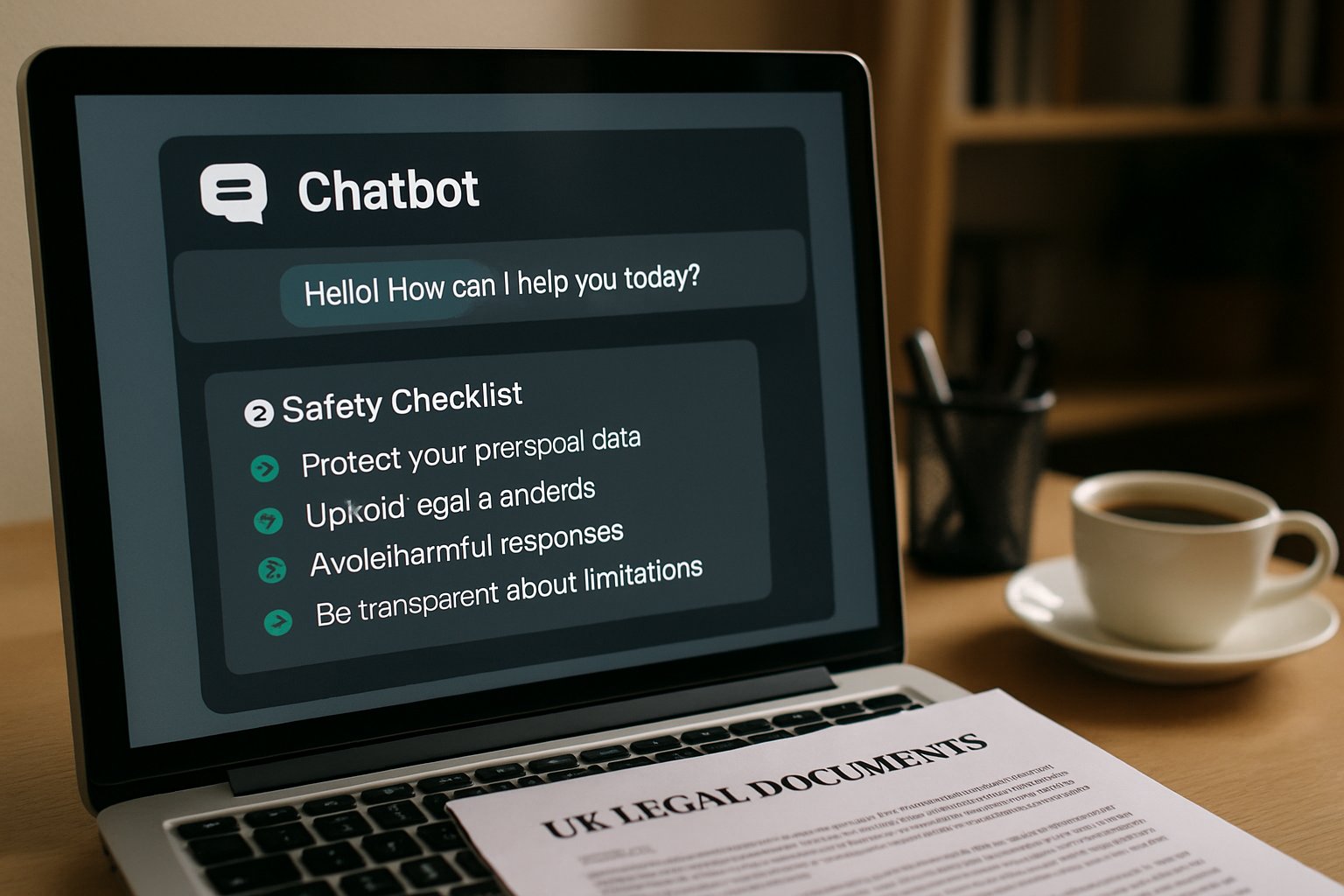
Key Mandatory Duties Checklist
Ofcom has published detailed codes describing how companies should fulfill the Act’s baseline safeguards. Moreover, the digital safety toolkit launched in January 2025 walks teams through each required document.
Below is a concise checklist summarising the headline tasks.
- Complete Illegal Harms Risk Assessment by mid-March 2025.
- Appoint a named senior compliance officer.
- Deploy proportionate content moderation and removal workflows.
- Implement “highly effective” age assurance for adult material.
- Conduct continuous safety-by-design testing for generative models.
Additionally, Ofcom expects platforms to document staff training, resource allocation, and product experiments. Therefore, compliance must become an ongoing engineering practice rather than a quarterly legal task. Embedding Chatbot Safety metrics into dashboards helps executives track real-time risk reduction. Such transparency aligns with UK Rules enforcement philosophy, which prizes evidence over promises.
These duties provide a clear blueprint for engineering, policy, and legal teams. However, understanding the penalties for ignoring them is equally vital.
Strong Enforcement Powers Explained
The Online Safety Act arms the regulator with unprecedented financial and technical sanctions. Specifically, the regulator can fine whichever is greater of £18 million or 10% of global revenue.
Furthermore, courts may order UK internet access providers to block non-compliant services. Consequently, global platforms cannot treat British requirements as optional regional features.
Recent guidance notes 130 priority offences that must shape risk models. Subsequently, failing to detect AI-generated terrorist content or CSAM could trigger large fines.
For context, the Internet Watch Foundation logged 17 AI-generated child abuse incidents on one chatbot in ten weeks. Nevertheless, no public enforcement case has yet reached court, so early cooperation remains advantageous. Proactive Chatbot Safety audits can demonstrate diligence and influence the regulator’s supervisory approach.
Penalties are severe and reputational damage even worse. Therefore, industry responses merit close examination next.
Industry Reaction Remains Mixed
Major platforms have largely welcomed clarity but raised operational concerns. For example, Character.AI says human review capacity must expand to match creative misuse.
Meanwhile, civil-society groups remain skeptical. Andy Burrows from the Molly Rose Foundation labelled the first codes “a bitter disappointment.” In contrast, the IWF praised the regulator for acknowledging AI-generated CSAM risks yet demanded faster enforcement.
Meta and Google have already updated terms to restrict sexual content in public chatbot personas. Moreover, both firms are experimenting with watermarking to support Chatbot Safety detection pipelines.
Reuters reports many UK fintech startups worried about compliance cost, especially expensive age-assurance vendors. Nevertheless, certification programs can offset uncertainty by standardising controls across teams. Professionals can enhance their expertise with the AI Data Specialist™ certification. Adopting these standards demonstrates alignment with UK Rules and reduces audit friction.
Stakeholders agree on the goal yet debate the pace and specificity. Consequently, technical hurdles loom large.
Operational Hurdles Loom Ahead
Detecting synthetic illegal content at scale challenges current moderation tools. Moreover, adversaries quickly adapt prompts to bypass keyword filters.
Age assurance remains another pain point because biometric checks raise privacy and bias questions. Nevertheless, Ofcom insists “highly effective” solutions are non-negotiable for adult content.
Integration overhead also surprises teams. Therefore, product roadmaps must incorporate security gates without ruining latency. Continuous red-teaming is essential for Chatbot Safety given evolving prompt exploits and model updates.
Key hurdles include:
- Limited labeled datasets for AI-generated abuse patterns.
- Cross-border jurisdiction conflicts complicating takedown requests.
- Resource strain for small development teams.
These challenges highlight critical gaps. However, forthcoming milestones may incentivise faster innovation.
Future Roadmap Milestones Set
Ofcom’s roadmap labels 2025 a “year of action” with multiple consultation deadlines. Subsequently, final codes on child safety and algorithmic transparency will publish in 2026.
Providers must submit Illegal Harms Risk Assessments by mid-March 2025 and evidence mitigation progress quarterly. Consequently, internal dashboards should already merge event telemetry with policy attestations.
Government officials also consider fresh UK Rules targeting standalone chatbots outside current definitions. Therefore, product strategists should track parliamentary updates alongside regulatory bulletins.
Marketplace differentiation may increasingly hinge on certified Chatbot Safety attestations, not only feature velocity.
Deadlines now create tangible accountability. Nevertheless, decisive action today prevents rushed fixes tomorrow.
Chatbot Safety has evolved from an abstract principle into statutory duty. Ofcom’s guidance, combined with stiff penalties, leaves little room for passive observation. However, compliance remains achievable when teams embed safety-by-design, mature moderation, and transparent metrics. Moreover, aligning architectures with UK Rules reduces uncertainty ahead of future legislative tweaks. Professionals that champion rigorous Chatbot Safety cultures will shield users while unlocking trust-driven growth. Consequently, now is the moment to benchmark programs against the checklist above. Take the next step by earning an industry certification and demonstrating tangible mastery of Chatbot Safety requirements.


