

AI CERTS
4 months ago
Central Banks Flag AI Market Concentration Risks
Furthermore, the Financial Stability Board lists third-party concentration among leading drivers of Systemic Risk. NVIDIA controls most data-center GPUs, while three Hyperscalers dominate global cloud spend. Consequently, financial institutions face vendor exposure levels unseen in previous tech cycles. Market Concentration also stretches into equities: the so-called Magnificent 7 command outsized index weight and Valuation premiums. Regulators warn that a sudden repricing could ripple through credit markets backing AI infrastructure debt.
Global Regulators Sound Alarm
Central bank rhetoric has hardened over the past eighteen months.
Moreover, the BIS June 2024 review urged supervisors to cooperate because data and vendor concentration threaten resilience.
Shortly after, Janet Yellen told FSOC that common AI providers could amplify Systemic Risk across payment and trading networks.
The ECB added weight, publishing staff analyses that spotlighted AI Market Concentration within European financial services.
Consequently, supervisors now treat vendor dependency as a core prudential topic, not a peripheral technology issue.
Regulators agree that unchecked supplier dominance could undermine operational continuity and investor confidence. These alerts keep escalating. Therefore, understanding the hard numbers behind concentration has become vital.
Tracking Core Concentration Metrics
Data reveal how narrow the AI supply chain has become.
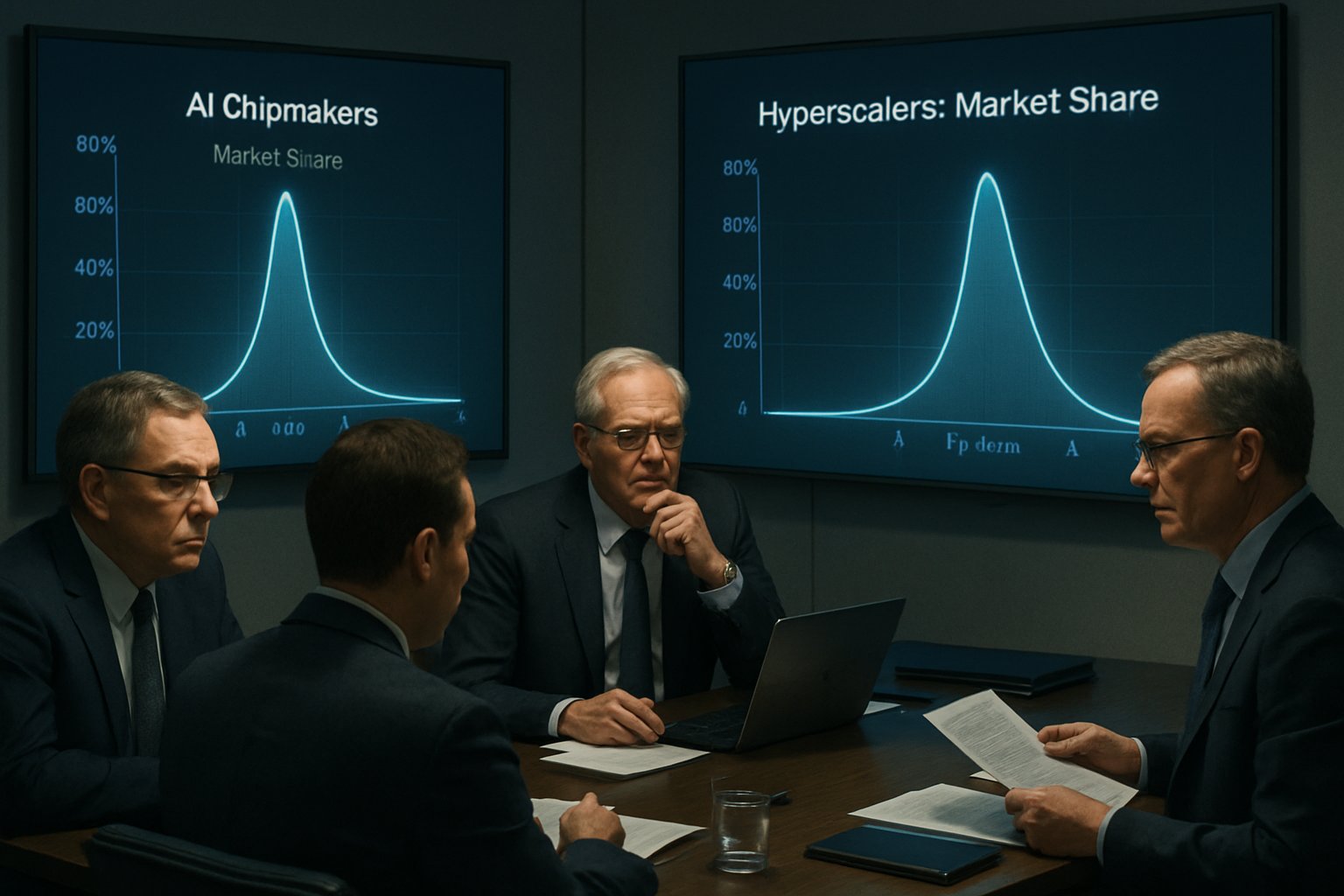
Synergy Research estimates that three Hyperscalers control 63 percent of global cloud infrastructure spending.
TechInsights places NVIDIA at 98 percent of data-center GPU shipments during 2023.
Meanwhile, the ECB notes that the Magnificent 7 now account for 30 percent of S&P 500 capitalisation.
The Bank of England warns that AI infrastructure spending could exceed $5 trillion, half financed through debt.
- Hyperscalers: AWS, Azure, Google Cloud share ~63% market.
- GPUs: NVIDIA holds 98% of 2023 data-center shipments.
- Equities: Magnificent 7 drive 30% S&P 500 capitalization.
- Financing: $5 trillion AI infrastructure, ~50% debt funded.
- Overall Market Concentration metrics show single-digit supplier counts across critical layers.
These data points illustrate severe Market Concentration across compute, cloud, and equity layers. They quantify the threat. Next, we examine how such clustering channels shock waves through finance.
Key Financial Stability Channels
Operational outages remain the most intuitive hazard.
However, central banks now rank herding and rapid feedback loops equally high.
If identical models mis-price securities, automated trading engines react simultaneously, magnifying volatility.
Moreover, common datasets can bake correlated errors into risk analytics and credit scores.
Leverage adds another layer.
The BoE highlights that half of planned AI infrastructure is debt financed, so asset repricing could hit lenders quickly.
Consequently, Systemic Risk may propagate through bond, loan, and derivatives markets before operational issues appear.
In short, correlated models, shared vendors, and leverage create a potent transmission cocktail. These channels demand policy attention. Therefore, regulators are crafting new oversight tools.
Critical Policy Tools Emerging
Supervisors are expanding third-party reporting templates and onsite audits.
Furthermore, international bodies push for unified exposure datasets capturing Market Concentration across cloud, model, and chip tiers.
FSB guidance urges scenario analysis that mimics Hyperscalers outages or simultaneous model errors.
Moreover, the BoE plans to embed AI-specific shocks in its 2026 stress tests.
Some officials debate whether systemically important AI vendors should face oversight similar to critical financial utilities.
Nevertheless, policymakers acknowledge innovation benefits and seek proportionate safeguards.
Policy work now balances resilience with competitive dynamism. Coordination remains the central task. Next, we examine industry reactions to these measures.
Industry Responses Diverge Widely
Banks and asset managers agree that diversification is desirable.
However, many claim that current Hyperscalers offer unmatched scalability, compliance tooling, and geographic reach.
Some firms negotiate multi-cloud contracts to reduce Market Concentration without sacrificing advanced accelerators.
Others pursue private GPU clusters, though Valuation hurdles and energy costs remain steep.
Meanwhile, chipmakers like AMD and Intel market new accelerators to chip away at NVIDIA's dominance.
In contrast, several cloud-native fintechs argue that concentration simplifies vendor management and accelerates deployment.
Industry positions split between diversification and scale loyalty. The debate remains fluid. Consequently, strategic mitigation frameworks are gaining traction.
Strategic AI Risk Mitigation
Boards are commissioning detailed vendor dependency maps across cloud, model, and chip providers.
Moreover, firms embed kill-switch logic and offline fallbacks to survive Hyperscalers disruptions.
Multi-cloud architectures remain costly, yet they spread Market Concentration exposure across independent regions.
Organisations are also revisiting Valuation models to ensure equity and debt pricing reflects concentration tails.
Additionally, scenario workshops train traders to manage correlated sell-offs driven by Magnificent 7 downgrades.
Professionals can enhance their expertise with the AI Project Manager™ certification.
Comprehensive playbooks require technical, financial, and governance capabilities. People remain the critical link. Subsequently, upskilling efforts focus on cross-disciplinary comprehension.
Upskilling For AI Resilience
Risk teams increasingly pursue structured learning paths that combine technology, compliance, and finance.
Therefore, certifications offering project governance and vendor management skills find rapid adoption.
The previously mentioned AI Project Manager™ program covers budgeting, third-party oversight, and Systemic Risk mapping.
Consequently, graduates can translate technical audits into board-ready insights that address Market Concentration threats.
Effective education builds organisational muscle against fast-moving AI shocks. It complements tooling and policy. Finally, we recap central lessons.
Conclusion And Next Steps
Central banks, from the ECB to the BoE, view AI supplier dominance as a growing fault line.
Shared vendors, correlated models, and debt-backed infrastructure create intertwined operational exposures that deepen Market Concentration.
However, proactive monitoring, diversified architectures, and skilled talent can curb Systemic Risk without derailing innovation.
Moreover, upcoming stress tests and international data sharing will refine Valuation assumptions and contingency plans.
Take action now: evaluate dependencies, adopt multi-cloud safeguards, and pursue the AI Project Manager™ certification.
Future shocks will reward prepared institutions.


