

AI CERTs
2 hours ago
Can Dormant Reactors End the AI Energy Crisis?
GenAI clusters are swallowing electricity faster than utilities predicted. Consequently, planners warn that an AI Energy Crisis could materialize before decade's end. Across the United States, hyperscalers now negotiate directly with generation owners for entire gigawatts. However, renewable growth alone cannot match the round-the-clock load shapes of advanced inference servers. Operators therefore seek firm, carbon-free capacity that scales quickly. Dormant nuclear units meet that profile. Moreover, federal loans and rich off-take contracts are reviving sites once considered permanent losses. Three Mile Island Unit 1, Duane Arnold, and Palisades headline this unprecedented restart wave. Industry leaders frame the movement as essential for data-center Sustainability and national competitiveness. Critics counter that reopening aged Infrastructure introduces fresh safety and Carbon uncertainties.
AI Workloads Surge Demand
Large language models require dense compute clusters that rarely idle. Meanwhile, DOE and LBNL show data centers used 4.4% of U.S. electricity during 2023. Projected share could reach 12% by 2028 under aggressive buildout scenarios. Therefore, utilities face multi-gigawatt capacity gaps in several regions. Google, Microsoft, and other firms respond by signing unprecedented twenty-plus-year power contracts. Additionally, transmission expansion lags hyperscaler construction schedules, compounding supply stress. Consequently, policymakers invoke the AI Energy Crisis when discussing emergency grid measures.
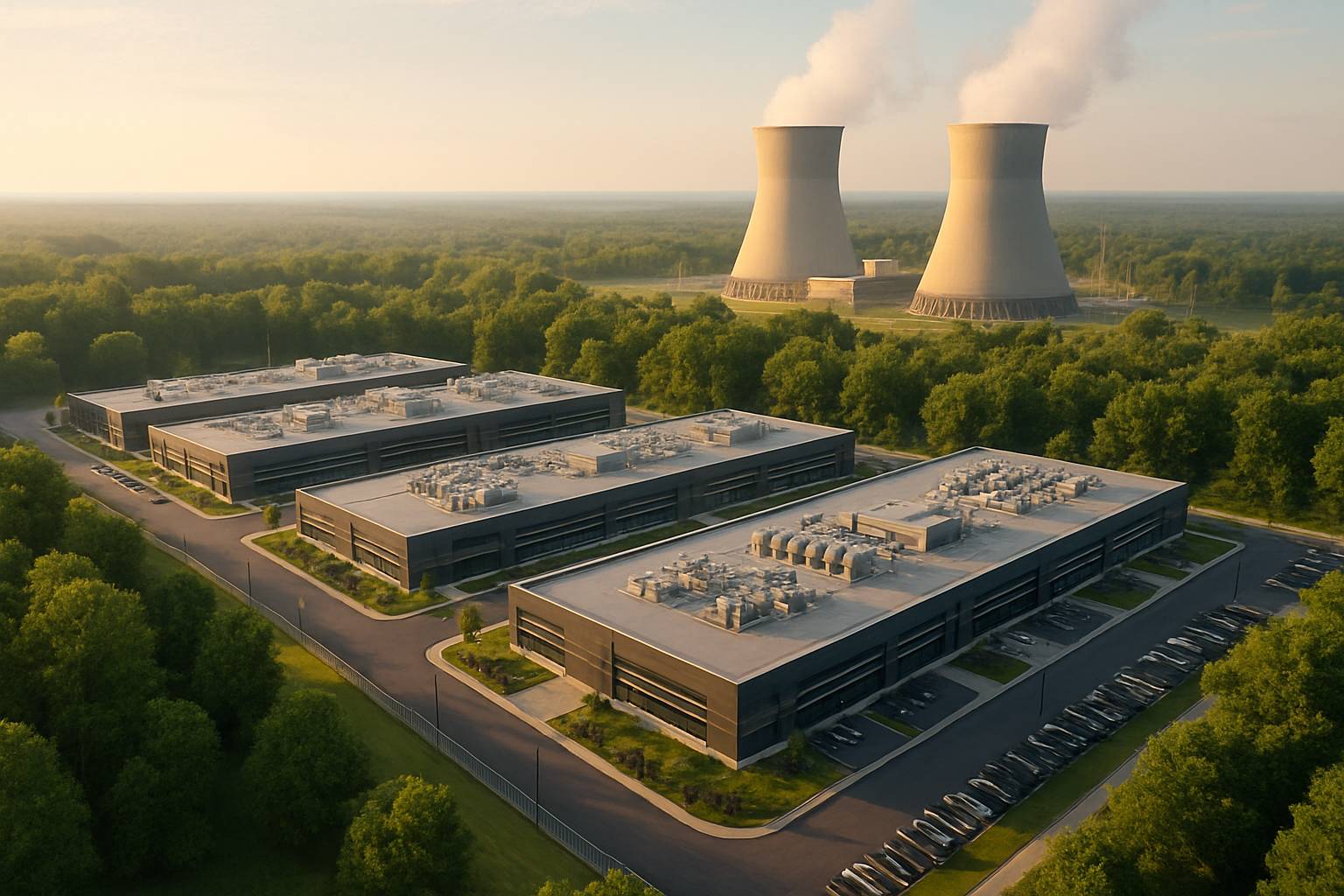
- U.S. data center load: 235 TWh in 2023, IEA data.
- Expected global demand: 945 TWh by 2030, IEA base case.
- Average hyperscaler campus draw: 100–300 MW per site.
- Peak AI training run: 50 MW weeks-long continuous usage.
These statistics confirm relentless growth. In contrast, renewable integration alone cannot fill every hourly gap. Thus, developers examine previously sidelined Nuclear plants for rapid capacity.
Reactivating Dormant Reactors
Constellation plans to restart Three Mile Island Unit 1 by 2028 under a 20-year Microsoft PPA. Furthermore, NextEra targets early 2029 for the Duane Arnold return, backed by Google’s 25-year agreement. Holtec seeks federal support to bring Palisades online, citing similar economics. DOE’s Loan Programs Office already closed a $1.0 billion loan for Three Mile Island. Moreover, conditional guarantees of $1.52 billion cover Holtec’s Michigan project. Developers argue that restart costs, although high, undercut greenfield builds by billions. In contrast, critics question refurbishing aging Infrastructure rather than investing in fresh designs. Nevertheless, the AI Energy Crisis pushes timelines that favor existing sites. Recommissioning uses intact cooling towers, switchyards, and skilled local labor, accelerating deployment. Additionally, Constellation estimates Crane Clean Energy Center will deliver 835 MW of Carbon-free electricity. Google’s Iowa deal unlocks 615 MW, enough to power several mid-sized AI campuses. Therefore, many observers see dormant Nuclear assets as low-hanging fruit amid tight capacity.
Restart projects illustrate a pragmatic path. However, regulatory hurdles still loom large. Next, funding structures determine whether more reactors follow.
Financing Through Long PPAs
Long-term PPAs provide predictable revenue vital for lenders and equity investors. Microsoft’s twenty-year commitment anchors the Crane Clean Energy Center refinancing. Meanwhile, Google’s 25-year contract for Duane Arnold reflects urgency created by the AI Energy Crisis. It also extends beyond typical renewables deals. Therefore, banks view these agreements as quasi-sovereign credit because hyperscalers hold high ratings. Consequently, debt terms tighten, lowering overall restart capital costs. The AI Energy Crisis motivates tech firms to lock capacity before rivals escalate bidding wars. Furthermore, boards accept higher prices per megawatt to guarantee emissions-free supply. Investors also weigh DOE loan guarantees that reduce downside risk. Nevertheless, transparency remains limited because PPA strike prices stay confidential. Ultimately, capital markets now treat Nuclear restarts as Infrastructure plays rather than pure generation bets.
Robust contracts and public loans realign risk. Therefore, finance appears solvable despite the AI Energy Crisis spotlight. Attention now shifts toward local impacts.
Community Concerns And Risks
Local activists remember Three Mile Island’s 1979 partial meltdown vividly. Consequently, trust in Nuclear oversight remains fragile near Harrisburg. Beyond Nuclear and Sierra Club filed petitions demanding deeper environmental review. Additionally, water withdrawal for both cooling and data-center chillers triggers ecological worries. Residents in Iowa raise similar alarms over Duane Arnold’s comeback. Opponents argue that renovated Infrastructure could mask hidden corrosion or outdated safety systems. Moreover, campaigners question whether DOE loans socialize risk while privatizing revenue. Companies answer with transparency pledges, emergency-planning drills, and independent safety audits. They also emphasize Carbon reductions achieved when Nuclear displaces fossil baseload. Nevertheless, the AI Energy Crisis magnifies scrutiny because any failure would ripple across digital commerce.
Public acceptance will decide ultimate timelines. Therefore, project teams must earn sustained community trust. Grid planners simultaneously confront broader system questions.
Future Grid Planning Needs
Regional transmission organizations already flag congestion around major data-center clusters. Therefore, new high-voltage lines must parallel Nuclear restarts to deliver capacity effectively. However, permitting for wires often exceeds reactor refurbishment timelines. Consequently, utilities explore onsite battery storage and flexible demand response. Analysts at Bates White warn that grid-edge Infrastructure upgrades could cost billions. Meanwhile, cloud providers pursue Sustainability metrics that track hourly Carbon intensity, not annual averages. Matching nuclear output with those dashboards requires granular data integration. Furthermore, policymakers debate including advanced reactors and geothermal within clean capacity portfolios. The AI Energy Crisis forces rapid collaboration between regulators, utilities, and hyperscalers. Consequently, stakeholder alignment tops the agenda for upcoming FERC technical conferences.
Comprehensive planning must coordinate generation, wires, and cooling. Nevertheless, execution speed will shape competitive advantage. Professional competencies now become critical.
Certification Pathways For Professionals
Talent shortages threaten on-time delivery of complex energy projects. Engineers, project managers, and policy specialists require cross-disciplinary fluency. Moreover, employers prize credentials that blend data-center operations, Sustainability, and energy procurement. Professionals can enhance expertise via the AI Marketing™ certification. Consequently, teams can translate evolving market drivers like the AI Energy Crisis into actionable strategies. Additionally, continuous education supports rigorous Carbon accounting and transparent reporting. Nevertheless, certifications alone do not replace field experience and regulatory knowledge. Therefore, blended learning and mentorship accelerate workforce readiness.
Upskilled professionals can narrow capability gaps. Consequently, the sector gains resilience against project delays. Finally, strategic alignment must coalesce into decisive action.
Dormant reactors are returning because data-center demand shows no sign of plateauing. Federal loans, long PPAs, and community engagement now form the new nuclear playbook. However, reliability victories will ring hollow without parallel grid and water planning. Sustainability goals also require transparent Carbon accounting and equitable local benefits. The AI Energy Crisis has transformed once-obscure licensing dockets into headline issues. Consequently, professionals who understand policy, finance, and technology can steer outcomes. Explore emerging roles and secure credentials today to help solve the AI Energy Crisis while advancing your career.


