

AI CERTS
3 hours ago
Broadcom share drop: margin warning shakes Nasdaq tech
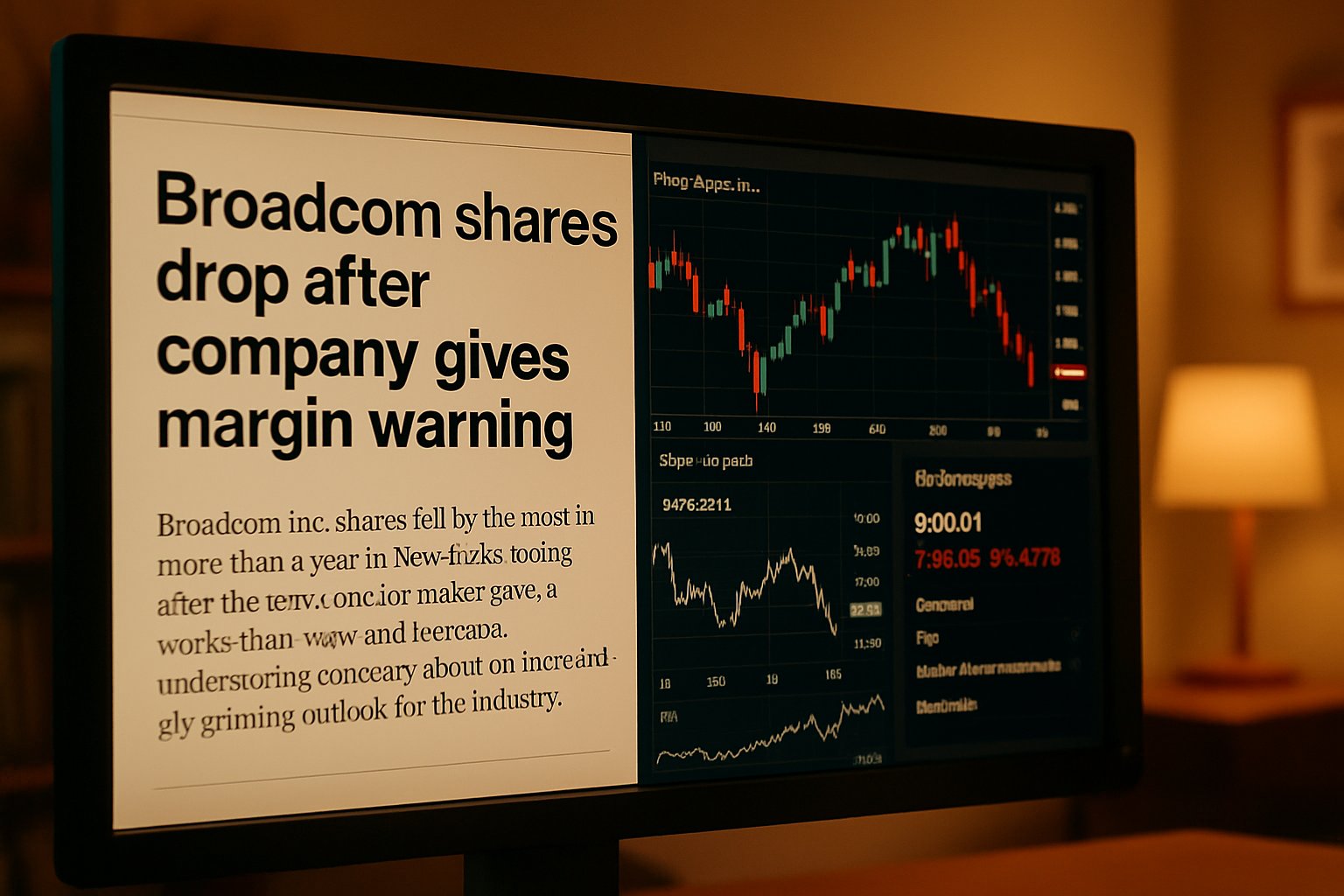
Traders erased tens of billions in market value before lunchtime.
Meanwhile, peers across the Semiconductor complex also retreated as margin fears spread.
This article unpacks the numbers, the reaction, and the consequences for tech investors.
Furthermore, it highlights practical takeaways for finance professionals navigating volatile Nasdaq conditions.
Detailed coverage follows, beginning with the immediate market shock and extending to strategic outlook.
Additionally, readers will find certification resources to strengthen AI infrastructure skills and mitigate similar portfolio risks.
Market data cited herein reflects prices at 11:24 UTC on December thirty, 2025.
Therefore, numbers may vary slightly by publication time, yet directionally the story remains consistent.
Stay with us as we dissect the forces behind this sudden valuation reset.
Market Shock Explained Simply
Broadcom’s earnings release landed after the bell on December eleven.
Initially, futures pointed to modest gains on strong revenue and backlog disclosures.
In contrast, the pre-market tape reversed when management detailed the margin headwind.
Consequently, sellers overwhelmed bids at the open, driving an eight to eleven percent rout.
By midday, quotes printed near $350, compared with $390 twenty-four hours earlier.
That swift move constituted the second-largest single-session decline for 2025 on Nasdaq tech megacaps.
Nevertheless, trading volumes remained orderly, suggesting algorithmic funds absorbed liquidity without flash-crash dynamics.
Institutional desks reported automated sell programs triggered when shares breached the 50-day average.
Subsequently, retail traders followed momentum, amplifying the velocity of the decline.
These facts establish the mechanical contours of the sell-off.
Investors reacted before digesting fine print.
However, earnings details reveal deeper causes, explored next.
Earnings Fuel Investor Anxiety
Quarterly revenue reached $18.015 billion, up twenty-eight percent year over year.
Moreover, AI Semiconductor revenue surged seventy-four percent to roughly $6.5 billion.
CEO Hock Tan called the figures record-breaking during the call.
Yet CFO Kirsten Spears warned consolidated gross margin would fall about 100 basis points sequentially.
Furthermore, the tax rate is set to rise, trimming projected earnings per share.
Analysts modeled margin at sixty-eight percent; guidance implied sixty-seven percent.
In finance, a one-point margin shift can erase billions in discounted cash flow value.
Therefore, traders expedited revisions, pushing option implied volatility to yearly highs.
Importantly, software revenue, which carries higher margin, remained stable but was overshadowed by hardware headlines.
Amid the Broadcom share drop, some funds cited margin math as the decisive trigger.
Strong sales thrilled bulls.
Nevertheless, the margin outlook stoked fresh doubts, leading to our next focus on revenue mix.
Margin Mix Pressure Details
Broadcom designs custom AI accelerators and bundles them into full systems for hyperscalers.
Consequently, hardware integration lowers unit margins versus licensing standalone Semiconductor intellectual property.
In contrast, networking software acquired through VMware often carries seventy-plus percent gross margin.
Spears highlighted the changing mix, noting AI backlog at roughly $73 billion over eighteen months.
Meanwhile, total company backlog totals near $162 billion, underscoring scale but complicating fulfillment optics.
To illustrate margin erosion drivers, consider the following list.
- Custom system assembly adds manufacturing overhead and logistics costs
- Volume discounts demanded by hyperscalers compress pricing power
- Service warranties accompany integrated racks, increasing deferred revenue liabilities
Analysts estimate system solutions carry gross margin roughly fifteen percentage points below chip royalties.
In contrast, enterprise software margins seldom fluctuate more than two points quarter over quarter.
Collectively, these elements equate to roughly a hundred basis points of sequential pressure.
The Broadcom share drop reflects investors repricing that externality into twelve-month earnings forecasts.
Margin dilution appears manageable long term.
However, perception risk lingers, which echoes through the wider sector discussed next.
Broader Sector Ripple Effects
Nasdaq index futures slipped immediately after Broadcom commentary hit the tape.
Moreover, fellow tech giants Nvidia and AMD surrendered early gains.
Cloud operators Alphabet and Meta, heavy AI spenders, also pulled back.
Analysts feared an "AI bubble" narrative, citing stretched Semiconductor valuations across the board.
Consequently, ETF baskets tracking the Semiconductor ecosystem shed over three percent.
Nevertheless, some portfolio managers viewed the move as healthy consolidation within a longer tech uptrend.
Amid the volatile session, headlines repeatedly referenced the Broadcom share drop as a sector proxy.
Cloud service suppliers, substantial buyers of accelerators, reassessed capital spending timelines.
Consequently, supply-chain partners, from substrate makers to testing firms, experienced sympathetic weakness.
Sector tremors stressed correlation risk.
Therefore, analysts next weighed bullish and bearish scenarios.
Analysts Split On Outlook
Bank of America reiterated a Buy rating, citing strong backlog and diversified cash flows.
In contrast, several hedge funds reduced exposure, highlighting limited visibility into margin recovery.
Moreover, some experts argued that the Broadcom share drop offered an attractive entry point.
JPMorgan trimmed 2026 EPS forecasts by three percent but kept price target unchanged.
Meanwhile, implied volatility remained elevated, rewarding disciplined finance practitioners who sell premium.
Goldman Sachs viewed the episode as "noise within a secular AI upgrade cycle."
These diverging opinions underscore the importance of scenario planning.
Opinion diversity fuels price discovery.
Subsequently, investors must scrutinize quantitative indicators discussed in the next section.
Key Metrics In Focus
Professionals tracking Nasdaq names monitor revenue growth, margin trajectory, and backlog burn rates.
Furthermore, cash flow conversion offers insight into finance capacity for continued AI capex.
Analysts also parse product mix to isolate high-margin software from hardware-heavy lines.
Moreover, watch order cancellation rates, which could transform backlog optimism into inventory risk.
Below are headline figures investors should bookmark.
- AI backlog: $73 billion across 18 months
- Total backlog: $162 billion companywide
- Q1 FY2026 revenue guide: $19.1 billion
- Expected gross margin: ~67 percent
Year-on-year free cash flow growth of twenty-four percent also underpins dividend sustainability.
Clearly, these metrics anchor valuation debates.
Consequently, mastery of such data equips professionals against sudden moves like the Broadcom share drop.
Metric literacy builds conviction.
Next we distill actionable strategies.
Strategic Takeaways For Professionals
Risk managers should pre-define tolerance bands for large cap tech holdings given rising event volatility.
Moreover, diversification across Semiconductor subsectors reduces single-name shock exposure.
Pairing option collars with tight stop losses can mitigate damage during a Broadcom share drop scenario.
Professionals can enhance their expertise with the AI Network Security™ certification.
Additionally, continuous education bolsters career resilience amid rapid Nasdaq rotations.
Finance leaders may also adopt scenario matrices, updating cash flow sensitivity with every corporate guidance tweak.
Meanwhile, quantitative funds can hedge through sector rotation models that short correlated ETFs.
Moreover, scenario back-testing across past AVGO drawdowns helps refine exposure caps.
Consequently, such disciplined processes convert uncertainty into repeatable advantage.
The latest Broadcom share drop reinforces that principle across cyclical and secular cycles alike.
Actionable playbooks outlive headlines.
Therefore, we conclude by summarizing core lessons.
The events of December twelve illustrate how quickly sentiment can reverse, even after robust execution.
Broadcom share drop episodes repeat whenever growth outpaces profitability, reminding investors that revenue quality matters.
Nevertheless, the latest Broadcom share drop also showcases management’s formidable positioning within AI infrastructure.
Therefore, disciplined analysis of backlog mix, margin signals, and valuation remains essential for tech stakeholders.
Ultimately, act decisively, keep learning, and leverage certifications to convert volatility into opportunity.
Consequently, readers who act on these insights may convert turbulence into sustained alpha.


