

AI CERTS
2 hours ago
Bridging Enterprise Deployment Maturity Gaps
Meanwhile, vulnerability counts and regulatory pressure grow rapidly. Therefore, organizations require clear roadmaps, reliable Infrastructure, and practical governance if they hope to keep pace. This article unpacks fresh survey Benchmarks, security trends, and governance models guiding leaders through rising open source complexity. Moreover, readers will gain actionable steps and certification resources to close their maturity gaps.
Subsequently, we highlight operational levers that deliver short-term risk reduction and long-term competitive edge. In contrast, ignoring structured governance now invites costly remediation during future audits.
Adoption Outpaces Formal Governance
Open-Source use hits near total saturation, according to 96% adoption recorded by OpenLogic. Nevertheless, only 34% of surveyed firms declared a defined open-source policy. That statistic underscores a yawning governance gulf.
Moreover, just 26% maintain an OSPO to coordinate licenses, contributions, and Infrastructure policy. Large enterprises remain 2.4 times more likely to host an OSPO than small peers. Consequently, maturity increasingly correlates with company scale rather than risk exposure.
Stakeholders also demand premium support; 71% expect sub-12-hour responses when open source failures threaten production. Therefore, operational pressures intensify while governance lags. These statistics set our maturity baseline.
Adoption clearly races ahead of oversight. However, rising security risk is forcing a reckoning. Let us examine those risk indicators now.
Escalating Security Risk Indicators
Sonatype and Black Duck record surging vulnerabilities per codebase across every vertical. In 2025, median flaws grew by double digits, yet patch latency also expanded. Consequently, technical debt balloons and Enterprise Deployment Maturity scores suffer.
Moreover, data quality complicates triage; NVD scoring delays limit actionable prioritization windows. Meanwhile, AI-assisted coding accelerates dependency sprawl, amplifying unseen weaknesses. Therefore, leaders treat SBOM adoption as a foundational control.
- Vulnerabilities per codebase: +18% year over year (Black Duck, 2026)
- Only 59% of firms run automated scans (OpenLogic 2025)
- 75% cite skills gaps as a top barrier to secure architectures
The numbers confirm a widening attack surface. Security failures quickly undermine innovation gains. Next, we explore organizational levers that lift deployment discipline.
OSPO Model Roadmap Explained
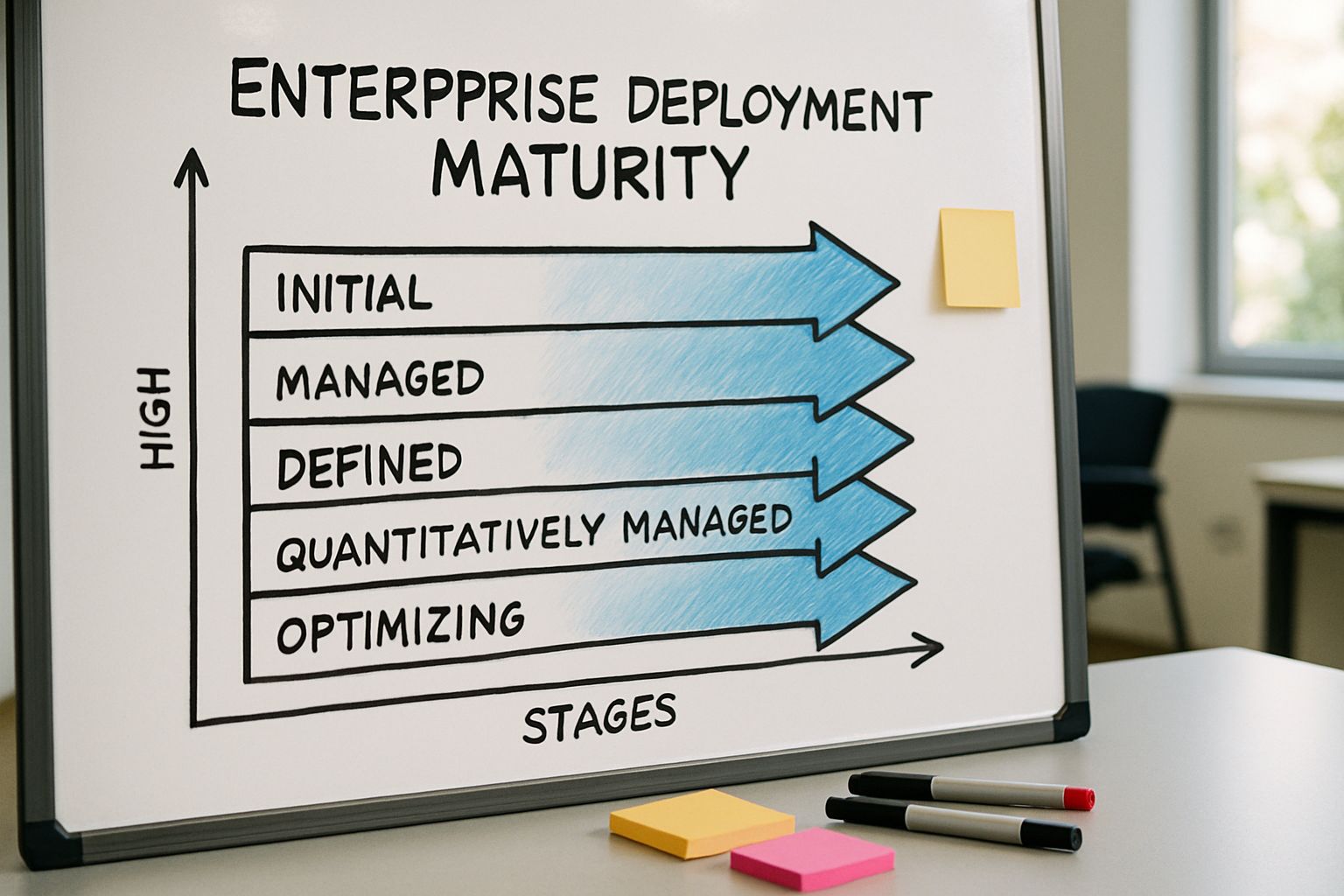
An Open Source Program Office centralizes policy, compliance, and community engagement. Furthermore, the TODO Group maps five maturity stages from ad-hoc to strategic leadership. Progress through those stages directly boosts Enterprise Deployment Maturity.
Stage zero features uncontrolled consumption without governance. In contrast, stage one introduces license compliance and basic vulnerability scanning. Subsequently, stages two and three enable contribution policies, InnerSource adoption, and dependency sponsorship. Finally, stage four embeds OSS decisions into corporate planning and product roadmaps.
Organizations often accelerate progress by assigning executive sponsors and publishing public open-source positions. Consequently, external communities view the company as a trustworthy partner. That perception reduces maintenance friction and improves hiring standards.
OSPO roadmaps offer a structured path. They convert scattered efforts into measurable Enterprise Deployment Maturity. Now, we assess enabling tools and standards.
Essential Tooling And Standards
Automated SCA and SBOM generation anchor modern security Infrastructure. Moreover, OpenSSF’s SLSA framework prescribes provenance controls that harden build pipelines. Organizations mapping these controls against internal metrics gain instant visibility into supply-chain gaps.
Many firms also purchase commercial support for critical open source packages to meet production SLAs. Consequently, developers patch faster and align with enterprise platform standards. Furthermore, security teams integrate vulnerability feeds into chatops, shrinking response cycles.
Professionals can enhance their expertise with the Chief AI Officer™ certification. The curriculum covers risk governance, SBOM policy, and Infrastructure automation across hybrid clouds. Therefore, graduates drive Enterprise Deployment Maturity within cross-functional teams.
Robust tooling and skills accelerate safe adoption. However, leaders still need comparative Benchmarks. Our next section explains measurement frameworks.
Measuring Against Industry Benchmarks
Enterprises increasingly publish scorecards that map controls to external survey Benchmarks. For example, leaders track response time, OSPO staffing, and vulnerability backlog clearance. Consequently, boards gain transparent views into Enterprise Deployment Maturity and risk posture.
OpenLogic and Linux Foundation reports deliver reference points segmented by company size and sector. Additionally, organizations benchmark operations costs, patch cadences, and community contribution rates. Those metrics align closely with Strategy objectives for innovation velocity.
Nevertheless, numbers only help when leaders set public targets and share progress. Therefore, quarterly reviews should include external auditors or community advisors. These practices maintain credibility before regulators and customers.
Metrics translate abstract goals into concrete dashboards. Transparent metrics sustain Enterprise Deployment Maturity momentum. The final section focuses on future Strategy alignment.
Building Future Strategy Alignment
Strategic planning must integrate regulatory forecasts such as the EU Cyber Resilience Act. Moreover, AI driven development will magnify both value and risk. Consequently, roadmaps should tie component selection, license compliance, and Infrastructure automation to product lifecycles.
Leaders can embed governance checkpoints within release planning ceremonies. Additionally, incentive programs for maintainers ensure sustainable Open-Source ecosystems supporting enterprise roadmaps. Meanwhile, cross-functional workshops reinforce shared accountability and boost Enterprise Deployment Maturity culture.
Investment decisions should prioritize components with active communities, clear governance, and reliable indicators. In contrast, unsupported code introduces hidden technical debt. Therefore, supply-chain health metrics belong on executive dashboards next to financial indicators.
Forward looking Strategy embeds governance into product innovation. This integration cements Enterprise Deployment Maturity gains. We conclude with practical next steps.
Open-Source adoption shows no sign of slowing. However, unchecked growth invites security threats, legal exposure, and spiraling technical debt. Leaders who apply structured planning, skilled teams, and automated Infrastructure controls can seize the innovation dividend. Moreover, establishing an OSPO, generating SBOMs, and tracking Benchmarks raise Enterprise Deployment Maturity above industry averages. Consequently, organizations position themselves for upcoming regulations and market scrutiny.
Professionals eager to lead this evolution should pursue the Chief AI Officer™ credential. Take action now and turn governance into a competitive edge. Subsequently, share roadmap milestones publicly to inspire trust among customers, partners, and regulators. Your next quarterly review can demonstrate tangible progress when these steps begin today.


