

AI CERTS
2 months ago
Brain-Inspired Compute Hits Commercial Milestone In 2026
2026 Market Momentum Surge
Investor interest grew steadily during 2025. However, the coming year marks a transition from demos to revenue. BrainChip, Innatera, SynSense, and GrAI Matter Labs all maintain public production schedules. Intel’s Hala Point will stay a research platform, yet its visibility validates Brain-Inspired Compute for large partners. Market studies now forecast neuromorphic revenue topping one billion dollars by late 2026, despite methodology variance. Furthermore, independent labs plan third-party benchmarks that compare spike processors with conventional hardware.
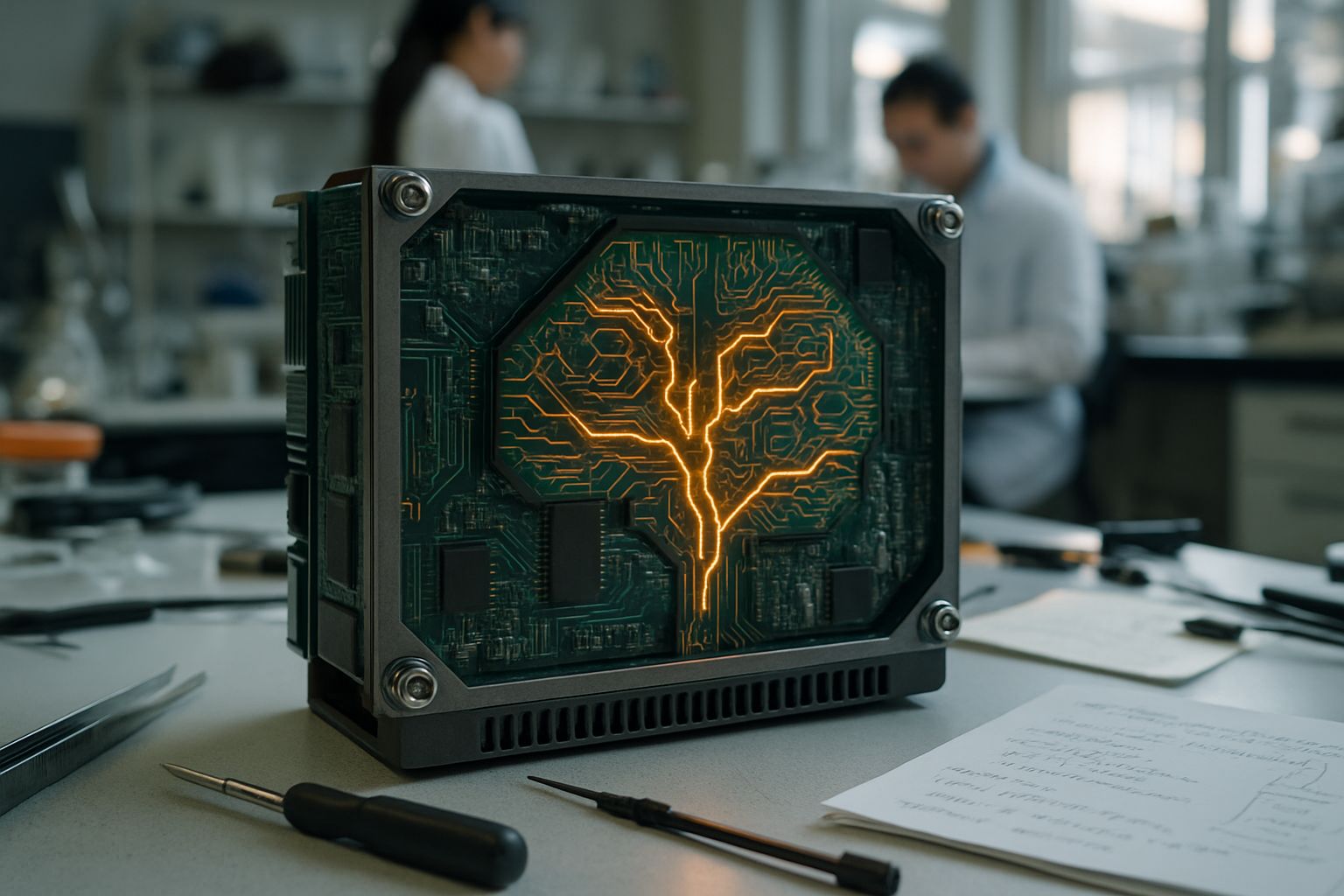
These signals confirm rising demand and confidence. Consequently, stakeholders expect faster design cycles ahead.
Key Product Milestones Ahead
Several launches will shape perception next year. BrainChip sampled the AKD1500 in November 2025. The co-processor delivers 800 GOPS while drawing less than 300 mW. Volume production remains targeted for Q3 2026. Additionally, Innatera plans live customer demonstrations of the Pulsar microcontroller at CES 2026. The device blends SNN cores, RISC-V control, and CNN acceleration, enabling microwatt-class sensing.
SynSense and iniVation continue joint work on vision modules. Moreover, GrAI Matter Labs pursues industrial robotics wins. Each roadmap highlights Brain-Inspired Compute as a catalyst for long-life products. Consequently, OEMs should monitor supply commitments closely.
Chipsets Performance Snapshot Data
- BrainChip AKD1500: 800 GOPS, <300 mW, samples available now.
- Innatera Pulsar: microwatt always-on inference, hybrid architecture.
- Intel Hala Point: 1.15 billion neurons across 1,152 dies; research only.
These specifications illustrate divergent design philosophies. Nevertheless, every vendor emphasises efficiency for mobile and embedded hardware. The milestones also indicate maturing software stacks that once stalled progress.
Collectively, the launches will test market appetite. Meanwhile, analysts will scrutinise shipment volumes.
Technology Fundamentals Explained Clearly
Neuromorphic circuits emulate spiking neural networks. Therefore, computation occurs only when events arrive, reducing idle cycles. Memory sits alongside compute units, removing energy bottlenecks caused by off-chip transfers. Event cameras complement the approach by sending pixel changes rather than full frames. Furthermore, some processors support on-device learning through plasticity rules, letting models adapt without cloud updates.
This paradigm differs radically from dense tensor accelerators. In contrast, Brain-Inspired Compute shines when data streams are sparse and time-structured. Chipsets built for these patterns can outperform general hardware on latency and efficiency. Consequently, developers must rethink algorithms and toolchains.
Understanding these fundamentals helps engineers map suitable workloads. Subsequently, it guides realistic performance targets.
Benefits And Use Cases
Brain-like processors unlock distinct commercial advantages. Moreover, they align with edge privacy concerns.
- Ultra-low power always-on sensing extends battery life in wearables.
- Sub-millisecond reaction times improve drone navigation safety.
- On-device adaptation lowers maintenance costs for industrial monitors.
- Event-driven vision reduces bandwidth in smart surveillance.
These benefits converge on one theme: efficiency without sacrificing responsiveness. Consequently, Brain-Inspired Compute positions itself as the right fit for billions of IoT endpoints. Professionals can enhance their expertise with the Certified AI Expert™ certification.
Power, latency, and autonomy together shape new product categories. Therefore, designers are rethinking form factors around neuromorphic hardware.
Adoption Risks And Bottlenecks
Excitement does not erase challenges. Software immaturity remains the loudest complaint. Furthermore, incompatible toolchains hinder portability across Chipsets. Manufacturing yields also worry investors because novel circuits push process limits. Additionally, certification bodies struggle with adaptive behaviour that defies deterministic testing.
Market analysts caution that Brain-Inspired Compute advantages appear only on particular workloads. In contrast, dense language models still favour GPUs. Nevertheless, targeted deployments will proceed while ecosystem gaps narrow.
These hurdles underscore the need for community standards. Consequently, consortia discussions are intensifying.
Roadmap Beyond Year 2026
After first-wave shipments, vendors plan broader portfolios. BrainChip hints at automotive-grade variants, while Innatera eyes medical sensors. Moreover, Intel continues scaling research arrays to inform future commercial dies. Analysts expect cumulative unit shipments to surpass 50 million by 2028 if production stays on schedule.
Tooling improvements should follow. Consequently, developers may gain Python-level abstractions that hide spike details. Standardisation will also reduce integration bottlenecks. Meanwhile, certification frameworks could clarify safety evidence for adaptive devices.
Continuous learning, energy efficiency, and edge autonomy will likely converge. Therefore, Brain-Inspired Compute could eventually become an invisible default inside smart objects.
These future steps depend on successful 2026 launches. Subsequently, market feedback will refine roadmaps.
Conclusion And Outlook
Neuromorphic engineering spent decades in academia. However, 2026 brings its first genuine commercial verdict. Chipsets from multiple vendors promise orders-of-magnitude efficiency gains. Nevertheless, software gaps and certification questions demand attention.
Professionals should track shipment milestones, benchmark reports, and ecosystem alliances. Moreover, gaining formal credentials strengthens readiness for the coming wave. Explore the Certified AI Expert™ program today and position yourself at the forefront of Brain-Inspired Compute innovation.


