

AI CERTs
2 hours ago
Boston Dynamics Boosts Humanoid Robot Manufacturing
Boston Dynamics has crossed a pivotal threshold. At CES 2026, the company announced that Atlas is rolling off assembly fixtures. Consequently, the spotlight now shines on Humanoid Robot Manufacturing as an industrial reality. Industry veterans view the move as the first credible shift from demos to scaled deployments. Furthermore, early production slots are already spoken for by Hyundai and Google DeepMind. This article unpacks the milestones, partnerships, market outlook, and unanswered questions facing Atlas. Moreover, we assess what the transition means for factories planning 2028 Deployment roadmaps. General Purpose Robotics ambitions lurk behind every announcement, promising versatile machines for human spaces. However, cost, safety, and integration hurdles remain unresolved. Therefore, decision-makers must separate marketing gloss from operational evidence.
Atlas Production Milestones Today
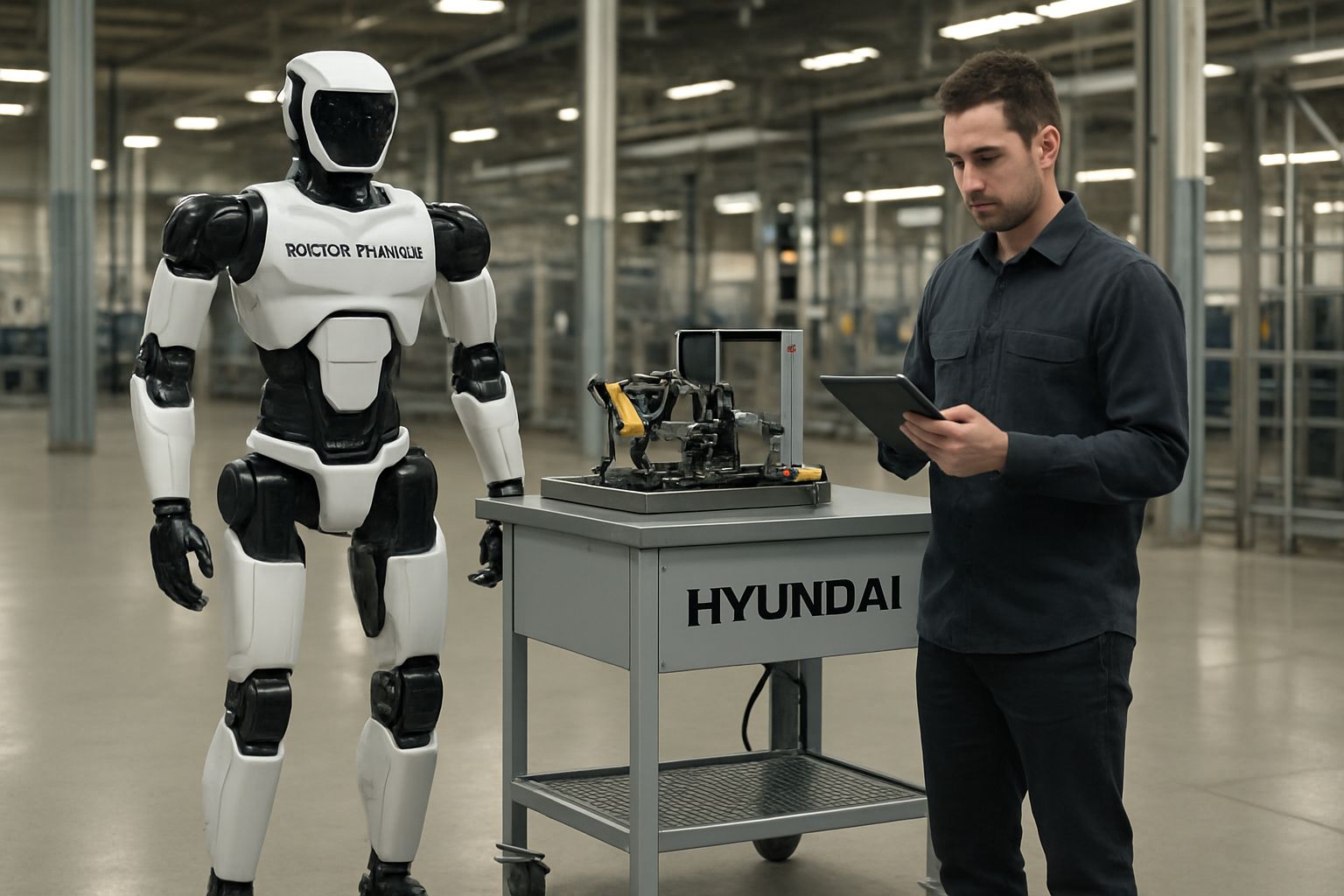
Atlas left the research lab and entered the assembly hall on January 5, 2026. Subsequently, Boston Dynamics confirmed immediate production at its Boston headquarters. All 2026 units are earmarked for Hyundai RMAC and Google DeepMind pilot programs. Hyundai Factory executives praised the timeline during CES stage remarks. Robert Playter called Atlas "the best robot we have ever built." The step marks a tangible victory for Humanoid Robot Manufacturing beyond concept videos.
- 56 degrees of freedom and 50-kilogram payload
- Operating range −20° to 40° Celsius
- Autonomous battery-swap for continuous operation
- High water resistance for outdoor tasks
- Four hours runtime per pack
These milestones validate Atlas as a commercial product rather than a perpetual prototype. However, production volume remains a guarded figure, steering scrutiny toward manufacturing scalability. Next, we examine the assembly process itself.
Inside The Boston Line
Inside Boston, engineers redesigned Atlas for manufacturability, dropping unique parts by half. Additionally, Hyundai Mobis supplies automotive-grade actuators that fit existing supply logistics. Consequently, component lead times align with Hyundai Factory norms. Each robot features 56 degrees of freedom, a 50-kilogram payload, and autonomous battery swap. Meanwhile, the production cell supports four hours of run-in testing per unit. Humanoid Robot Manufacturing thus adopts automotive takt-time thinking. Nevertheless, Boston Dynamics has not disclosed yield percentages or units per shift. Such data will determine capital payback for versatile robotics customers. Current transparency stops at design wins and headline specs. Therefore, supply chain clarity becomes the next investigative focal point. Hyundai’s wider strategy offers that perspective.
Hyundai Supply Chain Strategy
Hyundai outlined a Physical AI roadmap that hinges on a United States robotics plant. The group targets 30,000 Atlas units annually by 2028 Deployment capacity. Moreover, the Hyundai Factory blueprint leverages automotive stamping, painting, and MES systems already proven. Consequently, analysts expect cost curves to mirror electric vehicle battery pack declines. General Purpose Robotics benefits because common parts can feed multiple humanoid models over time. Yet, unit pricing remains opaque, with estimates hovering in the high-six-figure range. In contrast, Boston’s Spot robot sells for $74,500, underscoring the premium. Hyundai pledges scale, but price disclosures will test investor patience. Next, attention shifts to software intelligence that makes hardware valuable.
DeepMind Powers Robot Intelligence
Google DeepMind joins the program to embed foundation models handling perception, planning, and action. Furthermore, Carolina Parada promised "the world’s most advanced robot foundation model" during CES. Such AI aims to enable General Purpose Robotics customization through fleet learning. Consequently, Atlas could learn new factory tasks overnight without custom scripting. Humanoid Robot Manufacturing therefore depends on data pipelines as much as torque curves. Nevertheless, safety validation and regulatory audits must verify every autonomous routine. Subsequently, MES and WMS integrations will unlock value through real-time job assignments. AI progress unlocks dexterity, yet governance frameworks must keep pace. We now examine market economics shaping adoption speeds.
Market Forecasts And Economics
Research houses disagree on near-term sizing. MarketsandMarkets projects a $15.26 billion humanoid market by 2030, with 39% CAGR. For investors, Humanoid Robot Manufacturing represents both high risk and outsized optionality. In contrast, Grand View foresees $4-7 billion, implying a 17-26% CAGR. Moreover, variance reflects uncertainty around Humanoid Robot Manufacturing costs and volumes. Analysts nonetheless benchmark against Hyundai Factory’s 30,000-unit aspiration. Consequently, ROI calculations assume price drops as learning curves compound. Boston Dynamics refuses to disclose MSRP, fueling speculative spreadsheets.
- Labor shortages in logistics and automotive assembly
- Desire for flexible automation amid product mix volatility
- Rapid AI advances lowering programming barriers
- Corporate sustainability goals favoring electric robots over hydraulics
These drivers push executives toward pilots despite lingering financial opacity. However, skepticism persists until field data confirms uptime, throughput, and payback. Risks warrant their own assessment.
Risks And Open Questions
Every breakthrough invites scrutiny. McKinsey panelists warned that use cases, not demos, define success. Subsequently, safety regulators may require new certifications for fenceless collaboration. Moreover, labor groups question workforce displacement ahead of 2028 Deployment milestones. Humanoid Robot Manufacturing still lacks standardized metrics for mean cycles between failure. Nevertheless, Boston Dynamics claims water resistance and cold-weather tolerance from −20° to 40° Celsius. Pricing, warranty terms, and support SLAs also remain unpublished. Consequently, some factories wait for second-generation cost curves. Risks underscore the gap between prototypes and profitable fleets. Next, the timeline toward mass rollout continues to compress. Finally, we map the road ahead.
Roadmap Toward 2028 Deployment
Boston Dynamics plans rolling releases, shipping limited volumes through 2027. Meanwhile, Hyundai Factory construction will begin later this year according to filings. General Purpose Robotics testbeds at Hyundai’s Metaplant will handle sequencing tasks first. Subsequently, Atlas could expand into palletizing, inspection, and end-of-line rework. Humanoid Robot Manufacturing viability hinges on this staged learning curve. Industry watchers expect software updates every quarter, delivered over-the-air. Therefore, early adopters may gain capabilities without hardware swaps. Professionals can enhance their expertise with the AI Writer™ certification. Consequently, teams stay current on the language driving robotics communications. Stakeholders betting on Humanoid Robot Manufacturing expect cost parity with cobots within five years. Roadmaps reveal incremental scaling, yet require disciplined execution. Therefore, stakeholders must track each milestone closely.
Atlas entering production reshapes industrial conversations. Moreover, partnerships with Hyundai and DeepMind accelerate hardware and software maturation. Market forecasts remain divergent, reflecting price and volume unknowns. Nevertheless, Humanoid Robot Manufacturing has advanced further than many skeptics predicted. Future validation will come from 2028 Deployment metrics inside Savannah’s Metaplant. Continuous software updates will define the eventual cost curve. Consequently, leaders should monitor pilot KPIs and pursue skill enhancement now. Explore relevant training, including the earlier linked AI Writer™ credential, and stay ahead. The next three years will determine whether Atlas legitimizes this emerging automation frontier.


