

AI CERTs
4 weeks ago
Biological AI Computing: Lab-Grown Neurons Beat DOOM
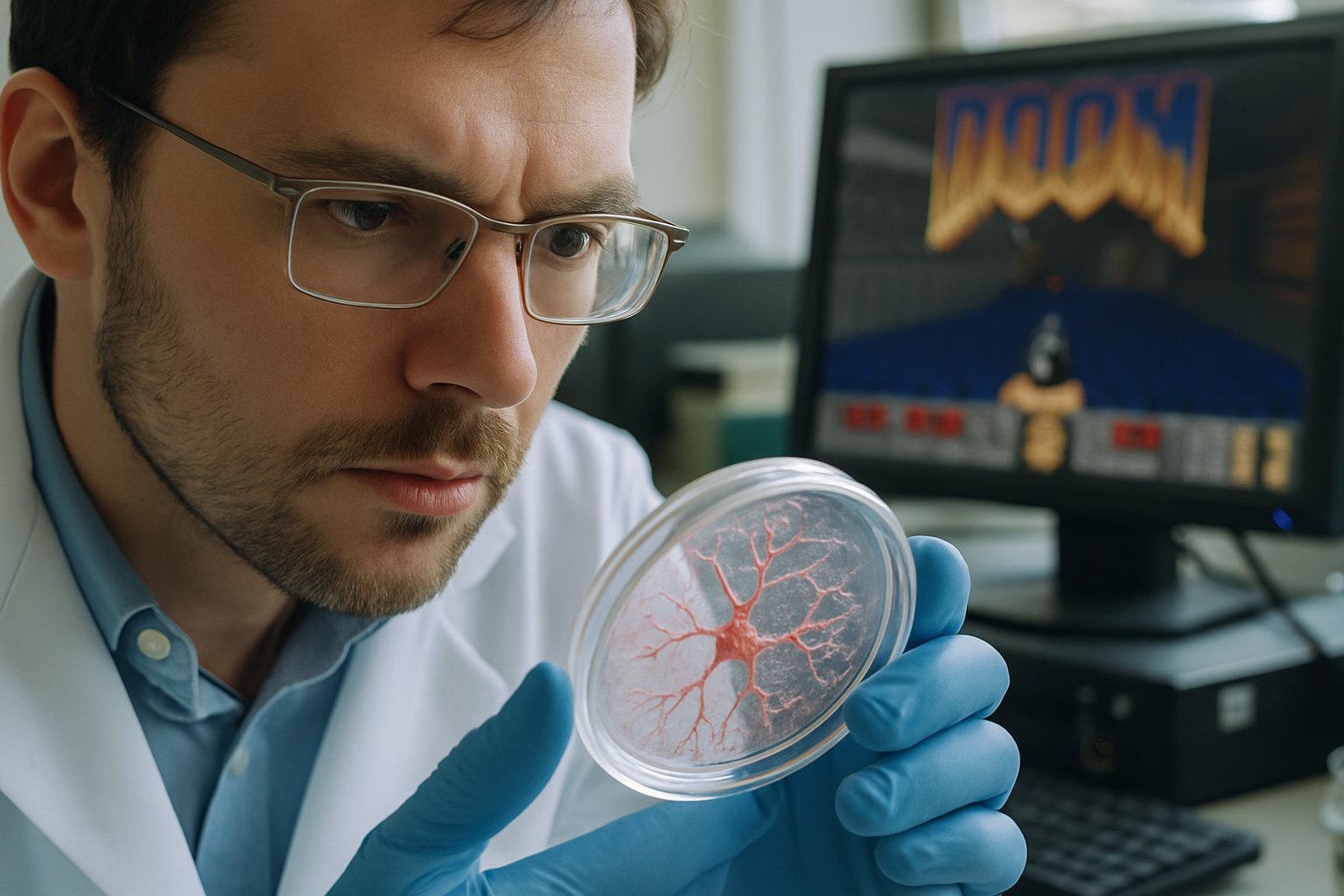
The doom-playing neurons video shocked many observers in late February 2026. Consequently, the clip showcased a bold stride for Biological AI Computing. Cortical Labs revealed that 200,000 living neurons controlled tasks inside the 1993 shooter. Moreover, the CL1 device translated game pixels into electrical sensations and interpreted spike trains as actions. Meanwhile, an open-source project named “doom-neuron” managed the reinforcement learning loop. Therefore, researchers saw a tangible leap beyond the 2022 DishBrain Pong milestone. However, performance remained far below human skill, highlighting both promise and limitation. In contrast, traditional silicon hardware learns the same game through billions of simulated neurons. The demonstration still advanced hybrid experimentation at the bleeding edge of Neuro-Engineering. Subsequently, investors and ethicists alike scrambled to assess ramifications across emerging markets.
Biological AI Computing Demo
Firstly, Cortical Labs streamed its DOOM session through a dedicated cloud dashboard. The company wired the game engine to the CL1 through WebSocket APIs. Additionally, independent coder Sean Cole published full training scripts to GitHub. Nevertheless, the neurons needed nearly seven days before exceeding random shooting behavior. Consequently, Tom’s Hardware reported a kill ratio roughly twice baseline chance.
- Neuron count engaged: 200,000
- Training duration: nearly 7 days
- Power draw: less than 1 W
- Stimulation channels: 48
- Recording channels: 12
Experts considered that statistic modest yet meaningful because living cells processed every decision. Moreover, spike recordings showed adaptive activity clusters similar to short-term plasticity traces observed in DishBrain. In contrast, no evidence suggested consciousness or advanced cognition. The demo underscored Biological AI Computing once again as an experimental tool rather than sentient entity.
These findings validate closed-loop learning inside cultured tissue. However, deeper inspection of the hardware clarifies remaining hurdles.
Hardware Platform Key Details
The CL1 houses a high-density multi-electrode array under sterile microfluidic channels. Moreover, perfusion pumps supply nutrients, keeping Silicon Neurons alive for months. Therefore, researchers can address each electrode independently for stimulation or recording. Meanwhile, the board connects to Cortical Cloud through encrypted USB-C gateways. In contrast, earlier DishBrain rigs required on-site electrophysiology benches. Additionally, CL1 firmware supports tick rates from 10 Hz to 250 Hz, matching game loop demands. The configured demo mapped 48 stimulation channels to sensory input and 12 recording channels to actions. Consequently, the hybrid stack consumed less than one watt, dwarfing GPU power budgets. Such efficiency fuels enthusiasm for Biological AI Computing in embedded robotics.
The hardware merges living tissue with digital buses in one shippable box. Subsequently, attention shifted toward the software stack driving adaptation.
Training Loop Deep Dive
The open-source “doom-neuron” project implements an encoder-policy-decoder scheme. Furthermore, a Proximal Policy Optimization algorithm tunes encoder and decoder weights. However, the biological policy remains non-differentiable, forcing reward pulses to guide synaptic plasticity. Meanwhile, observations convert into amplitude-modulated stimulation bursts across Silicon Neurons. The spikes feed into a temporal decoder that outputs move, turn, or shoot commands. Consequently, the PPO loop updates after each episode, reinforcing successful neuronal patterns. Researchers froze encoder weights during ablations to confirm learning occurred within the tissue itself. Moreover, the weeklong curve revealed gradual accuracy gains that plateaued around episode 5000. This workflow illustrates Biological AI Computing interfacing smoothly with mainstream reinforcement libraries.
The algorithmic scaffolding remains familiar to machine-learning engineers. Nevertheless, market observers want proof that the model scales commercially.
Broader Market Reaction Overview
Investors responded swiftly after the demo circulated on social platforms. Moreover, several robotics startups contacted Cortical Labs regarding pilot access. TechRadar highlighted rental pricing lower than some gaming consoles for weekly sessions. Nevertheless, some venture analysts feared high culture maintenance costs could limit adoption. In contrast, pharmaceutical firms saw opportunity for drug screening using similar closed-loop assays. Additionally, academic laboratories praised the simple REST API, which hides complex electrophysiology plumbing. Consequently, Biological AI Computing captured headlines across both biotech and gaming outlets. The excitement, however, came with tempered expectations about real labor displacement. Ethicists simultaneously urged regulators to convene workshops before broader deployment.
Public enthusiasm remains balanced by caution. Therefore, commercial forecasts rely on clear revenue stories.
Commercial Implications Take Shape
Cortical Labs lists the CL1 at roughly thirty-five thousand US dollars. Furthermore, a cloud tier permits hourly access without owning wet-ware hardware. Enterprises exploring Silicon Neurons appreciate the low upfront capital requirement. Meanwhile, power consumption sits near 1 W, slashing operating costs compared with GPU clusters. Consequently, edge devices that need adaptive control could benefit from Biological AI Computing architectures. However, culture longevity presently caps continuous use at several months before replacement. Additionally, unit throughput remains low; each CL1 handles single tasks sequentially. Nevertheless, Cortical Labs hints at parallel racks containing dozens of dishes for scale. Professionals can enhance their expertise with the AI Researcher™ certification to navigate this hybrid market.
Economic viability hinges on scaling culture production and uptime. In contrast, ethics debates may slow that scaling.
Persistent Ethical Questions Loom
Bioethicists question donor consent, dignity, and possible emergent sentience. Moreover, the DOOM demo reignited debate started by the 2022 DishBrain study. Consequently, commentators ask whether game enjoyment implies disrespect toward human cells. Cortical Labs asserts no higher cognition exists within these networks. Nevertheless, calls for independent oversight panels are growing inside Neuro-Engineering circles. Additionally, regulators may impose disclosure rules about cell origin and experimental stimuli. In contrast, some researchers argue that these cultures parallel organoids already used in disease modeling. Meanwhile, practical guidelines remain scattered across jurisdictions. A unified framework could shield Biological AI Computing from reputational harm while enabling responsible innovation.
Ethical clarity will influence investor confidence. Subsequently, attention turns toward upcoming scientific publications.
Likely Future Research Paths
Researchers plan richer 3D environments and multi-task sessions to probe generalization. Furthermore, electrode densities may double, granting finer stimulus resolution to Silicon Neurons. Meanwhile, machine-learning teams explore curriculum schedules that mimic early childhood development. Consequently, collaboration between wet-lab and software talent becomes essential. Moreover, expanded datasets could let Neuro-Engineering teams benchmark living networks against recurrent neural models. Nevertheless, data reproducibility demands open release of raw spike matrices and stimulation logs. Therefore, journals might require preregistered protocols before accepting future articles. The roadmap ultimately envisions portable co-processors powered by Biological AI Computing inside autonomous systems. Such visions remain speculative until cost, ethics, and reliability align.
Roadmaps show both excitement and caution. Finally, industry stakeholders must weigh next moves carefully.
Conclusion
The Doom experiment illustrates a pivotal moment where wetware meets code. Moreover, living circuits now interact with complex 3D tasks under controlled reinforcement schemes. Nevertheless, commercialization demands hardware reliability, culture scalability, and transparent ethics. Biological AI Computing promises unmatched power efficiency and adaptive capabilities if those hurdles fall. Consequently, professionals who grasp both electrophysiology and machine learning will lead future teams. Additionally, credentials like the linked AI Researcher™ certification can strengthen that interdisciplinary profile. Therefore, readers should track upcoming peer-reviewed papers and regulatory hearings. Engage now, and shape how humanity integrates conscious-less yet learning tissue into tomorrow’s devices.


