

AI CERTs
3 months ago
Autonomous Workflow Repair Systems Cut Downtime, Boost Resilience
Every minute of digital downtime drains revenue and reputation. Industry surveys peg hourly losses at hundreds of thousands, sometimes millions. Consequently, operations leaders hunt for faster, smarter remediation. Autonomous Workflow Repair Systems have moved from theory to boardroom budgets. These agent driven platforms detect incidents, diagnose root causes, and act within seconds. Moreover, early adopters report sharply lower mean time to repair. This article examines the market, technology, risks, and next steps. It highlights why Autonomous Workflow Repair Systems now sit atop strategic roadmaps. Furthermore, we assess vendor claims against independent data. Finally, readers receive a practical adoption checklist. In contrast to past rule based automation, new agentic models learn and adapt. Therefore, understanding their power and pitfalls is essential before production rollout.
Adoption Market Forces Trends
Cloud scale, microservices drift, and talent shortages pressure operations. Therefore, enterprises crave tools that close detection and response gaps automatically. Recent vendor launches intensified focus on Autonomous Workflow Repair Systems across IT teams. PagerDuty, BigPanda, and Dynatrace each announced agent suites within twelve months.
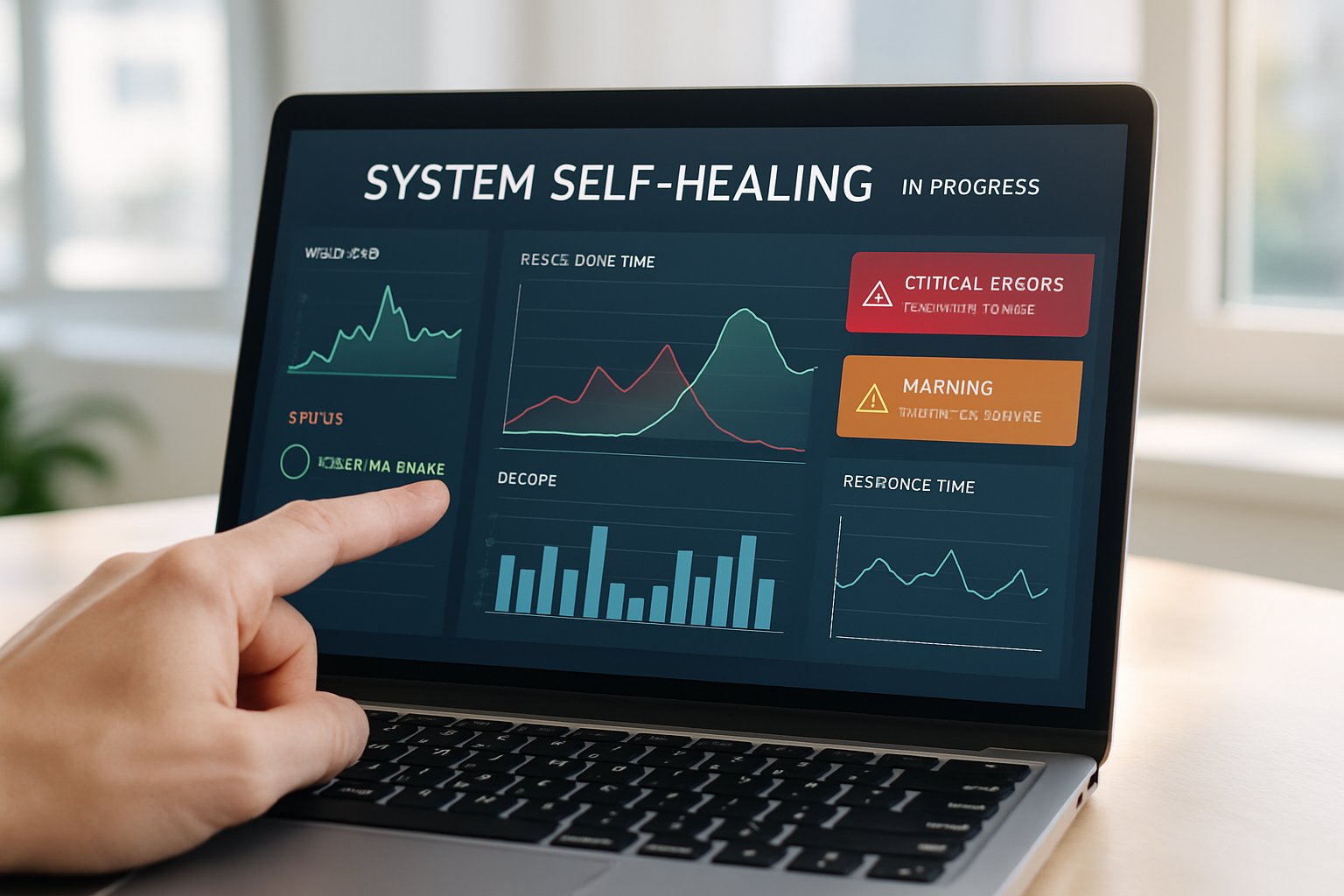
Moreover, mergers such as Palo Alto Networks acquiring Chronosphere signal consolidation around ops resilience AI. Market researchers estimate AIOps spending will grow beyond USD 30 billion by 2028. Consequently, budget holders view self acting remediation as a strategic differentiator.
- Uptime Institute found 54% of recent outages exceeded $100k in costs.
- ITIC reported 16% of respondents suffered losses above $1M per hour.
These dollar figures amplify the adoption case. However, technology design must support scale and trust, a topic we explore next.
Technology Under The Hood
Autonomous engines combine telemetry ingestion, causal correlation, and policy governed execution. Additionally, retrieval augmented large language models produce context rich runbook steps. Komodor’s system self-healing feature reverts bad Kubernetes deployments without operator clicks. Meanwhile, cloud providers supply orchestration primitives that agents call through secured identities.
Architecture usually follows three stages.
- Detect anomalies through logs, metrics, and traces.
- Diagnose root cause using correlation graphs and language models.
- Remediate by executing scripts, scaling resources, or rolling back versions.
Governance layers approve or reject actions when risk exceeds thresholds. Therefore, ops resilience AI depends not only on algorithms but also strong policy engines. Autonomous Workflow Repair Systems embed audit trails for later compliance reviews.
Technical depth drives capability yet raises new safety questions. Consequently, understanding the vendor landscape becomes vital.
Key Vendor Landscape Snapshot
BigPanda positions agentic detection and response for general availability in 2025. Fred Koopmans claims the approach reimagines level one operations entirely. PagerDuty touts up to fifty percent faster incident resolution from its AI agents.
Komodor markets Kubernetes focused system self-healing with optional human approval. Dynatrace deepened AWS integrations, promising autonomous troubleshooting tied to topology maps. Moreover, traditional players like BMC and ServiceNow add generative capabilities to existing runbook tools.
Analysts such as Gartner expect multiple entrants to emphasize ops resilience AI features soon. Nevertheless, independent benchmarks like MicroRemed show full automation remains challenging in complex microservices. Autonomous Workflow Repair Systems must therefore prove reliability across diverse stacks.
Vendor breadth offers choice but complicates evaluation. In the next section, we examine measurable business impact.
Critical Business Impact Metrics
Most buyers track mean time to detect and repair as north star metrics. Early BigPanda users cite thirty percent MTTR gains. PagerDuty customers report up to fifty percent faster incident closures.
Cost avoidance follows performance. Furthermore, every minute saved can protect six figure revenue streams for digital retailers. Uptime Institute confirms major outages increasingly exceed $100k.
Autonomous Workflow Repair Systems also reduce alert fatigue by correlating events. Consequently, engineers reclaim time for innovation, improving morale and retention. Ops resilience AI metrics now appear in quarterly board reports at several enterprises.
Improvements look compelling but hinge on careful risk management. Therefore, governance deserves equal scrutiny.
Risks And Governance Controls
Automation that writes into production increases blast radius if misconfigured. Azure Automation’s 2025 privilege escalation advisory illustrates potential exposure. Moreover, LLM hallucinations can generate harmful commands without strong validation.
Security teams recommend least privilege, credential rotation, and segmented automation identities. Additionally, many firms tier remediations into auto, approval, and recommend-only categories. Autonomous Workflow Repair Systems should log every action with human readable context.
Governance frameworks align agents with compliance mandates. In contrast, unchecked automation risks fines and brand damage. System self-healing must never override legal data retention rules.
These safeguards mitigate core concerns while preserving speed. Next, we outline practical rollout guidance.
Practical Implementation Best Practices
Successful teams start small. They target noisy, low impact runbooks for initial automation. Subsequently, metrics like false remediation rate guide expansion.
Invest early in observability. Complete telemetry enables accurate diagnoses for ops resilience AI engines. Meanwhile, maintain clear service level objectives to measure progress.
Professionals can upskill through the AI Sales™ certification. Consequently, organizations gain internal champions for Autonomous Workflow Repair Systems projects.
Key checklist items include:
- Define human-in-the-loop thresholds before enabling write privileges.
- Audit automation actions daily during pilots.
- Create rollback plans for every remediation script.
Following these steps builds trust and momentum. Finally, we explore what comes next.
Future Outlook And Steps
Market signals show acceleration. Analysts forecast double digit AIOps growth over five years. Meanwhile, research benchmarks push vendors toward transparent performance reporting.
Expect broader integration between security automation and system self-healing for unified governance. Moreover, cloud providers will embed native Autonomous Workflow Repair Systems into managed stacks. Nevertheless, independent validation will remain necessary to separate hype from durable value.
Adoption pace appears strong yet measured. Consequently, decision makers should prepare structured evaluations now.
Autonomous Workflow Repair Systems are reshaping digital operations economics. Nevertheless, risks around security, correctness, and governance require disciplined action. Start with low risk automation, strengthen observability, and document every agent decision. Moreover, cultivate cross functional trust through transparent metrics and clear escalation paths. Business leaders should benchmark savings against outage cost baselines to prove value. Professionals wanting deeper expertise should pursue certifications and join emerging practitioner forums. Take the next step and evaluate pilot candidates this quarter.


