

AI CERTs
2 months ago
Autonomous supply chain negotiation agents transform procurement
Procurement leaders face relentless cost, risk, and talent pressures. Meanwhile, digital transformation budgets remain under scrutiny. Therefore, fresh automation options receive immediate executive attention. Within that context, autonomous supply chain negotiation agents have moved from pilot to board agenda. Vendors claim minutes-long deal cycles and measurable savings. Moreover, early adopter surveys signal near universal intent to deploy these agents during 2025. This article unpacks the technology, market data, benefits, and governance steps for U.S. enterprises. Actionable takeaways conclude each section. Readers will also find links to professional certification resources that deepen responsible AI expertise. Consequently, teams can accelerate adoption without sacrificing oversight.
Market momentum surge
Analyst data confirms surging demand. Fortune Business Insights pegs procurement software at roughly $8 billion today, doubling by 2032. Furthermore, a ProcureCon survey found 90% of leaders plan to implement AI agents this year. Coupa, Pactum, and Zycus have intensified marketing, funding, and product releases to capture that interest. Consequently, autonomous supply chain negotiation agents now headline most North American procurement events. These numbers suggest a tipping point.
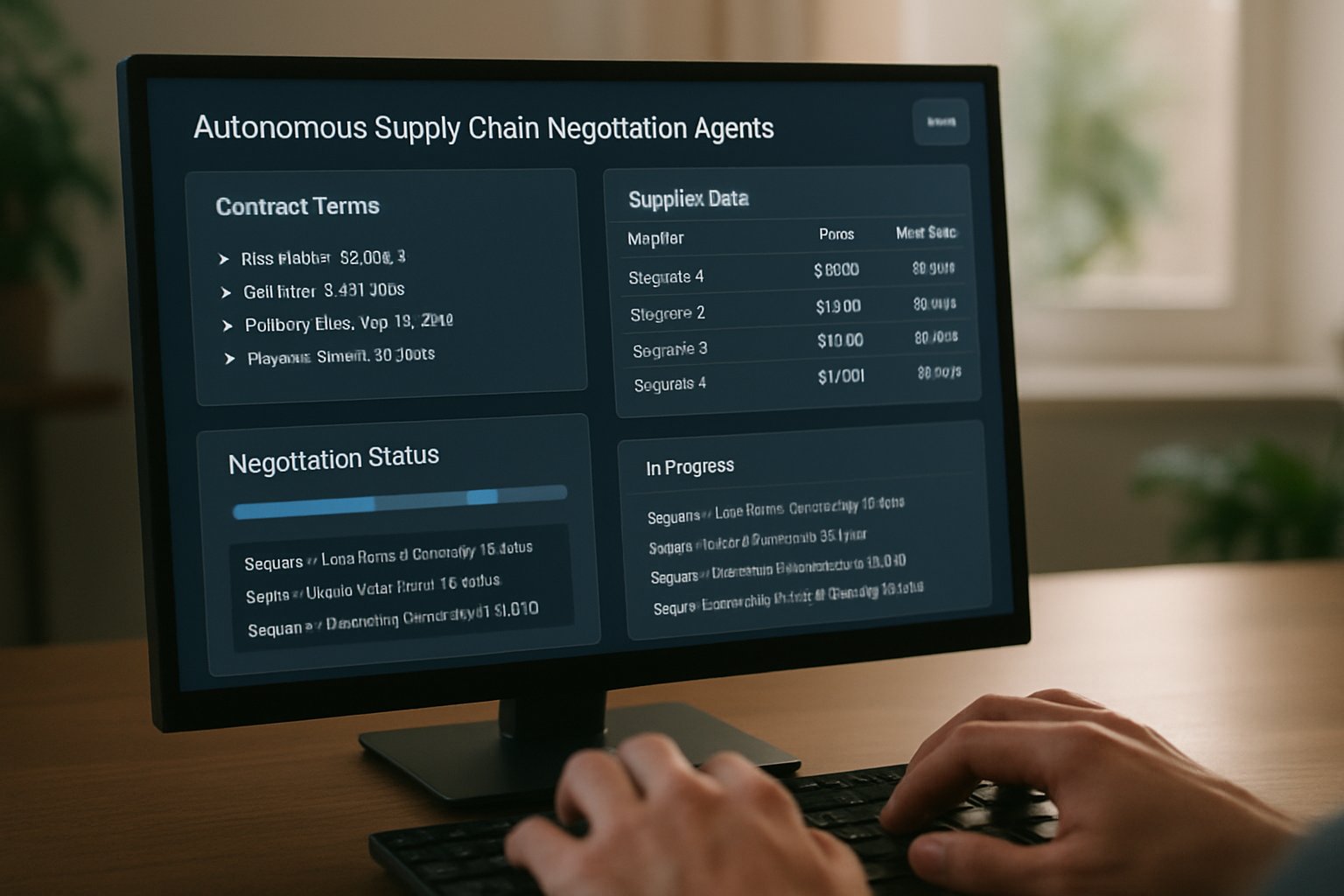
Adoption intent is undeniable. However, understanding the underlying technology remains essential before budgets shift. The following section explains the mechanisms behind the agents.
Technology explained briefly
The core architecture blends large language models with rule-based decision engines. Additionally, the agent hooks into ERP, CLM, and supplier portals through secure APIs. A spend playbook defines allowable concessions, escalation thresholds, and win conditions. During live sessions, autonomous supply chain negotiation agents propose terms, evaluate counters, and iterate until targets meet. In some pilots, buyer and supplier bots converse directly, forming agent-to-agent negotiations. Moreover, continuous market feeds can trigger dynamic repricing without manual involvement. Such capabilities require pristine transactional data and robust authentication layers.
Clean data remains the main technical barrier. Nevertheless, once integrated, performance scales almost linearly. Next, we examine how these mechanics change procurement strategy.
Strategic shifts emerging
Enterprises are reallocating human buyers toward category strategy and supplier innovation. Meanwhile, autonomous supply chain negotiation agents tackle mid-tail and tail spend that once languished. Consequently, coverage expands from hundreds to thousands of annual negotiations. AI sourcing analytics feed the agents with benchmark prices and risk signals.
Continuous renegotiation further disrupts calendar-based sourcing cycles. In contrast, price lists can update weekly under the new model. Therefore, inventory managers gain fresher cost data, supporting margin control. Contract optimization goals also shift, emphasizing clause standardization so agents can auto-populate agreements. Strategic roles thus focus on value engineering and supplier diversity. Subsequently, KPIs pivot to agent throughput and realized savings per minute. The next section quantifies those benefits.
Benefits and metrics
Vendor case studies illuminate tangible performance lifts. Pactum reports that autonomous supply chain negotiation agents closed 64% of supplier outreaches for Walmart. Additionally, those autonomous supply chain negotiation agents completed each negotiation in under four minutes on average. Moreover, average savings ranged between 1.5% and 3% on negotiated spend. McKinsey estimates twenty-percent efficiency gains when transactional workloads shift to automation. Executives also highlight soft benefits such as faster compliance checks and improved audit trails.
- Cycle times dropping from weeks to minutes.
- 2-7% incremental savings on under-managed categories.
- Thousands of concurrent negotiations without headcount increases.
These statistics are vendor-reported, yet they illustrate early momentum. Therefore, boards feel confident approving larger rollouts. Benefits span cost, speed, and governance. However, risks demand equal scrutiny. Governance challenges occupy the following section.
Risks and governance
Automation without oversight introduces new exposures. OECD guidance stresses transparency, auditability, and human control for public procurement use. Similarly, antitrust experts warn that algorithmic collusion may surface if multiple parties deploy opaque agents. Nevertheless, most vendors embed escalation thresholds and immutable logs for every message. Enterprises must verify that autonomous supply chain negotiation agents follow approved financial and ethical boundaries. Moreover, data quality failures can cause mis-optimization at scale. Therefore, robust integration testing and periodic model audits become critical. Professionals can strengthen governance skills through the AI Ethics Professional™ certification program.
Informed oversight mitigates most risks. Consequently, enterprises should embed compliance reviews into every deployment phase. Implementation guidance appears in the next section.
Adoption roadmap guide
Successful pilots start small and focused. Most teams select indirect categories with high transaction volume and limited strategic importance. First, clean master data and sync playbooks with legal and finance stakeholders. Subsequently, deploy autonomous supply chain negotiation agents against a subset of suppliers to validate assumptions. Measure cycle times, acceptance rates, and AI sourcing savings weekly. If thresholds meet expectations, scale the same autonomous supply chain negotiation agents to adjacent categories. Additionally, feed contract optimization templates into the CLM to streamline award finalization. Keep finance, IT, and compliance teams in the steering committee.
Iterative rollouts reduce disruption risk. Consequently, credibility grows with every successful sprint. We now look toward future developments.
Future outlook insights
Vendors are already discussing buyer-side and supplier-side agent interoperability. In contrast, academic competitions test emergent negotiation strategies between AI systems. Moreover, Coupa leverages its $8 trillion community dataset for better counter-proposal generation. Industry watchers predict consolidation as platform vendors acquire niche specialists. Meanwhile, enterprises expect autonomous supply chain negotiation agents to cover larger direct material portfolios. Consequently, contract optimization will shift from static documents to living data objects. AI sourcing techniques will integrate demand signals, sustainability scores, and geopolitical risk forecasts.
Capability boundaries will expand rapidly. However, governance and talent development must keep pace. The conclusion distills actionable priorities.
Autonomous supply chain negotiation agents are moving from hype to mainstream reality. Early pilots deliver measurable savings and faster deal cycles. However, success hinges on clean data, tight integrations, and vigilant governance. Therefore, procurement leaders should begin with narrow pilots, clear KPIs, and strict escalation thresholds. Subsequently, scale deployments once suppliers show consistent acceptance. Parallel talent investment remains vital. Teams can deepen ethical AI knowledge through the linked AI Ethics Professional™ program. Consequently, organizations will unlock speed, savings, and strategic bandwidth. Act now to position procurement for the autonomous era.


