

AI CERTS
4 hours ago
Autonomous Maturity Pyramid Accelerates Industrial AI Adoption
Real pilots already deliver double-digit ROI, yet skepticism persists around scalability and safety. This article dissects the model, evidence, and governance that frame autonomy ambitions today. Readers will learn practical steps and certifications that accelerate talent readiness. In contrast, we highlight unresolved gaps demanding executive attention. By combining statistics, case studies, and expert quotes, we provide a balanced, news-style analysis. Finally, the piece links to a Project Manager certification that strengthens cross-functional leadership skills.
Market Forces Drive Adoption
Rockwell’s latest State of Smart Manufacturing survey captures growing momentum behind industrial AI. Furthermore, 95% of 1,560 respondents already invest or will soon invest in AI or machine learning. Half target product quality, while 49% earmark cybersecurity enhancements. Therefore, capital budgets increasingly prioritize analytics, edge compute, and closed-loop control.
Market analysts echo this surge. Grand View Research sizes the autonomous enterprise opportunity at $49.25 billion today, climbing to $118 billion by 2030. Meanwhile, Statista estimates sensor and autonomy hardware will reach $32.8 billion globally in 2025. Such growth underpins the urgency to navigate data, talent, and safety challenges. Autonomous features therefore shift from novelty to requirement.
Demand signals are unmistakable across research houses and plant floors. However, success depends on disciplined progression up the Autonomous Maturity Pyramid. The next section unpacks that four-level structure.
Four Level Technical Path
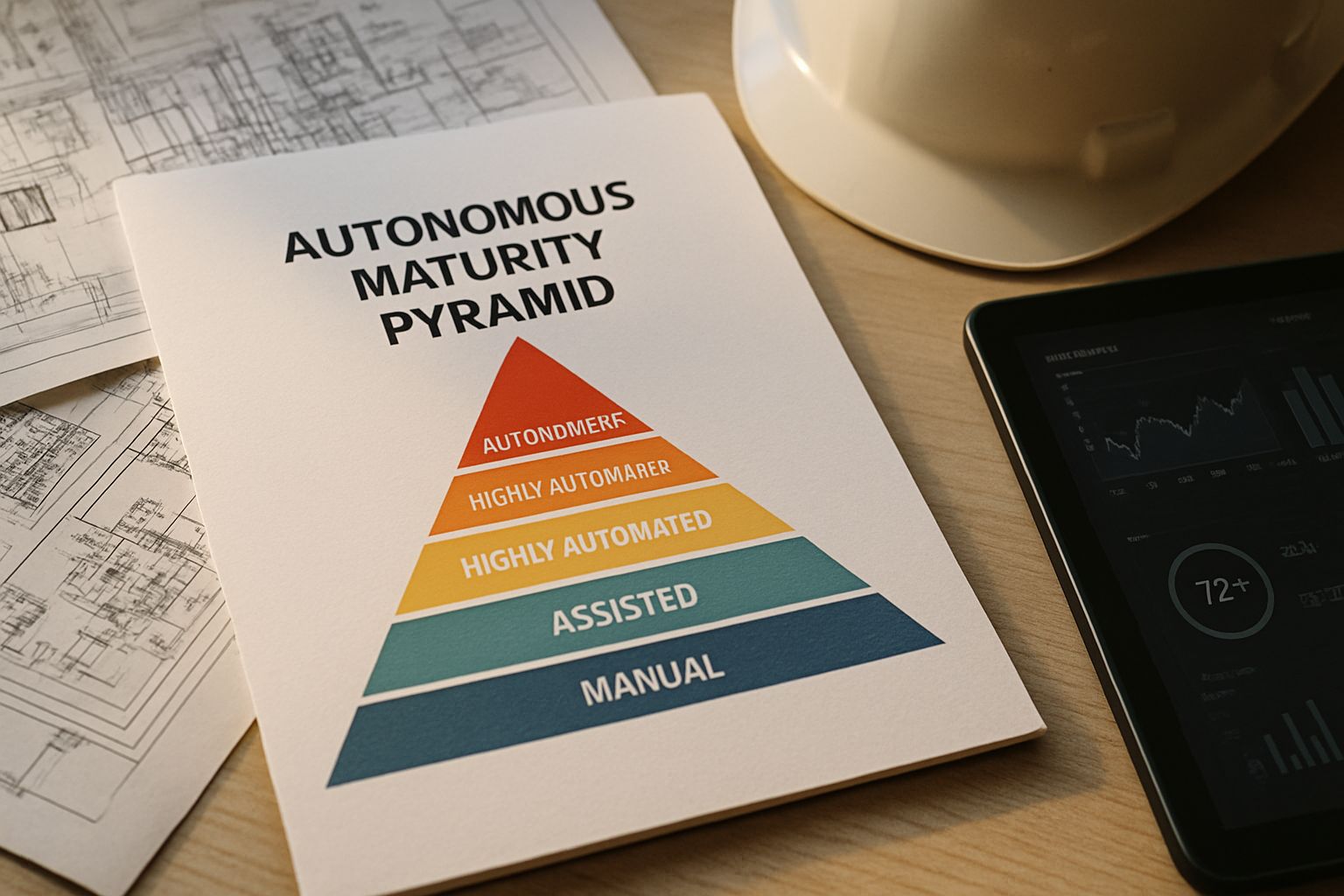
Rockwell and consulting arm Kalypso define four sequential stages. This entire framework constitutes the Autonomous Maturity Pyramid championed by the vendor. Observation contextualizes sensor, historian, and PLC data for human dashboards. Inference applies anomaly detection or predictive models that flag deviations before failures surface. Decisioning employs prescriptive engines, often model predictive control, to recommend optimal set-points under constraints. Finally, Action enables validated closed-loop execution, edging plants toward true autonomy.
Moreover, Rockwell’s FactoryTalk DataMosaix and unified namespace concepts anchor data governance at the edge. Digital twins verify control strategies before deployment, consequently safeguarding production. This staged approach also improves organizational maturity by clarifying decision rights at each level. NVIDIA and Microsoft partnerships add scalable compute and generative AI interfaces. Each segment of the pyramid aligns with specific talent competencies.
These layers create a pragmatic ladder rather than a disruptive overhaul. Subsequently, economic value compounds at each ascent, as the upcoming section demonstrates.
Tangible ROI Evidence Emerges
Case studies translate theory into financial terms. Notably, Rockwell’s Twinsburg pilot used DataMosaix to detect tooling degradation 30-60 days earlier. The intervention improved stencil printing fail rates by 22% and realized $9 million revenue sooner. Return on investment exceeded 200% during the evaluation window.
Kalypso reports that decisioning-stage MPC projects boost throughput 4–7%, raise yield 0.5%, and trim energy 2–5%. Consequently, incremental wins finance subsequent digital stages without large capital shocks. Manufacturers consistently cite payback periods under twelve months, reinforcing executive confidence. Gradual maturity boosts investor confidence because metrics speak louder than marketing slides.
- 95% of surveyed firms plan AI investments within five years.
- 22% scrap reduction at Twinsburg pilot.
- 4–7% throughput gains from MPC in CPG plants.
- $49 billion autonomous enterprise market today.
Collectively, these numbers validate the Autonomous Maturity Pyramid as more than marketing rhetoric. Nevertheless, formidable obstacles still slow widespread adoption, as the next section explains.
Challenges Still Slow Progress
Data integration remains the most cited barrier. Legacy historians use inconsistent tags, therefore undermining model accuracy. Skills shortages also bite; control engineers and data scientists rarely share the same shop floor. In contrast, leaders who pair reskilling with technology advance faster across stages.
Cyber-physical risk further complicates autonomy. Expanded connectivity enlarges attack surfaces, necessitating ISA/IEC 62443 and NIST mappings. Independent observers warn that vendor playbooks often underweight formal safety validation. Autonomous errors can erode operator trust and stall programs. Without trusted data, climbing the pyramid becomes impossible.
These challenges underline the need for rigorous governance alongside the Autonomous Maturity Pyramid. Therefore, the next portion focuses on emerging frameworks and certification paths.
Governance And Safety Layers
Governance frameworks bridge technical innovation with risk management. ISA/IEC 62443 prescribes defense-in-depth controls, while NIST’s ICS guide maps cybersecurity maturity. Moreover, academic voices push for continuous verification and mandatory human oversight in closed-loop action. Blake Moret states that technology must augment, not replace, people.
Certification can institutionalize these controls. Professionals can validate expertise through the AI Project Manager certification. Subsequently, organizations align talent, processes, and controls with the Autonomous Maturity Pyramid roadmap.
Robust governance mitigates technical and social risk. Next, we outline a concise implementation checklist.
Practical Implementation Steps Checklist
Implementation success starts with a candid self-assessment against each stage. Furthermore, building a unified namespace ensures data context for later inference.
- Benchmark current capabilities and KPIs.
- Consolidate data using contextual platforms.
- Pilot MPC or predictive maintenance for quick wins.
- Embed cybersecurity and change management gates.
Following this checklist accelerates movement up the Autonomous Maturity Pyramid while containing risk. Consequently, executive sponsors see measurable ROI sooner. Finally, we look ahead to industry implications.
Outlook And Next Moves
Industry momentum shows little sign of slowing. Rockwell recently unveiled a greenfield advanced factory that will showcase edge AI and GenAI controllers. CTO Cyril Perducat calls this shift a reinvention of automation toward autonomy.
Competitive vendors will likely adopt similar stage-gated messaging, yet differentiation may hinge on governance depth. Meanwhile, standards bodies evaluate whether existing certifications suffice for learning agents that write to PLCs. Academic research could soon formalize safety taxonomies that complement the Autonomous Maturity Pyramid.
Nevertheless, practitioners should focus on pilots that fund themselves and build internal champions. Autonomous advances need trusted data, multidisciplinary skills, and disciplined progression. Therefore, leaders who master both technology and change management will set the competitive pace.
The Autonomous Maturity Pyramid will continue shaping industrial narratives and budgets. Yet, final success depends on transparent metrics, resilient security, and empowered talent.
Factories worldwide are climbing data, analytics, and control ladders with remarkable speed. Evidence from Twinsburg and MPC pilots proves that incremental autonomy can pay for itself quickly. However, integration friction, skills gaps, and cyber risk still threaten momentum. Robust governance frameworks, continuous verification, and certified leaders can close these gaps. Consider pursuing the linked AI Project Manager certification to spearhead cross-functional programs. By combining structured governance with the Autonomous Maturity Pyramid, enterprises can unlock resilient, sustainable, and profitable automation.


