

AI CERTs
2 months ago
Autonomous code refactoring engines modernize enterprise software
Mainframes running decades-old code still anchor many critical enterprises. However, modernization budgets struggle against rising complexity and shrinking talent pools. In 2025, a new class of autonomous code refactoring engines emerged to tilt the balance.
These agentic systems analyze repositories, plan edits, and open pull requests without human keystrokes. Consequently, CIOs now see a viable path to rapid legacy system migration and streamlined DevOps automation. This article explores technology foundations, market traction, risks, and best practices for enterprise adoption.
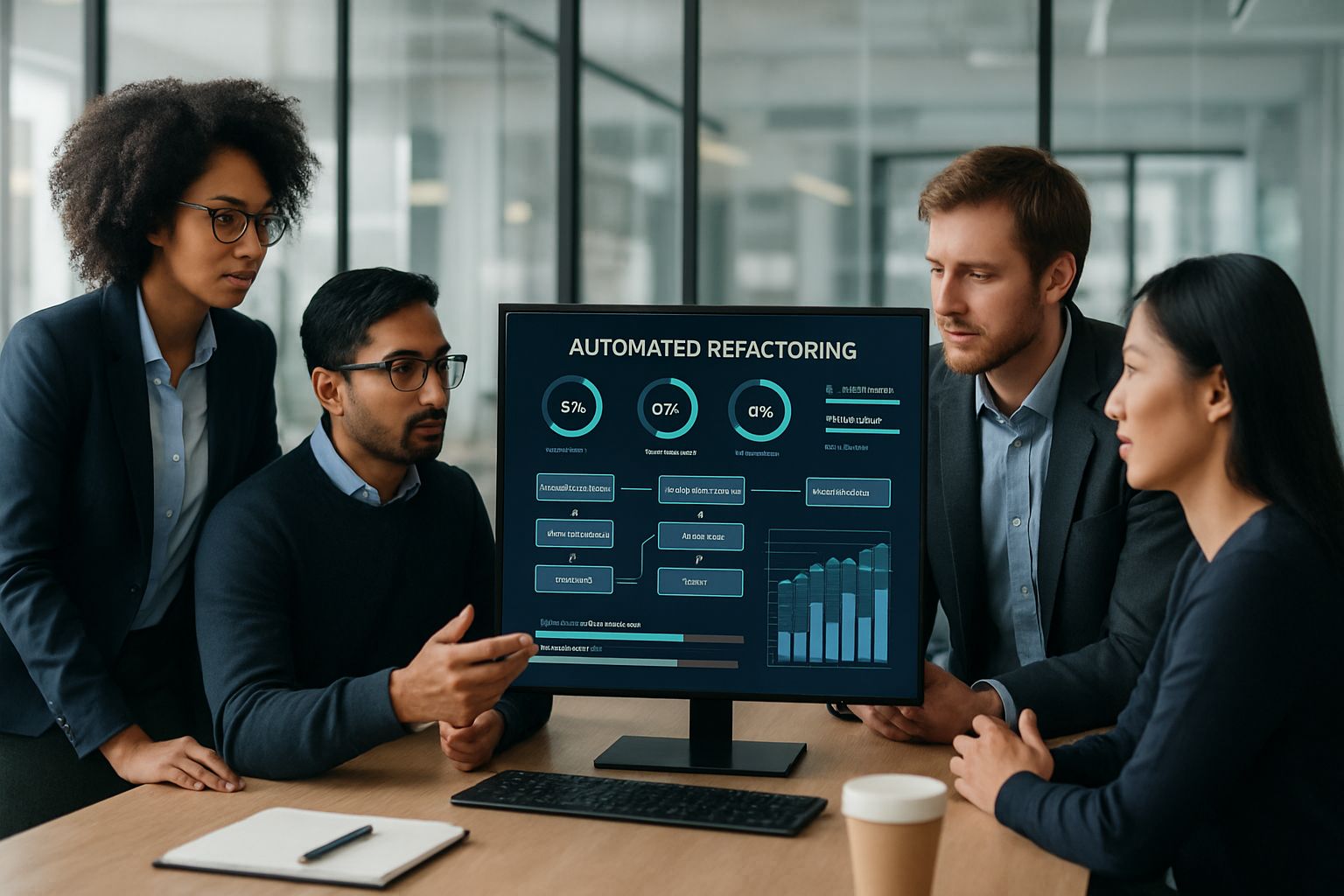
Moreover, we quantify cost savings and spotlight guidance from analysts, vendors, and security researchers. Readers will also find certification resources to strengthen governance skills in an agent-driven software future. Meanwhile, data from MarketsandMarkets and Stack Overflow underscores unprecedented momentum. Therefore, understanding the technology’s promise and pitfalls is now essential for every engineering leader.
Autonomous Code Refactoring Engines
At its core, a refactoring engine is an AI agent that preserves behavior while improving structure. Unlike snippet suggesters, the autonomous variant orchestrates multi-file edits, test runs, and validation loops.
GitHub’s Copilot coding agent, AWS Transform, and vFunction exemplify this progression. Additionally, OpenAI introduced Codex skills that let developers compose specialized agents for repetitive upgrades.
Therefore, autonomous code refactoring engines now operate as disciplined teammates rather than passive assistants. They usually clone repositories into isolated runners, iterate until tests pass, and then raise gated pull requests.
The technology has matured beyond prototype status. Nevertheless, understanding market momentum clarifies why adoption curves steepened in 2025. Let us examine the latest commercial and research signals driving that acceleration.
Market Momentum Accelerates Fast
MarketsandMarkets sizes application modernization services at USD 22.67 billion for 2025. Moreover, analysts forecast a 14.6 percent CAGR, doubling the figure by 2031.
Consequently, vendors rushed announcements through 2025. AWS reported that Transform analyzed 1.1 billion lines and saved 810,000 manual engineering hours.
Meanwhile, GitHub revealed an agent that opens draft pull requests across entire monorepos for Copilot Enterprise subscribers. Stack Overflow’s 2025 survey shows 84 percent of developers already use, or plan to use, AI coding tools.
Data confirms rising investment and developer readiness. Therefore, budget holders now expect faster legacy system migration outcomes. Understanding the technology stack powering these gains is the next logical step.
Technology Foundations Explained Clearly
Autonomous engines rely on hybrid static analysis, runtime telemetry, and large language models. Furthermore, architectural observability layers, such as vFunction’s intelligence, enrich prompts with component boundaries and dependency maps.
During the agent loop, the system spins up a sandbox runner, clones the repository, and triggers tests. Subsequently, successful iterations commit changes, while failures prompt targeted retries.
This tight loop allows autonomous code refactoring engines to preserve semantics even during aggressive legacy system migration steps. DevOps automation hooks then apply SBOM generation, SAST scans, and branch protections before human review.
In short, the pipeline blends proven analysis with cutting-edge language models. Nevertheless, benefits matter only if they translate into measurable business value. Quantitative results reveal how much value enterprises are already capturing.
Enterprise Benefits Quantified Rigorously
Bain reports 25-30 percent productivity gains when GenAI permeates the software lifecycle. Similarly, AWS claims up to five-fold acceleration on certain modernization workflows.
- 810,000 engineering hours saved through AWS Transform.
- 1.5 million LOC migrated monthly at a Thomson Reuters pilot.
- 13–47 percent complexity reduction in academic refactoring benchmarks.
- Up to 70 percent operating cost drop after Windows license elimination.
Moreover, autonomous code refactoring engines enable engineers to focus on design rather than rote syntax changes. DevOps automation also shortens feedback loops, improving deployment frequency and mean time to recovery.
The numbers illustrate real financial and engineering impact. Therefore, governance becomes the deciding factor for sustainable advantage. We now address the policies that keep automation safe and compliant.
Governance And Risk Controls
Security researchers warn that 30-45 percent of unchecked AI code can embed vulnerabilities. Consequently, enterprises must apply SAST, DAST, and software composition analysis to every agent patch.
Gartner recommends branch protection, provenance headers, and mandatory human approval to counter automation bias. Moreover, strict dependency whitelists prevent unexpected licenses from polluting the codebase.
Autonomous code refactoring engines should log reasoning steps to aid audits and post-incident forensics. DevOps automation pipelines can enforce these controls as policy-as-code, preserving velocity while tightening oversight.
Robust governance converts experimental promise into reliable production capability. Nevertheless, teams still need practical playbooks to implement policies quickly. The next section outlines a concise checklist for execution.
Implementation Best Practices Checklist
Start with repositories containing strong test suites and clear domain boundaries. Additionally, label refactors by risk class to match oversight levels.
- Pilot one workflow: legacy system migration of a non-critical service.
- Integrate DevOps automation gates for security, licensing, and performance metrics.
- Track agent pull request acceptance and rollback rates weekly.
- Upskill reviewers through the AI Foundation™ certification.
Moreover, schedule red-team exercises to stress test autonomous code refactoring engines under real failure modes. Legacy system migration metrics should include defect escape rate and total developer hours saved.
Consequently, continuous measurement aligns stakeholder expectations and secures further investment. Disciplined pilots build trust and surface unseen blockers. Therefore, leaders can expand coverage with confidence. We now look forward to where the market heads next.
Future Outlook And Predictions
Analysts expect standard agent protocols, comparable to CNCF specifications, to emerge within twelve months. Meanwhile, open benchmarks will likely grade autonomous code refactoring engines across multi-language repositories.
In contrast, regulatory bodies may mandate provenance metadata for AI-generated code in high-risk industries. Subsequently, vendors will embed attestation payloads directly into pull requests for compliance audits.
Legacy system migration workloads will dominate early adoption, yet greenfield projects will follow as trust grows. DevOps automation orchestration will evolve toward self-healing pipelines that revert faulty agent patches automatically.
The roadmap points toward increasingly autonomous, policy-aware engineering factories. Nevertheless, human oversight remains indispensable for ethical and strategic decisions. A concise recap solidifies these insights and directs readers toward next steps.
Autonomous code refactoring engines have shifted from aspirational demos to enterprise-grade accelerators. They compress modernization timelines, support scalable DevOps automation, and cut operational spend. However, risk governance, testing depth, and skill development determine sustainable success. Professionals can deepen their capabilities through the linked AI Foundation certification and other structured learning paths. Consequently, leaders who pilot, measure, and iterate will unlock autonomous code refactoring engines for legacy system migration. Explore case studies and start experimenting with autonomous code refactoring engines to future-proof your software portfolio today.


