

AI CERTs
2 months ago
Autonomous checkout vision stacks propel frictionless retail
Long lines still plague busy stores. Consequently, retailers hunt for faster options. Over the past 18 months, autonomous checkout vision stacks matured from pilot toys to scaled engines. Moreover, venue operators and grocers now retrofit aisles and kiosks at record speed. This article unpacks momentum, technology, economics, and risks shaping the 2026 rollout wave.
Global Market Momentum Grows
Industry headlines tell a clear story. Trigo unveiled an AI shrink solution in June 2025. Amazon relaunched its Dash Cart on 7 January 2026, shifting strategy from ceiling cameras to sensor-rich carts. Meanwhile, Zippin activated 15 stores within ten weeks and secured a $30 million Series B.
- Juniper forecasts billions of smart transactions by 2027.
- ResearchAndMarkets projects double-digit CAGR for vision checkout hardware.
- Trigo cites annual shrink exceeding $130 billion worldwide.
Additionally, stadium concessions thrive because small footprints simplify installs. Capital One Arena, AT&T Stadium, and Hard Rock Stadium now boast camera-only stores. Therefore, analysts expect thousands more micro-formats by 2027.
These adoption signals highlight robust demand. Nevertheless, shifting vendor positions indicate ongoing experimentation. The next section explains the technology enabling rapid change.
Technology Stack Anatomy Explained
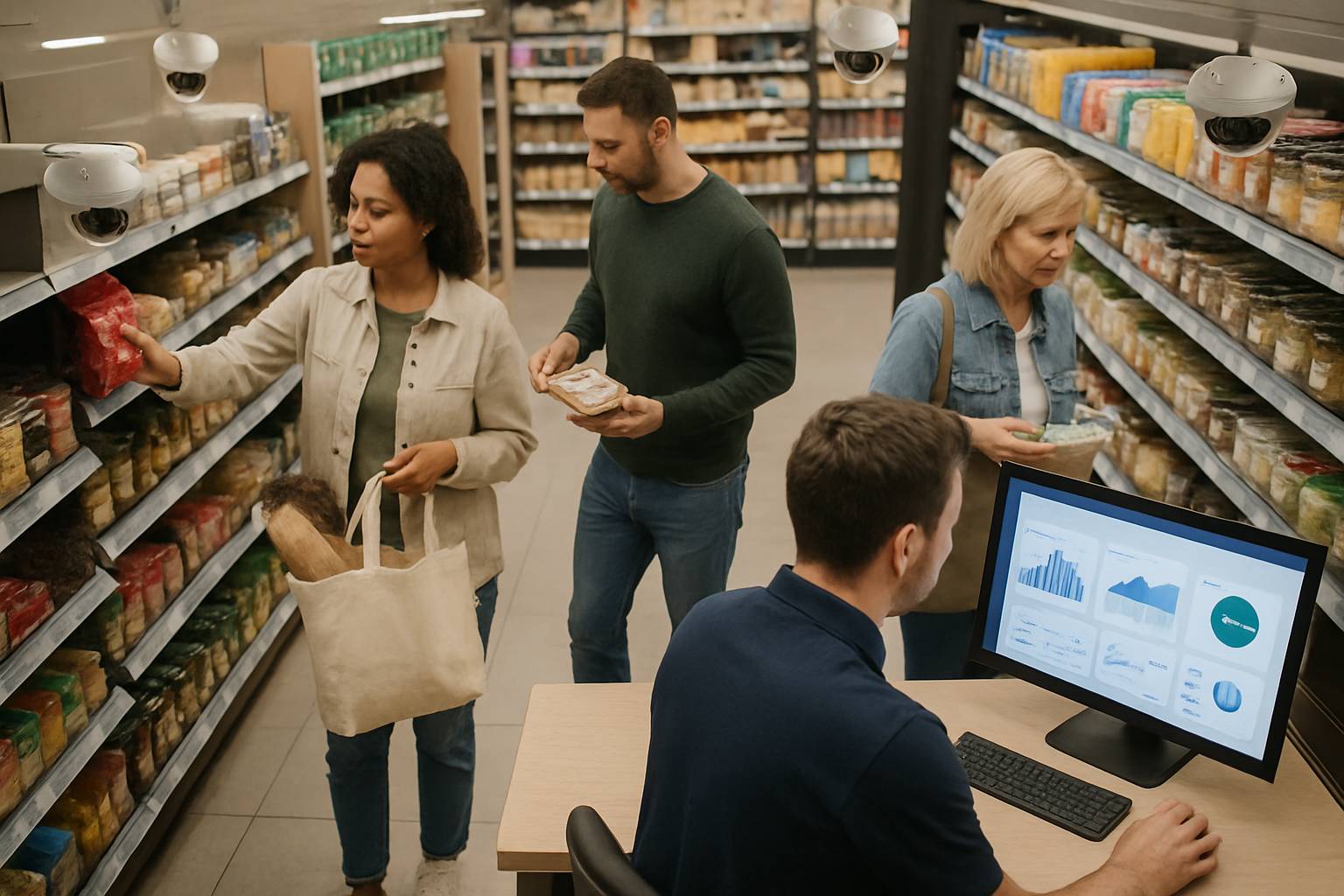
A modern autonomous checkout vision stacks installation uses layered engineering. Firstly, overhead cameras, shelf sensors, and cart scales capture raw events. Secondly, edge boxes run object detection, segmentation, and multi-object tracking. Consequently, the basket state updates in real time.
Sensor fusion aligns timestamps from multiple feeds. Therefore, pick or replace actions become deterministic. Backend “store OS” layers, branded StoreOS or Vision OS, reconcile baskets with payment systems and loyalty databases. Moreover, cloud modules analyze inventory, merchandising, and customer flow.
Major Vendor Landscape Shifts
Standard AI acquired Skip to blend self-checkout with vision. Sensei demonstrated a 1,200 m² autonomous supermarket in Portugal. In contrast, Amazon now licenses Just Walk Out to third parties while focusing fresh capital on carts. Each pivot proves the modularity of autonomous checkout vision stacks.
This modularity fuels hybrid formats, covered next.
Key Hybrid Format Strategies
Retailers rarely deploy single modes today. Instead, they mix ceiling cameras, smart carts, and walk-up lanes. Furthermore, computer vision retail teams integrate systems with existing kiosks to hedge cost risk. Zippin’s quick concession retrofits exemplify walk-up gains. Meanwhile, Amazon’s Dash Carts address larger footprints without ceiling rewiring.
Hybrid mixes deliver flexibility. However, device orchestration demands strong interfaces. Therefore, vendors expose APIs that let stores switch customers between modes mid-journey. Such agility keeps autonomous checkout vision stacks future-proof.
These format plays make sense only when numbers add up. The following section dissects economics.
Economics And ROI Dynamics
Investment committees ask two questions: payback period and shrink impact. Trigo claims its new module cuts shrink by double digits, tying activity to a virtual basket. Moreover, Zippin reports labor savings that offset hardware within 18 months in high-volume venues.
Additionally, computer vision retail deployments unlock fresh revenue. Real-time inventory accuracy drives better replenishment. Personalized offers become feasible because cameras identify pick intent, not just final scans. Consequently, analysts see blended ROI from labor, conversion, and basket lift.
Nevertheless, large supermarkets still struggle with ceiling camera costs. Therefore, many chains prefer rolling smart carts first. This phased approach lets capital budgets align with proof points while still embracing autonomous checkout vision stacks.
Solid returns look appealing, yet governance pressures rise. Risks are explored next.
Risk And Compliance Pressures
Legal scrutiny over biometric data intensifies. Home Depot faced an Illinois lawsuit involving facial recognition at self-checkout. Consequently, retailers demand privacy-first designs. Vendors now hash customer imagery or limit retention. Moreover, the academic community exposed adversarial patches that trick detectors, threatening system integrity.
Furthermore, loss prevention teams watch for new fraud vectors. Adversaries may conceal items between fast transactions. Therefore, multilayer sensors and human review loops remain essential. Trigo’s product positions vision as both checkout platform and loss prevention engine.
Operationally, network latency and edge failures can halt service. Nevertheless, redundant links and failover kiosks reduce downtime. Governance frameworks align these mitigations with SOC 2 and GDPR standards.
Professionals can enhance their expertise with the AI Customer Service™ certification. The credential deepens skills in ethics, support, and data stewardship for computer vision retail rollouts.
Risks will not deter progress. However, they shape the pace and form of future adoption, discussed next.
Future Adoption Outlook 2026
Analysts predict segmentation. Small, mission-driven stores will go fully autonomous fastest. In contrast, big supermarkets will blend smart carts, lanes, and ceiling cameras until hardware drops further. Additionally, stricter privacy laws may favor edge inference, keeping raw video onsite.
Moreover, continuous model retraining improves detection robustness. Standard AI’s Vertex AI alliance shows cloud orchestration can push updates nightly. Consequently, accuracy inches toward vendor-claimed 99 percent benchmarks. Meanwhile, investors still pour capital into emerging specialists, expanding the field.
Therefore, the next 24 months will feature intensified competition. Autonomous checkout vision stacks will evolve into full physical-store operating systems, powering pricing, replenishment, and marketing analytics. Retailers who prepare staff through targeted learning, including the above certification, will capture outsized gains.
These projections suggest unstoppable momentum. Nevertheless, disciplined pilots remain the surest path to scaled success.
Key Takeaway Checklist
- Define sensor scope and data retention policy.
- Model payback across labor, revenue, and loss prevention.
- Build hybrid fallback options for resilience.
- Seek audited accuracy numbers from vendors.
- Train teams using recognized programs to master computer vision retail operations.
This checklist distills urgent actions. Consequently, executives can navigate complexity while retaining strategic speed.
Overall, momentum, technology, economics, and governance converge to accelerate autonomous checkout vision stacks. However, success demands cross-functional alignment, transparent data use, and rigorous testing.
Forward-looking leaders should pilot now, measure fast, and iterate relentlessly.
Finally, enhanced skills secure project outcomes. Therefore, consider formal learning while shaping the next retail frontier.


