

AI CERTS
3 months ago
Apple’s Corporate AI Direction Shifts Under Amar Subramanya
Therefore, Apple must accelerate its roadmap while preserving privacy promises. This article examines the plan, the market context, and the challenges ahead. Additionally, readers will gain actionable insights for guiding their own strategies.
Apple Shifts AI Strategy
Apple framed the leadership handover as routine succession. However, analysts call it a public reset of Corporate AI Direction. Tim Cook thanked Giannandrea, yet highlighted Subramanya's foundation-model expertise. Meanwhile, Craig Federighi emphasized speed and quality for upcoming features. Gartner's forecasted 76% growth in GenAI spend underscores the timing. Consequently, Apple cannot afford further Siri postponements. Subramanya will oversee Apple Foundation Models, ML research, and evaluation teams. Moreover, redistributed groups now report to Sabih Khan and Eddy Cue.
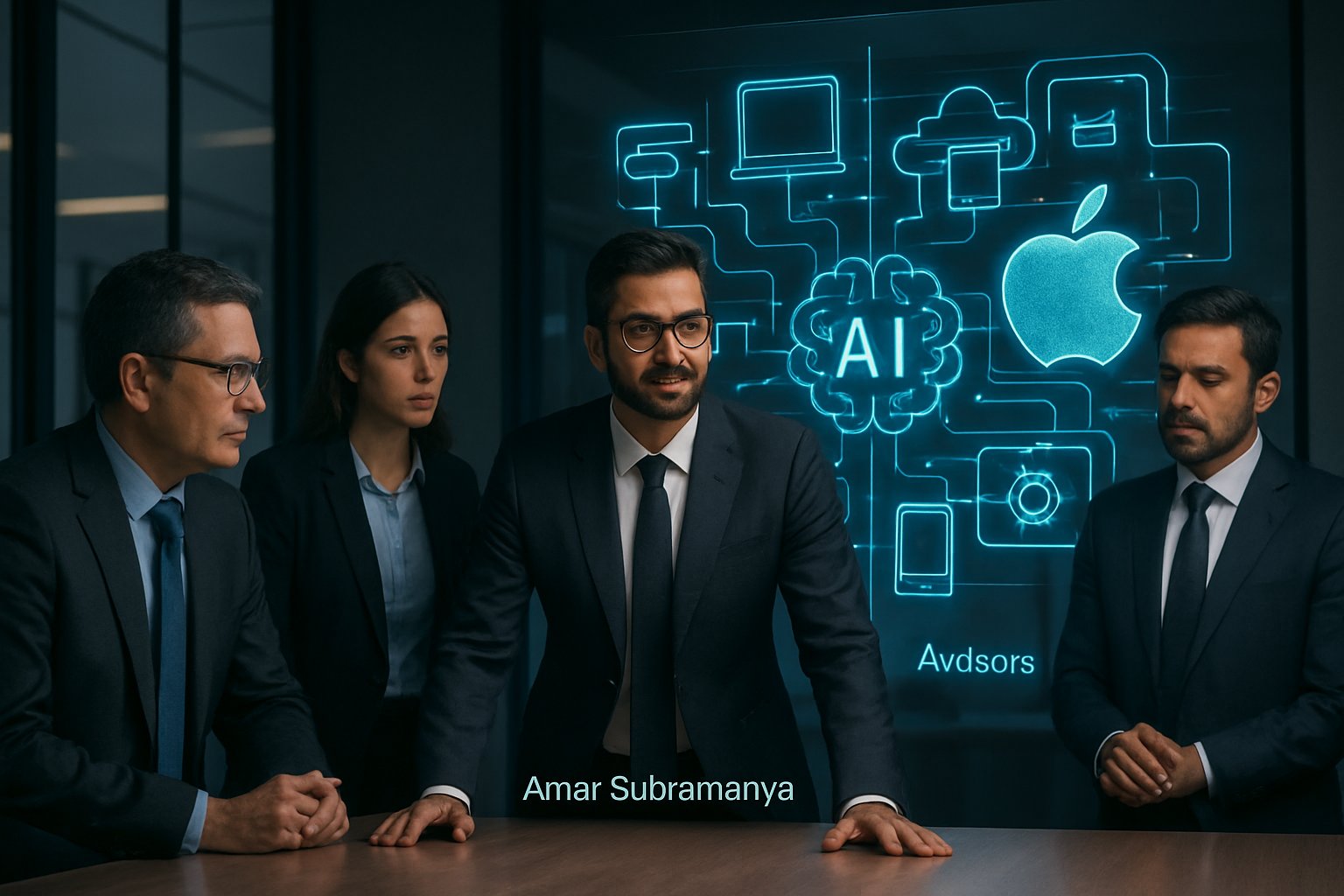
These moves centralize decision making and clarify accountability. In contrast, the next section reveals how Subramanya intends to execute.
Subramanya Technical Core Blueprint
Subramanya built Google’s Gemini Assistant and briefly guided Microsoft Copilot engineering. Therefore, his resume combines research depth with product scale. He has outlined a vision focused on privacy-aligned foundation models. Additionally, he supports tight on-device and cloud integration to reduce latency. Apple hopes the approach strengthens the iPhone-to-Mac ecosystem without surrendering data. Consequently, the blueprint aligns with Apple’s overarching Corporate AI Direction. Professionals can enhance their expertise with the AI Network Security™ certification. Furthermore, Subramanya prioritizes robust safety evaluation before any public launch. His team will refine model size and power draw for Apple silicon. These technical levers illustrate how engineering details support strategic goals. Nevertheless, market pressure demands visible milestones within twelve months.
Subramanya's blueprint marries privacy and performance. Subsequently, market forces determine whether the plan ships on time.
Market Forces Intensify Race
The external landscape grows fiercer each quarter. Gartner expects AI PCs to hit 77.8 million units this year. Moreover, GenAI spending will approach $644 billion. In contrast, Apple reported $34.55 billion in R&D for fiscal 2025. Analysts question if that outlay matches rivals’ cloud investments. However, Apple’s vast installed base favors local inference over rented compute.
- 31% of PCs will ship with dedicated AI accelerators by December.
- 76% year-over-year growth in global GenAI budgets.
- $2.5 trillion valuation risk if Apple lags on personalization.
Consequently, Corporate AI Direction must translate into faster releases. Furthermore, investors link AI progress to future services revenue. These market forces elevate the stakes for Subramanya’s blueprint.
Competitive velocity limits Apple’s margin for experimentation. The next section explores how product delays complicate execution.
Product Roadmap And Delays
Apple promised a rebuilt Siri during WWDC 2025. However, Craig Federighi admitted the assistant “needed more time.” Internal targets now point to spring 2026 for public release. Timelines slipped partly due to rigorous privacy evaluation. Additionally, engineers optimized multimodal models for on-device inference. These tasks slowed visible output, frustrating consumers and developers. Nevertheless, the new Corporate AI Direction demands firmer milestones. Subramanya reportedly set quarterly checkpoints for Siri personalization. Moreover, cross-platform integration tests will run inside Private Cloud Compute. Each phase must satisfy battery, latency, and safety thresholds.
Repeated delays erode brand confidence. Therefore, the following section audits Apple’s internal structure.
Organizational Realignment Signals Emerge
Leadership alignment often dictates product cadence. Apple split Giannandrea’s former groups among three executives. Consequently, hardware-adjacent ML teams now reside under Sabih Khan. Meanwhile, services-focused scientists moved to Eddy Cue. Federighi retains Foundation Models, keeping core research near software decisions. This reshuffle aims to unclog decision pipelines and improve integration velocity. Moreover, Subramanya’s charter clarifies Corporate AI Direction across these silos. Analysts applaud the clear line of sight from model to product. Nevertheless, rapid culture adaptation remains challenging. Apple’s privacy-centric ethos permeates its ecosystem, shaping every release.
Organizational charts now mirror technical dependencies. Subsequently, we assess remaining execution hazards.
Risks And Execution Hurdles
Even perfect charts cannot erase technical debt. In contrast, Apple’s hybrid architecture increases complexity. On-device limits constrain parameter counts and context windows. Furthermore, privacy rules restrict training data diversity. These constraints may blunt the assistant’s vision for seamless conversation. However, Subramanya has compressed models successfully in prior roles. He must repeat that feat without Google’s internal tooling. Additionally, talent churn poses continuity risks. Short stints at Microsoft show how volatile the market is. Consequently, Corporate AI Direction could falter if retention dips. Siri delays already eroded morale among some staff. Nevertheless, the vast Apple ecosystem offers unique incentives.
Technical and human factors intertwine. The final section distills actionable lessons.
Strategic Takeaways For Leaders
Leaders across industries monitor Apple for strategic cues. Therefore, several lessons emerge from this transition.
- Define a concise vision linked to quarterly metrics.
- Secure cross-functional integration early to avoid rework.
- Invest in safety tooling before public deadlines.
- Allocate budget proportional to market acceleration.
Additionally, executives should communicate Corporate AI Direction clearly to investors. Moreover, partner developers crave updated APIs aligned with that Corporate AI Direction. Consequently, transparent roadmaps can bolster loyalty even when dates slip. Professionals seeking credibility in this space may pursue the AI Network Security™ credential. Nevertheless, only disciplined execution translates blueprints into user delight. Apple now ties compensation milestones to progress, reinforcing Corporate AI Direction internally.
Strategic clarity, integration, and accountability support sustained innovation. Finally, leaders must balance ambition with feasible engineering timelines.
Apple’s AI shake-up illustrates how leadership changes can realign massive organizations. Moreover, Subramanya’s foundation-model pedigree offers credible velocity for overdue Siri upgrades. However, privacy constraints and hardware limits still challenge timely delivery. Continued market expansion means delay costs compound quickly. Consequently, leaders everywhere should refine their own visions, budgets, and integration plans. Ready to strengthen your credentials? Explore the AI Network Security™ certification and stay ahead.


