

AI CERTs
2 hours ago
Apple iOS 26.3 Elevates Carrier Privacy With Location Limits
In January Apple quietly slipped a powerful switch into the iOS 26.3 beta. However, most users missed the tiny Settings entry named “Limit Precise Location.” The toggle promises stronger carrier-level Privacy without touching familiar app permissions. Consequently, security professionals are examining what the feature does, where it works and why it matters. Meanwhile, regulators view it as another chess move in Apple’s ongoing privacy branding strategy. Field engineers carrying an iPhone often operate in regulated sectors. For developers, understanding the carrier dimension of localization was optional until now. Now, network architects must consider how diluted tower data impacts analytics, billing, and lawful access. Additionally, device procurement managers will ask which models and carriers support the new restriction before signing contracts. Therefore, this analysis delivers the facts, expert commentary, and actionable next steps for enterprise readers. Subsequently, you can decide whether early deployment makes operational sense for your fleet.
iOS 26.3 Update Scope
Apple published its supporting document on 26 January 2026, confirming the feature inside iOS 26.3. Furthermore, public betas show the toggle nestled within Settings > Cellular > Cellular Data Options. Once activated, the phone must restart before network behavior changes. In contrast, app-level Location Services remain untouched, preserving existing permission workflows. Therefore, the scope is narrow yet significant because it targets a layer users previously could not manage. This carrier focus advances Privacy control beyond previous OS releases. These fundamentals clarify what the switch does.
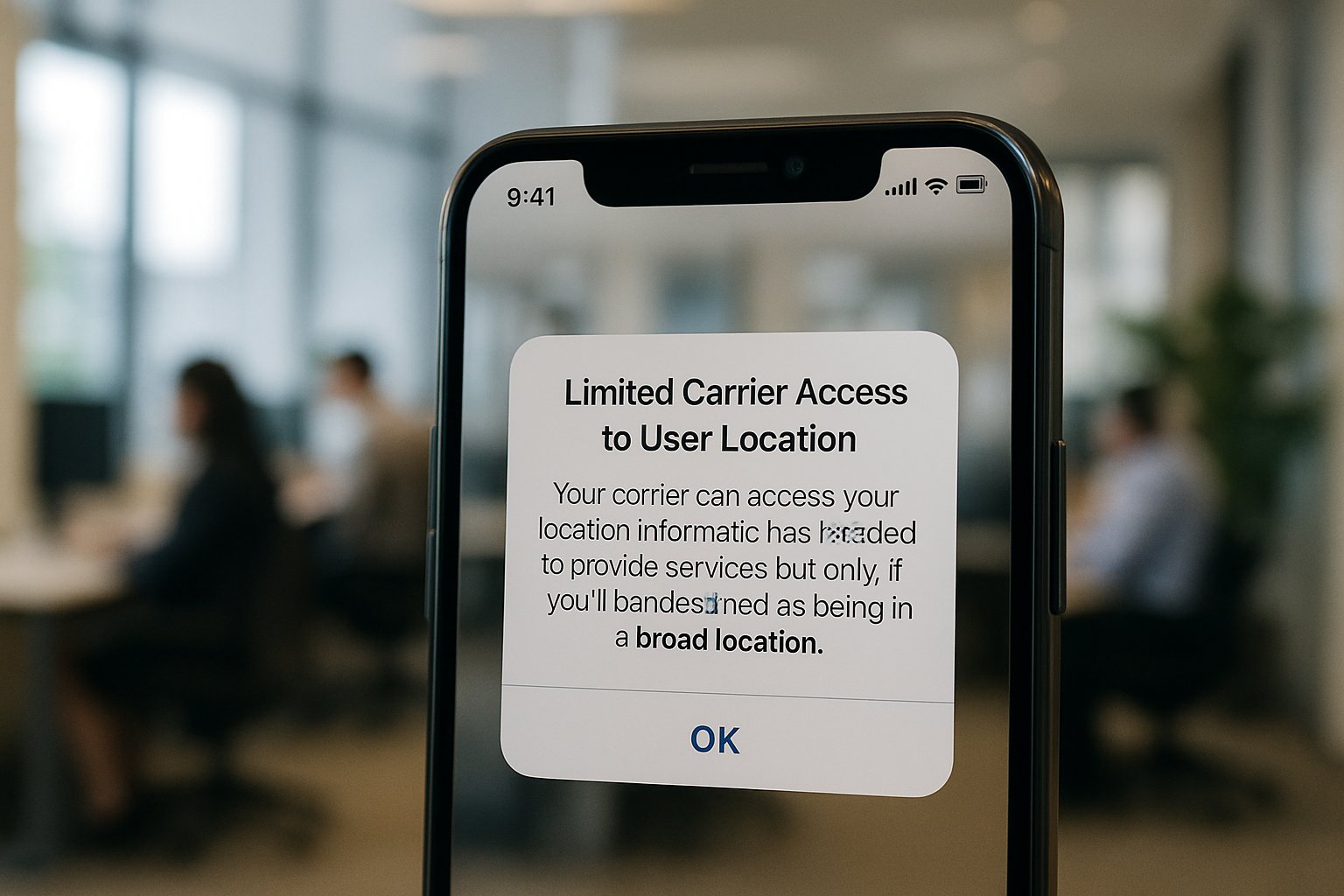
The update limits only carrier granularity, leaving apps unaffected. Consequently, enterprises must reassess network data exposure. Next, we examine how those carrier readings become less precise.
Carrier Location Precision Limits
Mobile networks traditionally locate devices by combining cell identifiers with timing measurements. Moreover, advanced systems use observed time difference of arrival to triangulate street corners. With the new setting enabled, carriers will only see an approximate neighborhood radius. Nevertheless, emergency calls bypass the limitation, safeguarding critical response accuracy. Apple’s support note states, “You can limit some information that cellular networks may use to determine your location.” For investigators, diminished granularity means extra legwork when correlating tower dumps or handset records. In practice, neighborhood accuracy spans roughly 500 meters, according to early field testers. Such rounding limits geofence correlation across adjacent towers. These technical changes redefine what carriers know.
The feature reduces radio-based positioning to block street-level insights and strengthens Privacy. However, it keeps lifesaving emergency accuracy intact. Availability constraints determine who actually benefits.
Hardware And Carrier Availability
Only devices sporting Apple’s C1 or C1X modems qualify today. Consequently, the list includes iPhone Air, iPhone 16e, and cellular iPad Pro with M5. Boost Mobile leads United States support at launch, while EE, BT, Telekom, AIS, and True join abroad. Meanwhile, major U.S. carriers remain absent, limiting enterprise pilot programs. Apple has declined to publish a timeline for broader rollout or legacy compatibility. Therefore, procurement teams must map fleet composition against carrier roadmaps before promising employees new protections. Meanwhile, corporate policies may require certain Location protections before device approval.
Current availability covers a narrow hardware and carrier slice for Privacy. Subsequently, support will likely widen as Apple modems proliferate. Regulatory pressure may accelerate that expansion.
Regulatory And Market Context
The update ships alongside other DMA-driven changes that open iOS interfaces. However, Apple positions the carrier feature as independent of European mandates. Analysts believe Apple leverages in-house silicon to differentiate around security and business model. In contrast, Android vendors depend on third-party basebands, limiting similar innovations. Furthermore, Privacy advocates cite rising law-enforcement demand for cell-site records as motivation. Civil-liberties groups argue any reduction is helpful, yet they still lobby for auditability. Consequently, they request published metrics on carrier retention intervals. Therefore, Apple gains reputational credit while pre-empting possible regulation of carrier data handling.
The context shows strategic alignment between policy shifts and product capabilities. Consequently, stakeholders must monitor future regulatory clauses referencing carrier precision. Attention now turns to practical advantages for users.
Benefits For End Users
First, the toggle gives individuals a rare control over carrier metadata. Moreover, enterprises handling sensitive field operations can shield corporate movement patterns from analytics resellers. Reduced granularity also hinders commercial Tracking products that rely on tower data aggregation. Additionally, research suggests fewer precise tower pings reduce surface area for triangulation attacks.
- Carrier logs record only rough cell position, not street coordinates.
- Analytics vendors receive less precise Tracking data for commercial profiling.
- Legal teams cite stronger protections when negotiating data-sharing clauses.
Professionals can enhance expertise with the AI Cloud Practitioner™ certification to design compliant architectures. Nevertheless, true security requires layered defenses that include app permissions and network segmentation. Stronger Privacy can improve compliance with emerging contractual clauses.
Carrier dilution offers meaningful yet partial risk reduction. Therefore, organizations should fold the feature into broader mobility baselines. Limitations remain and deserve equal scrutiny.
Remaining Privacy Pain Points
Misunderstanding scope could lead teams to ignore app Tracking or Wi-Fi beacons. Additionally, carriers may still retain raw measurements internally, exposing them under subpoena. Moreover, international roaming falls back to partner networks that might lack the precision block. Privacy gains vanish when the user switches SIMs to unsupportive operators. In contrast, attackers leveraging compromised apps still access GPS coordinates unaffected by the setting. Consequently, security awareness training should reinforce the layered nature of mobile defenses.
The new feature removes only one Tracking vector. Subsequently, managers must sustain holistic risk assessments. The roadmap illuminates future possibilities.
Roadmap And Next Steps
Industry watchers expect future iPhone models to ship with Apple modems by default. More carriers will likely activate reduced precision as network software updates roll out. However, Apple declined to disclose timing when contacted by multiple outlets. Testing should quantify how many meters the radius expands under real-world conditions. Meanwhile, enterprises should pilot the feature on small fleets and document legal discovery impacts. Organizations can also consult independent academics studying cellular Tracking accuracy for implementation insights.
Continued observation will reveal operational trade-offs. Therefore, early adopters gain valuable data for policy refinement. The discussion concludes with final recommendations.
Apple’s carrier-level initiative demonstrates measured innovation at the intersection of security and business goals. Moreover, limited hardware and carrier support underline why pilot projects matter. Privacy advocates welcome the step, yet they caution against complacency. Enterprises should pair the toggle with rigorous app controls, threat modeling, and continuous monitoring. Consequently, teams that validate precision changes now will shape future procurement criteria. Meanwhile, regulators may cite the move when drafting data minimization rules. Professionals eager to lead this evolution can pursue the AI Cloud Practitioner™ credential and strengthen strategic influence. In conclusion, proactive testing and transparent communication will turn Privacy enhancements into measurable competitive advantage.


