

AI CERTS
4 weeks ago
Appcast Q1 Briefing Reveals AI Workforce Trends
Moreover, we align findings with wider labor market signals and practical recruiting tactics. Consequently, readers will grasp why costs climbed even as hiring demand softened. Importantly, every takeaway connects to measurable action for Q1 workforce planning. Professionals can also pursue advanced skills through a linked certification in AI-driven HR. That balance of insight and capability defines the modern talent playbook.
Appcast Briefing Series Launch
Appcast announced the quarterly Hiring Economy Briefing on March 10, 2026. Subsequently, more than 2,000 registrants signed up for the free Q1 webcast led by Chief Economist Andrew Flowers.
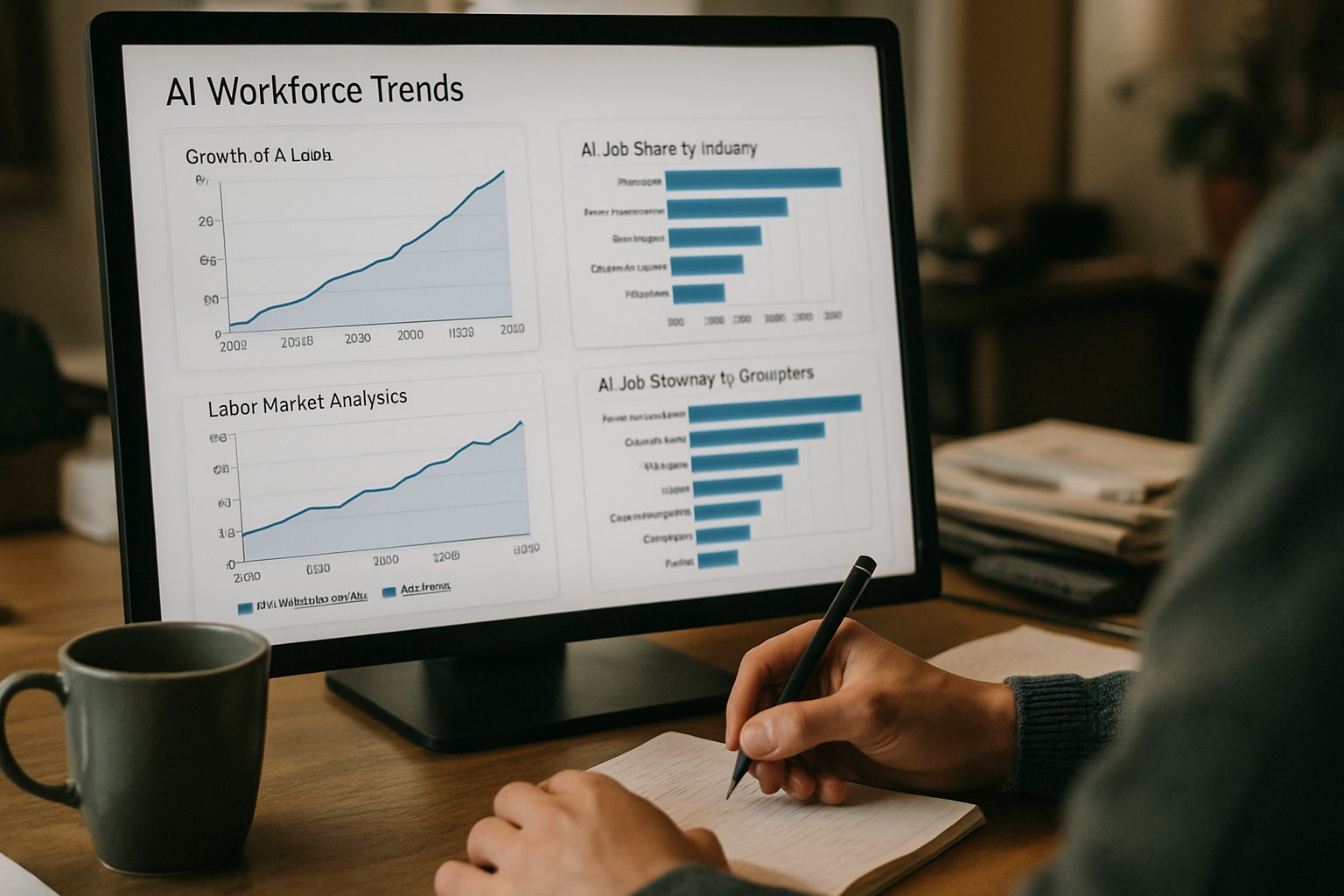
Flowers will dissect macro data, proprietary clicks, and apply volumes drawn from 1,200 employers. Furthermore, attendees receive slides summarizing sector movements, device shifts, and emerging AI Workforce Trends.
The virtual format reflects continuing hybrid habits inside the labor market information ecosystem. In contrast, earlier cycles relied on static PDF reports without live commentary or audience polling.
The launch institutionalizes timely analysis for TA leaders. However, deeper benchmarks matter even more, so we turn to the latest report.
Benchmark Report Key Insights
Released February 17, the 10th Recruitment Marketing Benchmark Report aggregates 302 million clicks and 27.4 million applications from 2025. Mobile devices accounted for 70.64% of clicks, while desktops delivered 29.36%.
Appcast labels 2025 a “low-hire, low-fire” year, yet cost-per-application climbed sharply. Moreover, median CPA grew fastest in high-competition metros and remote-heavy job families.
International benchmarks debuted, giving global enterprises comparative context across eight countries. Consequently, AI Workforce Trends appear increasingly borderless, especially regarding mobile-first apply behavior.
Recruiting leaders finally see how each media dollar converts into interviews.
The report moves beyond surface metrics and reveals funnel realities. Therefore, understanding conversion is crucial before discussing ad strategy.
Programmatic Advertising Model Explained
Programmatic recruitment automates where and when ads run across a vast job ad exchange. Instead of posting manually, algorithms bid in real time to hit application targets at the best price.
Appcast champions a pay-per-applicant model that charges only when a completed form arrives. In contrast, pay-per-click schemes can drain budgets without producing interviews.
Additionally, disposition benchmarks now link each click to final hires, tightening feedback loops. Such transparency underpins emerging AI Workforce Trends focused on accountable spending.
Programmatic efficiency depends on data depth and disciplined targets. Nevertheless, rising costs challenge the promise, prompting a closer metrics review next.
Cost Metrics Under Pressure
Appcast data show median CPA jumped 26% year over year despite balanced supply and demand. Meanwhile, cost-per-hire increased as downstream conversion rates plateaued.
Additionally, these shifts intersect with AI Workforce Trends that demand granular attribution. Why did spending swell during a softer labor market? Appcast attributes inflation to channel price moves, bidding competition, and applicant drop-off on mobile.
Independent analysts add that some employers lost visibility into exact sources inside aggregated exchanges. Consequently, finance teams struggled to reconcile invoices with realized hires.
Key cost drivers identified in the report include:
- Higher job board minimum bids following 2024 consolidations
- Scarce healthcare talent fueling premium bids across Sun Belt states
- Increased remote job volume intensifying nationwide competition
These factors compounded, pushing advertisers toward stricter optimization rules.
Cost inflation threatens ROI even for advanced buyers. However, sector dynamics reveal targeted opportunities, explored in the following section.
Sector Dynamics And Outlook
Healthcare remained the single strongest hiring engine in 2025 and early Q1 2026, according to Flowers. Moreover, government roles grew modestly, while technology postings cooled after pandemic surges.
Appcast data confirm a regional tilt as Sun Belt metros delivered lower CPA and higher apply rates. In contrast, coastal markets showed sluggish apply activity yet commanded premium advertising bids.
Therefore, recruiting leaders should rebalance budgets toward growth sectors and value geographies. That pattern aligns with broader AI Workforce Trends emphasizing precision over volume.
Sectoral nuance converts macro noise into tactical guidance. Subsequently, we outline concrete steps for day-to-day teams.
Practical Steps For Teams
First, audit funnel data against the new disposition benchmarks; identify leak stages and root causes. Next, align programmatic bid rules with acceptable CPA ceilings for each priority role.
Additionally, negotiate with top boards that raised minimums, using Appcast comparative data as leverage. Meanwhile, test emerging channels, such as streaming audio, where competition remains lighter.
Upskilling teams on responsible AI can accelerate optimization cycles. Professionals can enhance expertise with the AI Human Resources™ certification, which focuses on ethical automation and metrics literacy.
Consider the following action checklist:
- Publish weekly dashboards of CPA, CPH, and disposition ratios.
- Shift 10% of spend toward lower-cost Sun Belt requisitions.
- Schedule quarterly vendor reviews to maintain source transparency.
Consequently, disciplined execution transforms data into sustained savings and better candidate quality.
Operational rigor magnifies every dollar invested. Therefore, closing the loop completes our exploration of AI Workforce Trends.
Conclusion And Next Steps
Appcast’s latest briefing and benchmark report clarify a complex hiring landscape. Mobile dominance, balanced supply, and rising costs create new tensions for talent budgets.
However, AI Workforce Trends empower data-savvy leaders to resolve those tensions with targeted programmatic tactics. Therefore, teams should pair funnel analytics with sector prioritization and disciplined bidding.
Furthermore, certifications such as the AI Human Resources credential strengthen internal expertise and governance. Consequently, organizations navigate the labor market confidently through Q1 and beyond.
Stay engaged with future briefings, challenge cost drivers, and let AI Workforce Trends guide strategic recruiting investments.


