

AI CERTs
2 hours ago
Andrew Ng Backs Open Source AI for India’s Strategy
Davos rarely lacks bold policy recommendations. However, Andrew Ng's latest appeal carries unusual urgency for India. The celebrated AI pioneer urged New Delhi to anchor its strategy in Open Source AI models. He argued that collaborative code could secure cheaper, safer, and geopolitically resilient access to intelligence. Moreover, he linked the vision to mass upskilling, warning that talent gaps threaten India’s USD 280-billion IT sector. Consequently, national debates about sovereign models gained fresh momentum. This article dissects Ng’s Davos message, stakeholder reactions, risks, and policy pathways for practitioners. Along the way, we highlight critical data and actionable steps for technology leaders. Finally, we examine how AI Education and certifications can reinforce the proposed roadmap.
Andrew Ng's Davos Message
Ng spoke on 19 January 2026 during a World Economic Forum press huddle. He said that contributing to Open Source models remains the most efficient guarantee of access. According to Ng, openness prevents any single company or nation from throttling supply. Furthermore, he insisted that India should prioritise application layers instead of rebuilding every foundational model from scratch.
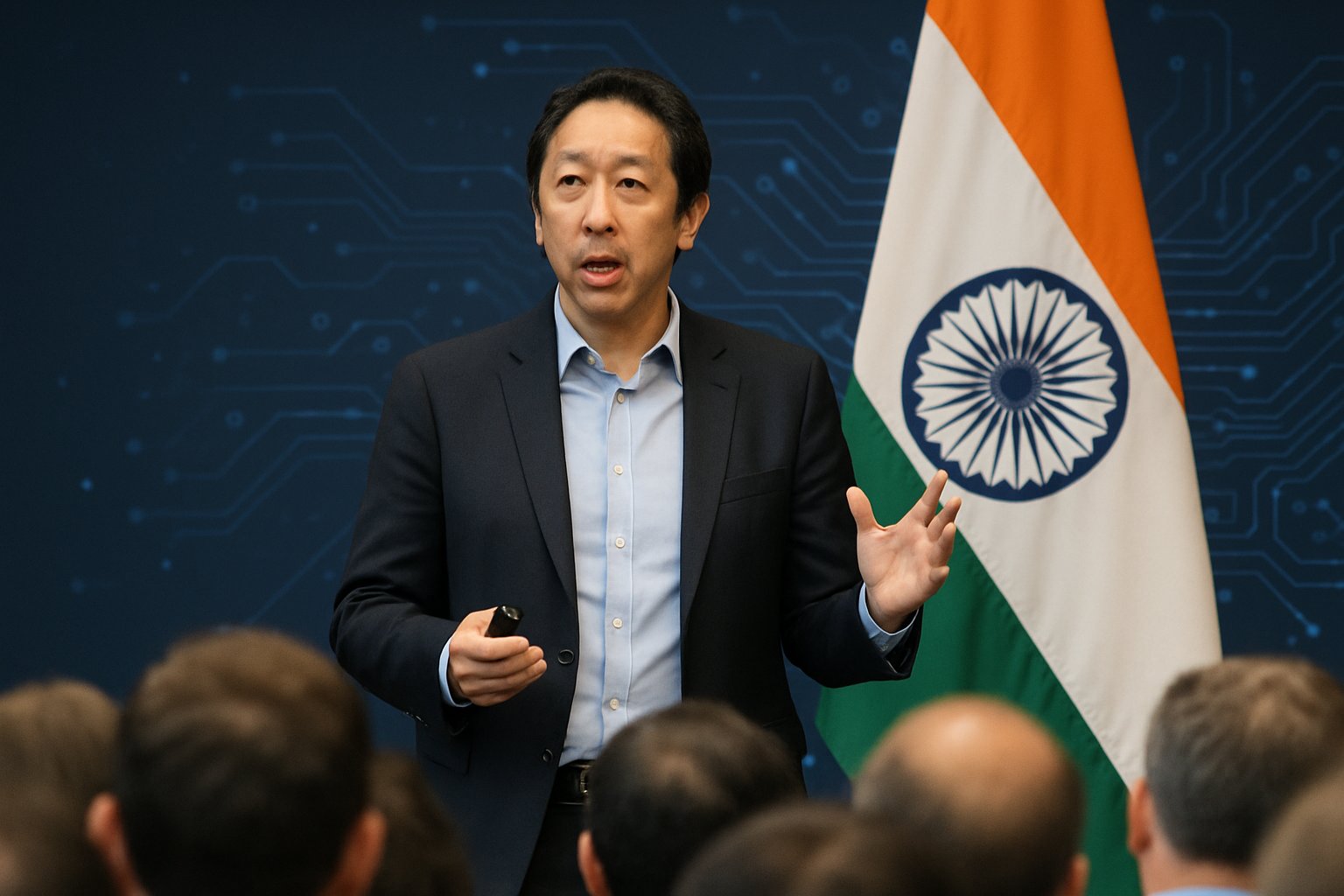
Reporters also asked about labour disruption. Ng replied, “People that know AI will replace people that don't,” emphasising proactive skilling. Consequently, the veteran researcher linked technical openness with human capital development.
Ng’s remarks connected technology strategy with workforce realities. Nevertheless, broader structural questions await deeper analysis in India.
India's Strategic AI Dilemma
India sits at a crossroads between sovereign development and collaborative tooling. The government champions Digital Public Infrastructure such as Aadhaar and UPI. Meanwhile, several ministries already pilot Open Source chatbots for citizen services. Moreover, initiatives like AI4Bharat and Bhashini showcase open language resources funded by philanthropy. In contrast, some policymakers still push for fully closed, sovereign models to guard data.
Nasscom and Arthur D. Little estimate DPI could reach four percent of GDP by 2030. Consequently, decisions on model openness influence billions in future value. Ng warns that missing the collaborative wave may saddle India with higher costs and slower innovation.
India therefore faces a strategic fork. Next, we assess why proponents champion the collaborative side.
Benefits Of Open Source
Advocates list three immediate advantages. First, shared code slashes compute and licensing bills for startups. Second, transparent weights accelerate research reproducibility and security auditing. Third, community governance diffuses geopolitical choke points across multiple actors.
- WEF reports AI wages in India have climbed 27% since 2019.
- India’s IT services revenue stands near USD 280 billion yearly.
- DPI value could triple to 4% of GDP by 2030.
Open Source ecosystems already illustrate these benefits through Meta’s Llama and Germany’s Falcon initiatives. Furthermore, AI4Bharat uses permissive licenses to localise speech models across 22 Indian languages. Professionals can enhance their expertise with the AI Ethics Professional™ certification. Ng argues that India’s contribution to Open Source repositories would unlock similar community dividends.
Cost, speed, and autonomy underpin the collaboration case. However, sceptics caution that openness invites new threats, which we examine next.
Risk And Safety Concerns
Security researchers highlight several stark dangers. Malicious actors can fine-tune public weights for misinformation, biothreat planning, or sophisticated phishing. In contrast, closed providers gate risky capabilities through usage policies and monitoring. Critics fear that Open Source weights lower barriers for threat actors with modest resources. Moreover, partial openness sometimes masks proprietary control, a practice OECD calls “openwashing”.
Yoshua Bengio and other safety voices urge calibrated release frameworks with red-team testing. Consequently, Ng supports layered mitigations like model cards, toxicity filters, and community oversight. Still, he contends that benefits outweigh risks when India invests in safeguards.
The debate thus boils down to risk governance rather than binary openness. Subsequently, workforce readiness becomes the parallel imperative.
Upskilling And AI Education
India’s IT labour pool exceeds five million professionals. However, only a fraction possess deep machine-learning expertise. Coursera data show that AI courses attract rapidly growing enrolments from Tier-2 cities. Ng insists that scalable AI Education initiatives must reach this demographic to sustain competitiveness.
Furthermore, enterprise learning budgets now blend MOOCs, in-house labs, and university partnerships. Many programs revolve around Open Source tooling for hands-on practice. Professionals acquiring prompt-engineering and model-evaluation skills command premium wages. Therefore, leaders are advised to tie AI Education metrics to career progression.
A skilled workforce reduces misuse risk and expands home-grown innovation. Consequently, policy design must align talent, infrastructure, and openness, which we discuss next.
Policy Paths Moving Forward
Policymakers can adopt a balanced multi-track agenda. First, mandate safety documentation for every domestic Open Source deployment. Second, fund shared compute clusters that prioritise researchers contributing code upstream. Third, integrate export-control style reviews for large weight releases to foreign entities. Moreover, incentives for multilingual datasets should mimic the AI4Bharat grant model.
Industry alliances could draft voluntary standards in partnership with OECD and WEF experts. Consequently, India would project responsibility while maintaining open-source momentum.
Balanced rules can unlock innovation without sacrificing safety. Finally, we distill the discussion into actionable insights.
Key Takeaways And CTA
India’s AI future hinges on collaboration, governance, and talent. Open Source participation offers affordable models, geopolitical resilience, and faster iteration. However, uncontrolled releases could empower malicious tools at unprecedented scale. Rigorous AI Education pipelines therefore remain equally crucial for safe adoption. Moreover, integrated safety documentation, model cards, and audit trails can curb abuse without stifling openness. Consequently, policymakers should craft incentives for transparent practice rather than restrictive prohibitions. Indian firms meanwhile can pilot shared compute clusters to test community governance models. Professionals can enhance credibility with the AI Ethics Professional™ certification, recognised across global enterprises. Subsequently, graduates may lead red-team exercises that strengthen national AI defences. Take the next step today and help shape an inclusive, innovative Indian AI ecosystem.


