

AI CERTs
2 hours ago
AlphaFold3: Clarifying Origins, Powering Gene Editing
Biology’s structure puzzle pieces are snapping together faster than ever. Driving the acceleration is AlphaFold3, the latest deep-learning model predicting multi-molecule assemblies with atomic detail. Consequently, researchers in Gene Editing now validate candidate enzymes and binders in silico before lifting a pipette. However, confusion persists over who actually released the model and how enterprises can deploy it efficiently. This article untangles the origin story, evaluates Nvidia’s contribution, and maps practical paths from prediction to bench. Moreover, we highlight compute constraints, emerging governance debates, and concrete Gene Editing wins informed by structural insight.
Industry readers gain a concise briefing shaped for decision makers overseeing bio-AI pipelines. Additionally, the piece links to a Chief AI Officer certification for leaders seeking formal skills recognition. By the end, you will know which stack supports your timeline, budget, and regulatory obligations. Consequently, strategic planning can shift from speculative to actionable within the quarter.
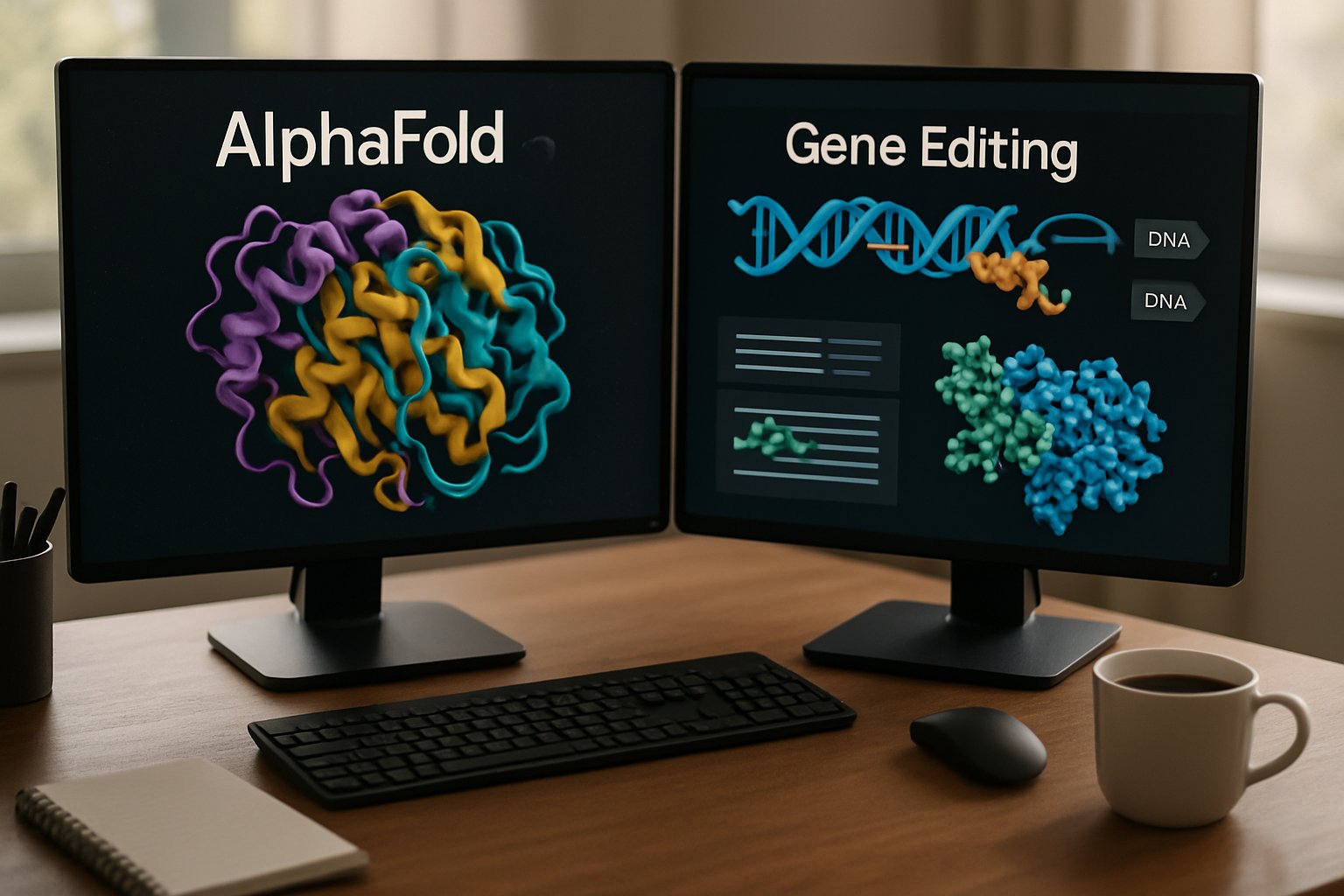
AlphaFold3 Model Origins Clarified
First, it is essential to credit the right laboratory. DeepMind, in partnership with Isomorphic Labs, created AlphaFold3, releasing papers, a server, and later restricted code. In contrast, Nvidia packaged OpenFold3, a PyTorch re-implementation inspired by the original architecture. Therefore, headlines claiming Nvidia 'released AlphaFold3' misrepresent the situation. The company instead offers an accelerated inference container named OpenFold3 NIM on its GPU platform.
Meanwhile, the open-source OpenFold consortium led by Columbia’s AlQuraishi lab ensures transparency and community governance. Subsequently, users can choose between DeepMind’s official path or the OpenFold3 route, depending on license needs. These distinctions matter for grant compliance and downstream commercialization. Consequently, project leads must verify terms before embedding models into automated pipelines.
DeepMind owns the core model while Nvidia supplies an optimized derivative. Understanding this split prevents legal surprises; next, we examine Nvidia’s technical stack.
Nvidia's OpenFold3 Stack Explained
Nvidia’s BioNeMo Inference Microservice, branded NIM, wraps OpenFold3 into a production-ready container. Furthermore, the stack integrates cuEquivariance kernels and MMseqs2-GPU acceleration to shorten runtime. Benchmarks show single H100 GPUs handling complexes with roughly 5,000 tokens in minutes rather than hours. Additionally, multi-GPU scaling through Triton inference serves many concurrent requests for high-throughput screening campaigns.
Developers pull the image from Nvidia NGC and launch with a single docker run command. However, the container still requires reference databases approaching one terabyte in size. Therefore, storage and network throughput planning remain critical. Notably, the stack supports all AlphaFold3 output formats, easing comparison between implementations. Consequently, scientists can reproduce published AlphaFold3 results while benefiting from Nvidia’s customer support.
This toolbox blends open code with enterprise reliability. With infrastructure mapped, we now explore live Gene Editing applications.
Gene Editing Use Cases
Laboratories increasingly pair generative protein design with structural validation to enhance editing precision. For example, a 2025 Cell paper designed an MLH1 binder using RFdiffusion and then scored candidates with AlphaFold3 before synthesis. Moreover, the optimized binder boosted prime editing efficiency eighteen-fold in HeLa assays. Consequently, similar in silico triaging is spreading to base editors, Cas variants, and delivery vectors.
Teams favoring Nvidia infrastructure integrate the OpenFold3 NIM directly into robotic screening loops. Meanwhile, academic Gene Editing groups often rely on DeepMind’s hosted server to avoid hardware costs. Nevertheless, both strategies shorten design cycles, lowering per-variant evaluation time from days to hours.
Early results demonstrate meaningful functional gains. However, compute and access challenges still loom.
Compute And Access Hurdles
Running state-of-the-art structure models demands formidable hardware. DeepMind recommends A100 or H100 GPUs with eighty gigabytes of memory for complex AlphaFold3 runs.
- GPU: A100 or H100, 80 GB memory
- Databases: >1 TB sequence and templates
- CUDA driver: Version 12 or higher
Additionally, sequence and template databases can exceed one terabyte, stressing network mounted storage. In contrast, smaller labs may choose hosted servers, sacrificing throughput for simplicity.
Licensing also complicates planning. DeepMind permits non-commercial research use under academic terms, whereas commercial exploitation requires negotiation. OpenFold3 offers Apache licensing, yet some pretrained weights carry separate notices. Therefore, counsel should review every dependency before product launch.
Hardware and legal filters remain significant. Next, we examine benefits that justify such investment.
Benefits For Drug Discovery
Despite hurdles, structure-first pipelines unlock unprecedented insight for medicinal chemists. Moreover, AlphaFold3 predicts interactions among proteins, nucleic acids, and small molecules within one coherent framework. Consequently, researchers can screen mutation effects, ligand poses, and off-target risks earlier in discovery.
- Earlier binding affinity ranking
- Reduced wet-lab iterations
- Improved off-target assessment
Pharma companies already report accelerated hit-to-lead progression when integrating structural scores with high-content assays. Additionally, Nvidia claims its NIM cuts average inference cost per complex by over sixty percent. These gains directly translate into shorter project timelines and reduced attrition.
Predictive accuracy plus speed yields clear monetary value. However, societal oversight must keep pace.
Governance And Safety Concerns
Rapid capability growth raises dual-use questions. Scientists worry malicious actors could co-opt AlphaFold3 style modelling to optimize harmful proteins. Therefore, DeepMind initially limited access, sparking criticism from open science advocates. Subsequently, the group released code and weights under controlled academic terms to balance innovation and security.
Meanwhile, policy makers discuss licensing, auditing, and watermarking to detect and deter misuse. Industry stakeholders should participate early to shape pragmatic, enforceable rules.
Responsible governance will underpin public trust. Finally, we outline practical next steps for teams.
Practical Deployment Guidance Today
Project managers should begin with a clear question and dataset size estimation. Next, choose either DeepMind’s hosted AlphaFold3 server for prototypes or Nvidia’s OpenFold3 NIM for sustained throughput. Furthermore, budget for at least eighty gigabytes of GPU memory plus one terabyte of storage. Create a versioned workflow defining sequence retrieval, structure prediction, scoring, and downstream experimental validation.
Developers should containerize custom code to ensure identical environments across laptops and clusters. Moreover, schedule nightly regression tests to catch silent library updates. Professionals can enhance their expertise with the Chief AI Officer™ certification.
Robust engineering and continuous learning safeguard long-term ROI. We close with key insights and an action prompt.
AlphaFold3 and its OpenFold3 cousin are reshaping molecular biology’s practical toolkit. DeepMind supplies foundational science, whereas Nvidia delivers enterprise-grade acceleration. Consequently, Gene Editing innovators can iterate faster, validate designs earlier, and save resources. However, hardware, licensing, and governance still demand meticulous planning. Moreover, teams that embrace rigorous engineering and professional upskilling mitigate these risks. Therefore, explore certification pathways, assemble an aligned roadmap, and propel your next discovery to clinic. Subsequently, stakeholders will convert structural predictions into tangible therapies that improve patient outcomes. Act now to secure strategic advantage before competitors scale similar pipelines. Invest early, iterate often, and measure impact with disciplined metrics.


