

AI CERTs
3 hours ago
Alibaba Qwen unveils open Qwen3-ASR speech models
On 30 January 2026, Alibaba open-sourced its new Qwen3-ASR speech stack. Consequently, the release signals a fresh milestone for developers focusing on real-time voice applications. The flagship family features two Automatic Speech Recognition models and a companion forced aligner. Moreover, support spans 52 languages and dialects, promising broad global reach. Time-to-first-token latency reportedly drops to 92 milliseconds for the smaller variant.
Meanwhile, the 1.7-billion-parameter model targets state-of-the-art transcription accuracy. However, independent benchmarks must confirm these claims. Industry observers note that Alibaba Qwen continues to position open models as an "operating system" for AI innovation. Therefore, enterprises and researchers should evaluate the announcement carefully. Additionally, the release arrives amid intense competition in open Speech-to-Text tooling.
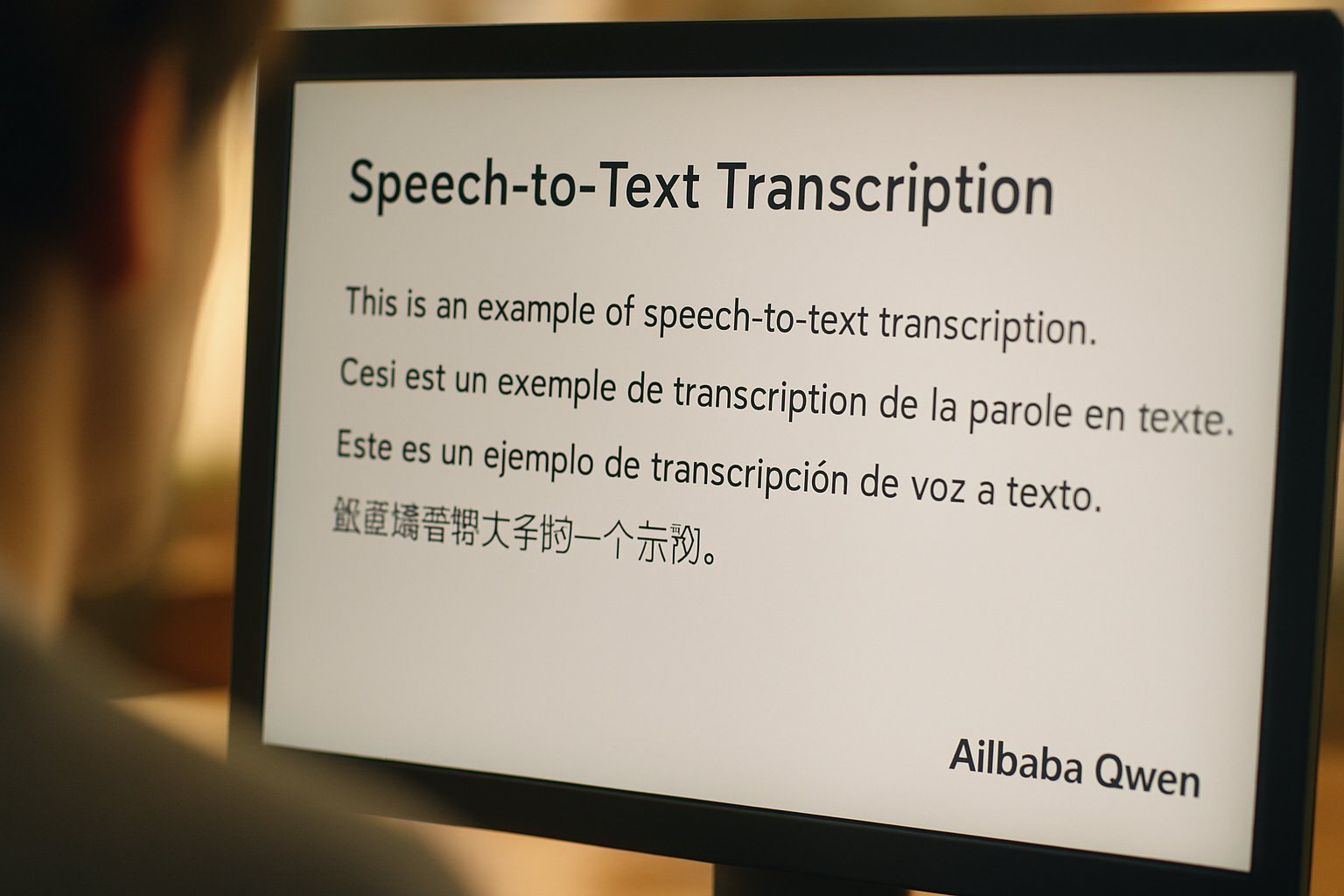
Open Models Released Globally
Alibaba published the Qwen3-ASR repository on GitHub and Hugging Face on 29 January 2026. Furthermore, weights, code, and model cards arrived under the permissive Apache-2.0 license. Consequently, businesses can embed the stack without negotiating commercial royalties.
The release includes two ASR variants and one forced aligner. Moreover, Alibaba Qwen emphasises support for long audio up to twenty minutes per pass. Therefore, podcasters and call-centre teams can batch process recordings efficiently. A Gradio demo Space enables instant experimentation inside a browser.
The GitHub repository bundles ready-to-use Dockerfiles for CPU, CUDA, and ROCm backends. Additionally, environment files simplify dependency management across Ubuntu and CentOS images. Consequently, newcomers can spin up demos in minutes on modest hardware.
These assets mark a significant commitment to openness. However, deeper technical scrutiny follows in the next section.
Alibaba Qwen Vision Statement
During the announcement, Alibaba Cloud executive Eddie Wu framed the effort as foundational. Moreover, he described Alibaba Qwen as the prospective "operating system" for enterprise AI. Consequently, the open speech models complement earlier text, vision, and TTS releases.
In contrast, many rivals still guard leading Speech-to-Text models behind paywalls. Therefore, Alibaba positions itself as an enabler rather than a gatekeeper. Additionally, the Apache-2.0 license invites forks and downstream research.
This vision highlights community collaboration at global scale. Subsequently, technical specifications reveal how the promise translates into practice.
Technical Specs And Claims
The flagship Qwen3-ASR-1.7B model hosts 1.7 billion parameters within a Transformer encoder-decoder design. Additionally, a lighter 0.6B option trades accuracy for latency and throughput. Furthermore, the companion Qwen3-ForcedAligner performs non-autoregressive timestamp alignment.
Alibaba Qwen documents claim support for 30 languages plus 22 Chinese dialects. Moreover, each pass can handle audio stretches reaching twenty minutes. Vendor benchmarks list singing WER at 13.9 percent for Chinese vocals. However, community leaderboards still await independent submissions for verification.
Latency matters for live conferencing. Consequently, Alibaba reports a 92-millisecond time-to-first-token on the smaller model. Meanwhile, asynchronous pipelines with vLLM allegedly process two thousand seconds of audio per second.
Below, key specifications summarise the release at a glance.
- Parameter sizes: 1.7B and 0.6B choices.
- Language coverage: 30 languages plus 22 dialects.
- Latency goal: 92 ms time-to-first-token.
The specifications underline aggressive engineering targets. Nevertheless, real-world comparisons provide clearer context, explored next.
Performance Versus Market Leaders
Independent speech leaderboards currently rank IBM Granite and NVIDIA Canary near the top. In contrast, official entries for Qwen3-ASR are still pending. Therefore, Alibaba Qwen encourages researchers to submit transparent evaluations.
Nevertheless, Alibaba's internal studies pit Qwen3-ASR-1.7B against Whisper large-v3 and GPT-4o Transcribe. Reported Chinese WER beats Whisper by three-tenths of a percentage point on selected data. However, the sample size remains undisclosed.
Developers often balance accuracy, cost, and latency. Consequently, the 0.6B model's speed may prove decisive for streaming chat agents. Moreover, Alibaba's cloud endpoints price traffic at $0.00009 per second outside China.
Cost efficiency often outranks marginal accuracy for customer-facing chatbots. Consequently, smaller models that scale horizontally can dominate production workloads. Furthermore, open weights avoid data residency hurdles common in regulated industries.
Early indicators suggest competitive performance with caveats on transparency. Accordingly, deployment scenarios merit closer attention now.
Practical Deployment Scenarios Now
Enterprises can self-host models via Docker or accelerate inference through vLLM streaming backends. Additionally, Alibaba Cloud offers "flash" and "realtime" APIs across Singapore, the United States, and Mainland China. Consequently, teams may blend on-prem privacy with burst cloud capacity.
Common use cases include live captions, customer-service analytics, and subtitle generation for streaming media. Moreover, Qwen3-ForcedAligner simplifies karaoke lyric timings and audio search indexing. Professionals can enhance their expertise with the AI Developer™ certification.
- Live captioning for events
- Call-centre sentiment analytics
- Media subtitling workflows
- Karaoke lyric alignment
- Voice search indexing
Speech-to-Text integration requires careful pipeline orchestration. Therefore, Alibaba Qwen provides example Python scripts for batch and streaming cases. Meanwhile, vLLM routes gRPC calls, ensuring low overhead across concurrent sessions.
Deployment flexibility stands out as a primary advantage. Nevertheless, risks require parallel evaluation, discussed next.
Risks And Open Questions
High-quality Speech-to-Text tools can accelerate malicious deepfake production. Consequently, policymakers urge vendors to integrate watermarking and detection APIs. In contrast, Alibaba Qwen has not detailed concrete mitigation roadmaps yet.
Another concern involves the provenance of training audio. Moreover, copyrighted materials may inhabit large web crawls unintentionally. Therefore, legal teams should conduct due diligence before commercial deployment.
Privacy regulations such as GDPR demand clear data retention policies. Therefore, teams should configure local logging and secure any uploaded audio. Moreover, automated redaction of sensitive identifiers can reduce compliance risk.
Ethical and legal uncertainties could complicate adoption timelines. Subsequently, strategic implications deserve industry reflection.
Strategic Industry Implications Ahead
Open sourcing advanced speech models reshapes competitive balance across cloud platforms. Consequently, enterprises gain bargaining power when negotiating vendor contracts. Moreover, Alibaba Qwen could spur rivals to loosen licensing on their own assets.
Analysts expect a shift toward vertically integrated voice agents running locally. Therefore, Speech-to-Text, TTS, and large language models will converge inside unified toolchains. Additionally, certification programs like the linked AI Developer™ credential help teams stay current.
Investors also monitor how open speech models influence chip demand for inference acceleration. Meanwhile, cloud providers race to optimise kernels for INT4 and FP8 precision. Consequently, hardware and model innovation remain tightly coupled.
The competitive dynamics appear fluid and fast-moving. Finally, readers can act on insights in the concluding section.
In summary, Alibaba Qwen's open release of Qwen3-ASR offers developers a flexible, multilingual speech toolkit. Moreover, permissive licensing reduces deployment friction across cloud, edge, and regulated environments. Nevertheless, independent benchmarking and ethical safeguards remain urgent priorities. Consequently, professionals should prototype early, measure honestly, and publish transparent results. Additionally, pursuing the AI Developer™ certification can solidify core skills for production deployments. Take action today and transform your voice applications with Qwen3-ASR. Moreover, community participation will validate claims and harden best practices. In contrast, passive observers may miss early adopter advantages. Consequently, start experimenting with multilingual speech pipelines today.


