

AI CERTS
2 hours ago
Alibaba AI Chip Zhenwu 810E: Specs, Strategy, and Market Impact
However, Alibaba positions Zhenwu as more than a replacement. It forms the final pillar in a self-controlled stack spanning chips, models, and cloud services. Consequently, the launch matters for engineers planning large-scale Training jobs or latency-critical Inference workloads. Moreover, export controls amplify the strategic value of domestic accelerators. This article dissects the technical highlights, business implications, and open questions around the Alibaba AI Chip initiative. Readers will gain a balanced, data-driven view suited to procurement and architecture decisions. Consequently, strategic planners cannot ignore this milestone.
Strategic Launch Context Explained
Zhenwu 810E surfaced on T-Head’s website with minimal fanfare yet massive supply chain implications. Previously, Alibaba relied on foreign GPUs subject to tightening United States export rules. Therefore, the Semiconductor Spinoff escalated internal design programs to secure compute sovereignty. Management signaled this urgency during multiple 2025 earnings calls. Meanwhile, Chinese media framed Zhenwu as completing Alibaba’s “golden triangle” of model, cloud, and hardware.
In contrast, Western analysts emphasized the need for verified benchmarks before celebrating parity with Nvidia. Nevertheless, early customer counts exceed 400 enterprises, including State Grid and XPeng. Reports also mention multiple ten-thousand-card clusters already active inside Alibaba Cloud data centers. Such numbers, if accurate, indicate production maturity beyond a typical pilot phase. Consequently, procurement teams must watch for public datasheets and delivery lead-time confirmations.
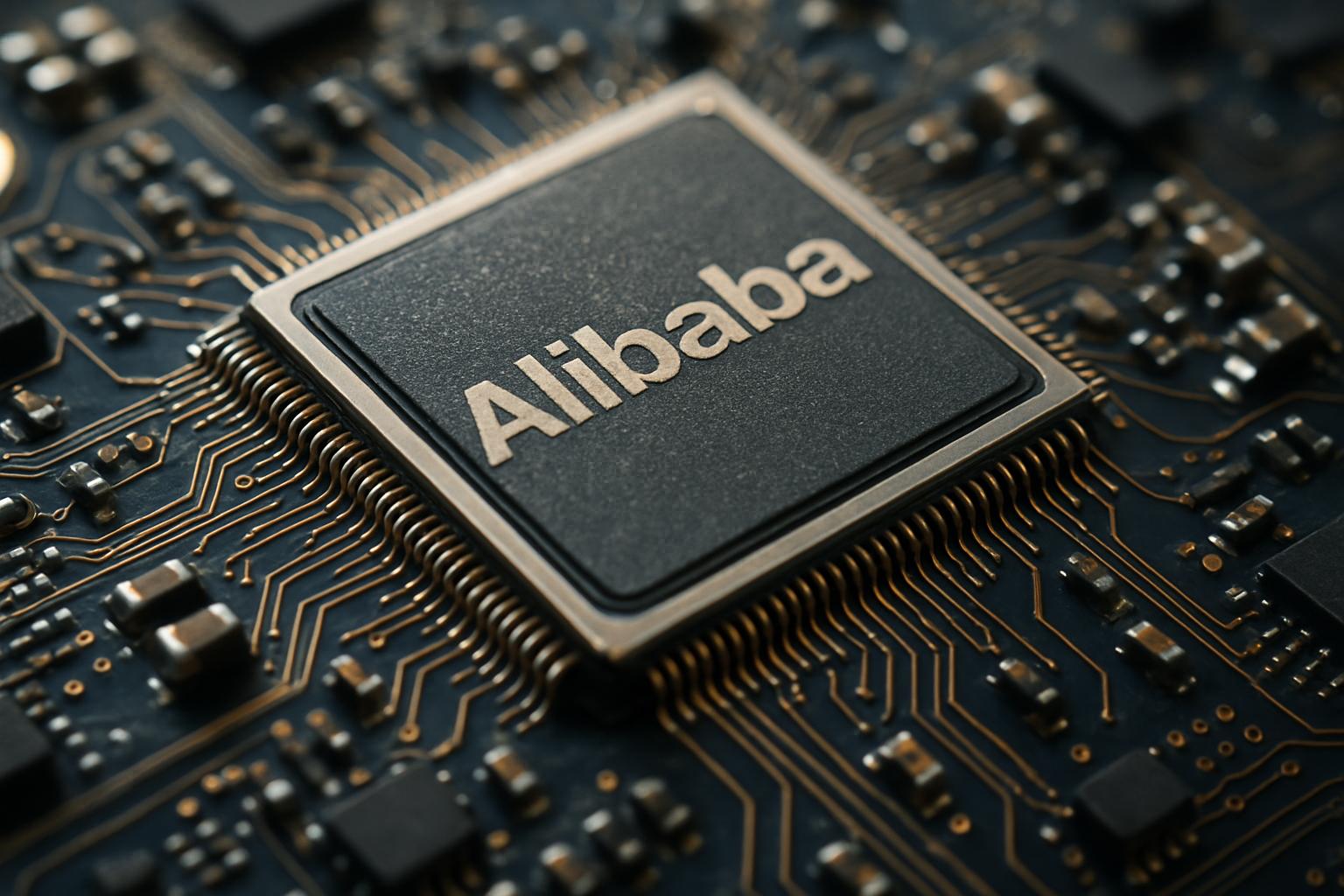
Zhenwu’s quiet debut masks aggressive internal scaling already underway. However, independent evidence remains essential before enterprises place strategic orders. With the contextual stakes clear, specifications demand closer inspection.
Zhenwu 810E Specifications Overview
The Alibaba AI Chip card pairs a custom parallel processing unit with on-package high bandwidth memory. Moreover, press releases highlight headline metrics rivaling Nvidia’s H20. Key published figures include the following.
- 96 GB HBM2e delivering massive on-chip working sets for giant models.
- 700 GB/s inter-chip bandwidth across seven dedicated ICN links for near-linear scaling.
- PCIe 5.0 x16 host interface aligning with next-generation server motherboards.
- Approximate 400 W board power requiring dense liquid or hybrid cooling.
- Full in-house compiler stack claimed compatible with mainstream PyTorch and TensorFlow.
Additionally, company graphics suggest FP16, BF16, and INT8 data types with hardware acceleration. However, peak teraFLOP numbers, clock rates, and foundry nodes remain undisclosed publicly. Consequently, comparing rated throughput against Nvidia A100 or Huawei Ascend requires caution. Still, Alibaba claims internal benchmarks match or surpass Nvidia A800 in several transformer tasks. These specifications promise serious horsepower. Furthermore, deeper performance tests will confirm whether real workloads achieve the theoretical targets. Performance matters most for Training and equally for Inference, so the next section focuses there. The Alibaba AI Chip thus enters procurement specification sheets across Alibaba Cloud’s partner ecosystem.
Training And Inference Performance
Alibaba positions Zhenwu as symmetrical silicon for both Training and Inference rather than a split portfolio. Therefore, customers could deploy unified clusters, reducing operational complexity. Press interviews cite internal Qwen-14B fine-tuning completing 18% faster versus Nvidia A800 clusters. Nevertheless, third-party verification, like MLPerf Training submissions, is not yet available. Meanwhile, latency numbers for 8-card inference pods reportedly beat 12 ms on 7-billion parameter chat models. In contrast, Nvidia A100 running identical prompts delivered around 16 ms in company tests.
Consequently, Zhenwu may lower tail-latency penalties in consumer services like Weibo trending. Energy efficiency remains a question because 400 W represents only chip power, excluding cooling overhead. Moreover, sustained throughput hinges on compiler maturity and communication latency across those seven ICN links. Preliminary figures appear promising. However, enterprises should demand real, audited datasets before migrating critical Training schedules. Implementing the Alibaba AI Chip can unify performance baselines worldwide once export barriers lift. Competitive pressures frame these performance debates, so the landscape deserves scrutiny next.
Competitive Landscape And Risks
The Alibaba AI Chip now occupies the domestic premium segment alongside Huawei Ascend and Biren BR104. Internationally, Alibaba must still confront Nvidia H20 and AMD MI300 accelerators. However, export licensing hurdles limit direct Nvidia competition inside mainland China. Consequently, domestic vendors benefit from demand overflow. Yet hardware parity alone cannot guarantee adoption. Analysts warn that ecosystem fragmentation could mirror previous CPU diversification waves.
Moreover, Zhenwu currently depends on proprietary ICN links, creating vendor lock-in risk. Software stability carries equal weight. In contrast, Nvidia has spent fifteen years refining CUDA libraries, profilers, and community tooling. Therefore, Alibaba must accelerate compiler hardening, documentation, and developer outreach. Manufacturing opacity raises further doubts. Reports remain silent on process node, yield rates, and packaging partners. Every Alibaba AI Chip sale weakens Nvidia’s historical lock on Chinese hyperscalers.
Competitive gains look real but conditional. Subsequently, market forecasts must weigh these uncertainties. The following section estimates potential revenue influence through 2026.
Market Impact Forecast 2026
Market researchers predict the data center accelerator market will exceed $200 billion by decade’s end. Consequently, even single-digit share gains translate to multibillion-dollar incremental revenue. Investors now study the Semiconductor Spinoff for eventual IPO signals. Alibaba Cloud already posted 34% AI revenue growth in late 2025, according to NBD coverage. Furthermore, the company claims 400 enterprise customers using Zhenwu-powered clusters in production. Assuming an average 32-card node, that footprint implies more than 12,000 shipped boards. Therefore, unit revenue likely already approaches hundreds of millions of dollars. MarketsandMarkets forecasts a 25% compound annual growth for accelerators through 2030.
If Alibaba maintains pace, the Alibaba AI Chip line could secure a durable domestic niche. Nevertheless, global share depends on export regulations and cross-border cloud expansion. Revenue upside seems tangible yet policy-dependent. Consequently, developers must evaluate long-term roadmap resilience alongside near-term performance gains. Those developer considerations form the next focus.
Developer Ecosystem Considerations Ahead
Hardware power means little without accessible tooling and community momentum. Therefore, T-Head released a unified compiler supporting PyTorch frontend APIs and ONNX interchange. However, early adopters report minor operator coverage gaps during complex reinforcement workloads. Moreover, profiling integration with standard NVIDIA Nsight equivalents remains immature. Early SDK releases bundle emulation for the Alibaba AI Chip to ease laptop prototyping. Subsequently, Alibaba intends to open-source select runtime libraries to stimulate contributions. In contrast, Google’s TPU community gained critical mass only after broad Keras support.
Consequently, Alibaba must replicate that playbook quickly. Meanwhile, campus outreach and stipend programs could enlarge the domestic talent pipeline. The Semiconductor Spinoff will host biannual hackathons to surface optimization ideas. Tooling gaps are solvable but urgent. Therefore, the final section summarizes action points for buyers and builders.
Key Takeaways
Zhenwu 810E signals a decisive stride toward sovereign high-end compute for Alibaba and China. Headline specs, early deployment counts, and integration with Tongyi models establish credible momentum. However, the absent third-party benchmarks and opaque manufacturing details warrant continued vigilance. Furthermore, software tooling must mature before mainstream developers shift mission-critical Training or Inference tasks.
Nevertheless, early results justify pilot projects using contained workloads. Decision makers should track forthcoming MLPerf data, pricing disclosures, and SDK updates. Meanwhile, professionals can future-proof skills by securing the AI Developer™ certification highlighted earlier. Take that step today and stand ready for the next generation of accelerated computing.


