

AI CERTS
2 hours ago
Algorithmic Trust Study Reveals Human Bias Limits
This article unpacks the new findings, compares policy responses, and outlines practical steps drawn from University Exeter research teams, global surveys, and live clinical deployments. Throughout, the Algorithmic Trust Study acts as the through line connecting data to action.
Bias Shapes Trust Shifts
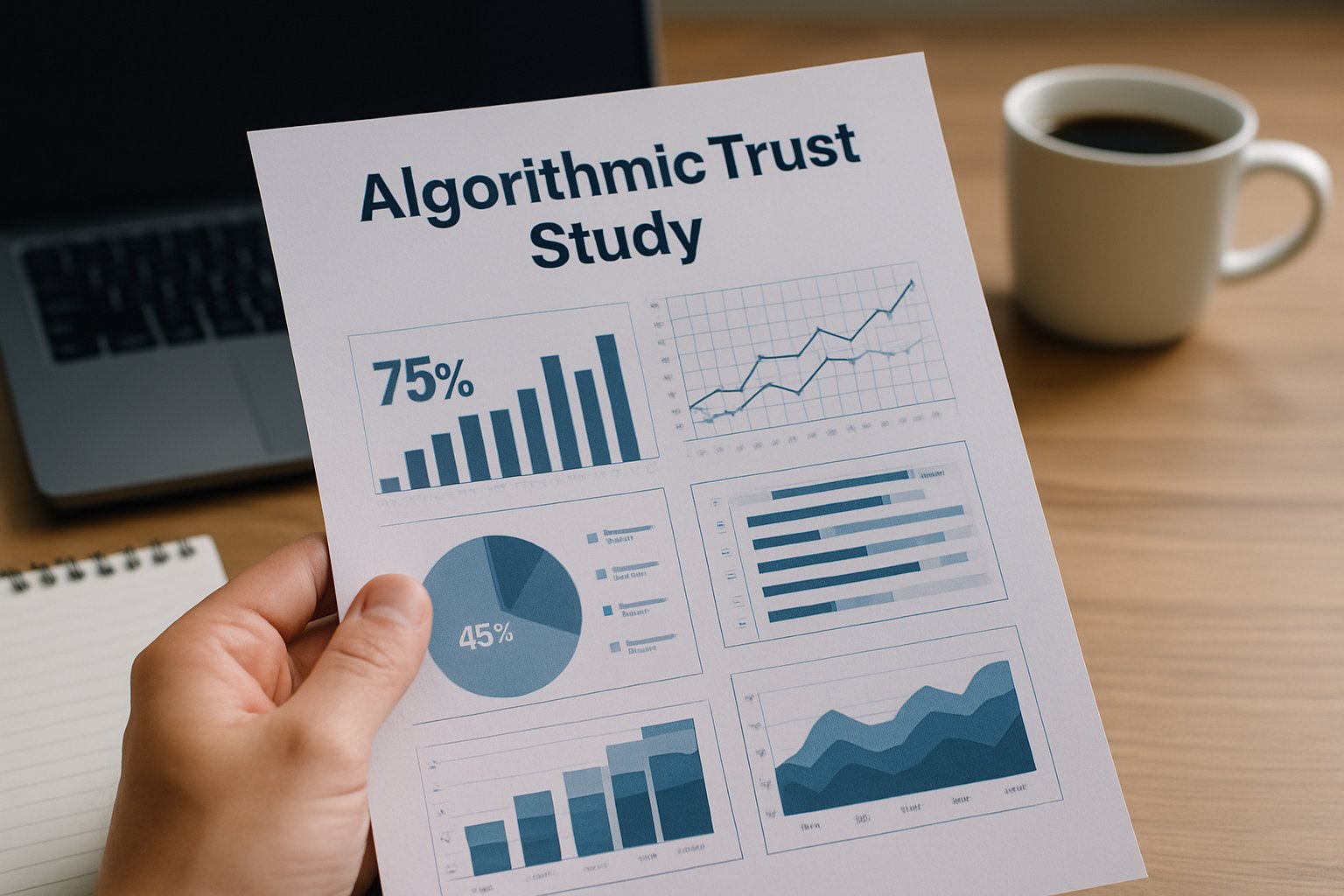
Human bias appears in every evaluation stage. Automation bias pushes operators to accept faulty AI advice. In contrast, algorithmic aversion leads users to ignore correct recommendations after early errors. Furthermore, recent laboratory work involving 9,000 participants confirmed that task difficulty amplifies both problems. The Algorithmic Trust Study summarizes these patterns across nine countries.
Impartiality remains difficult when interfaces hide uncertainty. Therefore, transparency features become essential. University Exeter psychologists found that simple confidence bands reduced over-reliance by 17%. These findings echo PubMed radiology trials where false positives misled clinicians during cerebral aneurysm screening.
Key takeaways emerge:
- 72% of Chinese respondents trust AI, yet only 32% of US respondents do.
- Radiologists missed anomalies 25% more often when AI highlighted wrong regions.
- Less than 50% of firms possess mature governance for trustworthy AI.
These insights confirm that bias disrupts impartiality. Nevertheless, targeted design and education can recalibrate decision-making. Next, we examine how worldwide surveys expose wider trust gaps.
Consequently, leaders should track shifting sentiment before rollout.
Global Surveys Reveal Gaps
Edelman’s 2025 Trust Barometer offers a composite snapshot. Moreover, Cisco, McKinsey, and Deloitte reports reinforce similar trends. The Algorithmic Trust Study integrates those datasets to map divergence across markets. Interestingly, adoption intent stays high even where skepticism rises.
Impartiality suffers when marketing promises clash with lived experience. Therefore, University Exeter analysts advise pairing pilots with transparent feedback loops. Meanwhile, employee polling showed 71% trust employers to act ethically on AI. However, only 43% saw concrete safeguards at work.
The numbers illustrate a widening expectations gap. These challenges highlight critical weaknesses. However, regulators are racing to close them.
Regulators Pursue Oversight
The United Kingdom released its Trusted Third-Party AI Assurance Roadmap in 2025. Additionally, the EU AI Act mandates human oversight for high-risk systems. Both frameworks cite automation bias as a policy driver. The Algorithmic Trust Study notes that legal clauses now reference trust calibration explicitly.
Nevertheless, policy can backfire if oversight teams inherit the same bias. Cambridge legal scholars caution that Article 14’s human-in-the-loop requirements may create a false sense of security. Consequently, harmonized standards and continuous evidence access become vital.
In summary, regulation acknowledges psychological realities. Still, successful execution demands better design, the topic of the next section.
Therefore, attention turns to interface choices shaping reliance.
Design Choices Influence Reliance
Explainable AI features promise clarity. However, systematic reviews show uneven results. Poorly framed explanations sometimes raise overconfidence. University Exeter usability studies confirm that icon placement and color cues shift attention more than text.
The Algorithmic Trust Study dedicates a chapter to human-centered evaluation gaps. Moreover, the research calls for standardized metrics to compare systems. Designers should test how variations affect impartiality and decision-making across demographics.
These findings stress that design equals governance. Subsequently, firms look for external signals to demonstrate reliability.
Consequently, assurance markets gain traction worldwide.
Assurance Markets Gain Momentum
Third-party audits now move from concept to commerce. Deloitte, KPMG, and PwC offer algorithm reviews aligned with the UK roadmap. Furthermore, several start-ups propose continuous monitoring dashboards. Each service aims to boost confidence without overstating certainty. The Algorithmic Trust Study tracks 27 such providers launched since 2024.
Nevertheless, only measured uptake ensures value. Impartiality improves when audits publish methods and limitations. In contrast, black-box certifications risk eroding trust. Therefore, procurement teams must verify that assurance routines address bias explicitly.
Key benefits of verified assurance include:
- Clear evidence trails supporting internal decision-making.
- Reduced liability through documented risk controls.
- Stronger market signals to skeptical stakeholders.
These advantages create momentum. However, workforce capability remains essential for sustained impact.
Subsequently, we explore upskilling pathways for professionals.
Skills And Certification Pathways
Governance adoption fails when staff lack practical expertise. Industry councils therefore recommend structured credentials. Professionals can enhance their expertise with the AI+ Human Resources™ certification. Moreover, that curriculum embeds modules on automation bias, impartiality, and ethical decision-making.
The Algorithmic Trust Study highlights that trained observers catch 30% more system errors during pilots. Additionally, certified teams integrate feedback faster, shortening remediation cycles. University Exeter case workshops show similar gains.
Next-generation leaders should combine domain skills with governance literacy. Consequently, organizations create internal academies linking design, policy, and psychology.
These initiatives close capability gaps. Nevertheless, constant review remains necessary to safeguard trust.
Section Recap And Transition
Upskilling equips teams to operationalize standards. Therefore, the final section distills lessons and sets an action agenda.
Conclusion And Next Steps
The Algorithmic Trust Study proves that technology alone cannot guarantee fair outcomes. Moreover, global surveys reveal uneven trust, while regulation introduces necessary yet imperfect safeguards. Design research shows that small interface tweaks influence reliance, and assurance markets supply external validation. Additionally, certifications build internal capability, reinforcing impartiality and robust decision-making.
Consequently, leaders should map human bias risks, adopt transparent design, and engage certified auditors. Finally, upskill teams through recognized programs to sustain calibrated trust. Explore the linked certification today and future-proof your AI strategy.


