

AI CERTs
2 months ago
Algorithmic treasury optimization engines boost liquidity
Corporate treasurers face volatile rates, fragmented data, and tighter governance. Consequently, many now explore algorithmic treasury optimization engines to regain control. These data-driven platforms combine machine learning, optimization solvers, and agentic AI. Moreover, early adopters report sharper forecasts and faster cash moves. However, surveys reveal lingering concerns about security and oversight. This article unpacks the technology, key players, benefits, and practical next steps.
Corporate Treasury Market Momentum
Market interest accelerated during 2025. Kyriba, FIS, and major banks unveiled AI-first suites that automate decision cycles. Meanwhile, Citi and EY surveys show more than 80% of treasury teams piloting AI, yet only 3% scaled deployments. Furthermore, global TMS revenues could hit mid-teens billions by 2030, according to multiple research firms. The stage is set for rapid maturity.
Adoption indicators therefore point upward. Nevertheless, scale will depend on measurable results and trusted controls. These trends lead directly to the engines powering change.
Algorithmic Treasury Optimization Engines
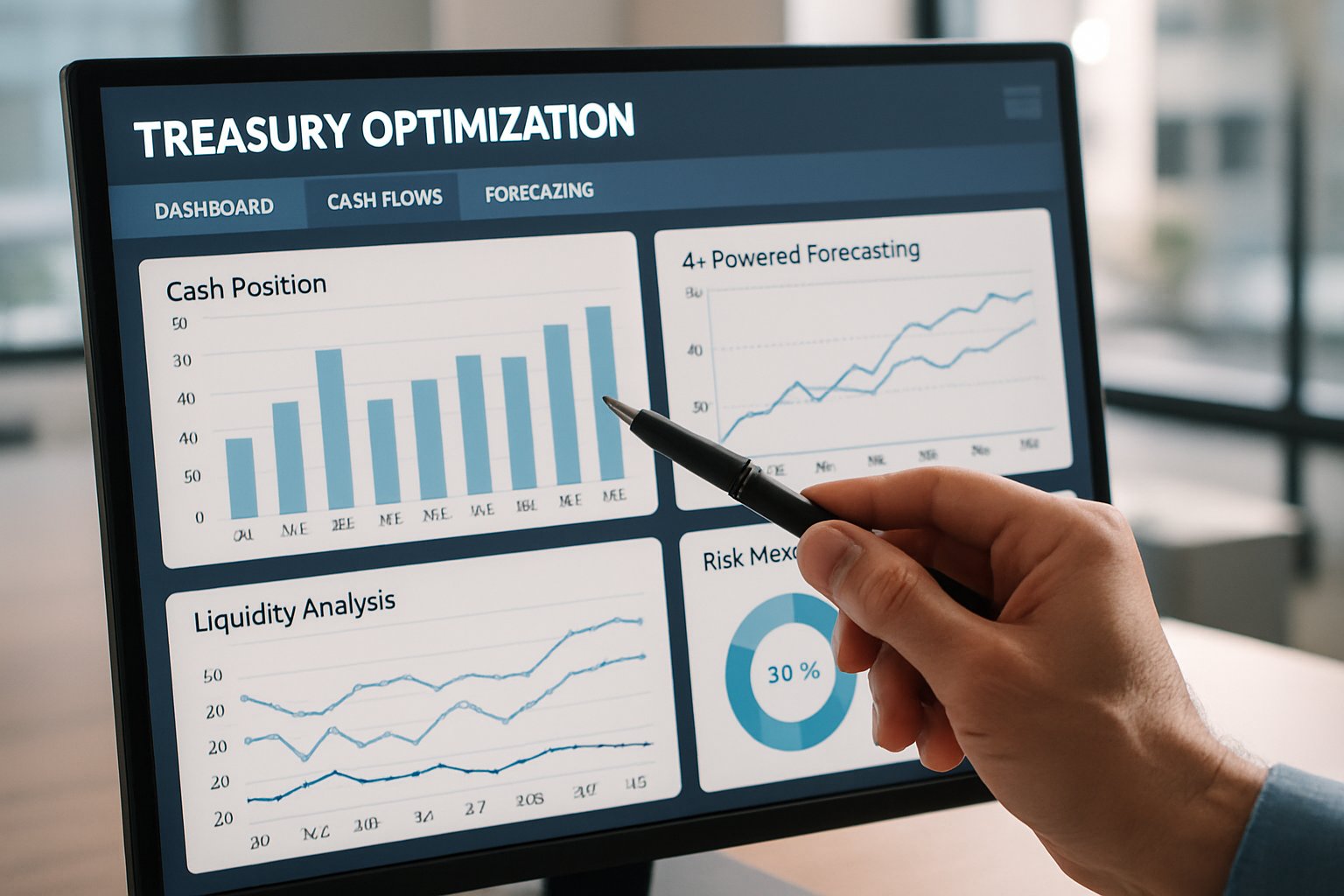
An algorithmic treasury optimization engine ingests bank, ERP, and market feeds. Subsequently, it forecasts inflows and outflows, runs liquidity scenarios, and proposes cash sweeps or short-term investments. Kyriba’s new TAI and FIS’s Neural Treasury illustrate the model. Both pair LLM reasoning with rule-based guards, ensuring recommendations stay within policy. Importantly, the primary keyword algorithmic treasury optimization engines delivers closed-loop execution under human approval.
The engines also integrate liquidity forecasting modules that learn seasonality and intraday patterns. In contrast, older TMS tools relied on static averages. Additionally, embedded cash flow AI surfaces anomalies and fraud signals alongside funding advice.
These technical upgrades reshape daily workflows. However, vendor differentiation hinges on governance, explainability, and integration depth. Understanding the supplier landscape becomes critical.
The mechanics reveal powerful potential. Consequently, treasury teams next examine who supplies credible solutions.
Key Vendors Reshape Landscape
Incumbent TMS leaders still dominate. Nevertheless, fintechs and banks now compete aggressively. Kyriba partnered with U.S. Bank to release Liquidity Manager. FIS embedded Treasury-GPT for conversational analytics. Meanwhile, Trovata acquired ATOM to build an AI-native stack.
Banks also integrate algorithms into portals. Bank of America’s CashPro added a Trade Evaluation Driver that suggests timing for USD placements. Moreover, Citi publishes practitioner guides to spur adoption.
Across offerings, algorithmic treasury optimization engines appear in marketing decks with similar claims. Therefore, procurement teams must validate proofs of concept and check audit logs. Vendor variety offers choice yet complicates due diligence.
The vendor race broadens options. However, buyers still ask whether tangible benefits outweigh transition costs.
Quantified Business Benefits Evident
Early pilots cite meaningful gains. Kyriba reports forecast error reductions exceeding 20%. Additionally, FIS customers noted quicker reconciliation cycles. The combination of liquidity forecasting and cash flow AI supports proactive funding moves, lowering idle balances.
- 53% of CFOs expect AI to redefine their role within five years.
- 43% of growth corporates already use AI to support expansion.
- Trovata now aggregates over USD 100 billion in client cash.
Furthermore, algorithmic treasury optimization engines enable execution algorithms that trim payment fees and boost short-term yield. Consequently, some treasurers see measurable carry gains within months. Verify those numbers during reference calls.
Benefits look compelling in slideware. Nevertheless, risk factors can erode returns if ignored.
Persistent Adoption Barriers Remain
Data fragmentation remains the top hurdle. Spreadsheets, multiple ERPs, and missing bank APIs disrupt model accuracy. Moreover, surveys reveal 76% of treasurers fear privacy breaches from external models.
Governance also challenges adoption. Automated execution raises concerns about duty segregation, regulatory audits, and model drift. Therefore, algorithmic treasury optimization engines must provide simulation modes and granular approvals.
Vendor lock-in risk surfaces as well. Consequently, buyers demand open APIs and exportable data schemas. Finally, the market lacks independent ROI benchmarks, limiting objective cost-benefit analysis.
These obstacles are real. However, structured implementation steps can mitigate each threat.
Implementation Success Checklist Guide
Data readiness comes first. Consolidate high-frequency feeds before enabling liquidity forecasting. Secondly, define approval hierarchies so human oversight remains intact. Thirdly, insist on explainable models that log every action. Professionals can deepen expertise through the AI Project Manager™ certification, which covers governance frameworks.
Additionally, evaluate cybersecurity posture, including private LLM deployment options. In contrast, public cloud LLMs may breach policy. Moreover, test scenario stress cases to verify engine robustness. Finally, negotiate exit clauses to curb concentration risk.
Algorithmic treasury optimization engines thrive when foundations are solid. Consequently, disciplined preparation accelerates value capture.
A clear checklist empowers teams. Meanwhile, attention turns toward what lies ahead.
Outlook For Next Phase
Industry experts expect broader automation within two years. Subsequently, agentic bots will trigger intraday funding and FX hedges with minimal clicks. Medium-term, tighter links to execution venues will emerge, blending cash flow AI with smart order routing.
Consultancies forecast widespread scaling by 2028. Moreover, regulators will formalize AI control standards, boosting trust. Algorithmic treasury optimization engines will likely become invisible infrastructure, similar to network routing today.
Nevertheless, independent benchmarks must surface to validate ROI claims. Therefore, journalists and buyers should push vendors for anonymized performance metrics.
The horizon promises deeper intelligence. Consequently, treasurers preparing now will enjoy strategic head starts.
Conclusion
Algorithmic treasury optimization engines have moved from concept to credible tools. Furthermore, vendors, banks, and fintechs now supply mature options. Combined liquidity forecasting and cash flow AI deliver faster, data-driven cash decisions. Nevertheless, success depends on data quality, governance, and careful vendor selection. Therefore, teams should follow the checklist and upskill through targeted programs. Explore certifications and engage vendors today to future-proof treasury operations.


