

AI CERTs
2 months ago
Algorithmic policy impact simulators reshape AI enforcement
Fines alone rarely change AI behavior. Regulators increasingly need predictive evidence before enforcing new rules. Consequently, simulation is moving from academic labs to policy war rooms. This article explores algorithmic policy impact simulators shaping that shift. These tools quantify how tweaks in law ripple through platforms, markets, and citizens. Moreover, they translate abstract guidelines into measurable risk, cost, and equity metrics. We examine recent developments, technology foundations, and adoption signals. Furthermore, we outline practical steps and certifications that advance practitioner skill. By the end, readers will grasp strategic benefits and open challenges. However, balanced governance remains essential throughout every simulator deployment.
Algorithmic Policy Impact Simulators
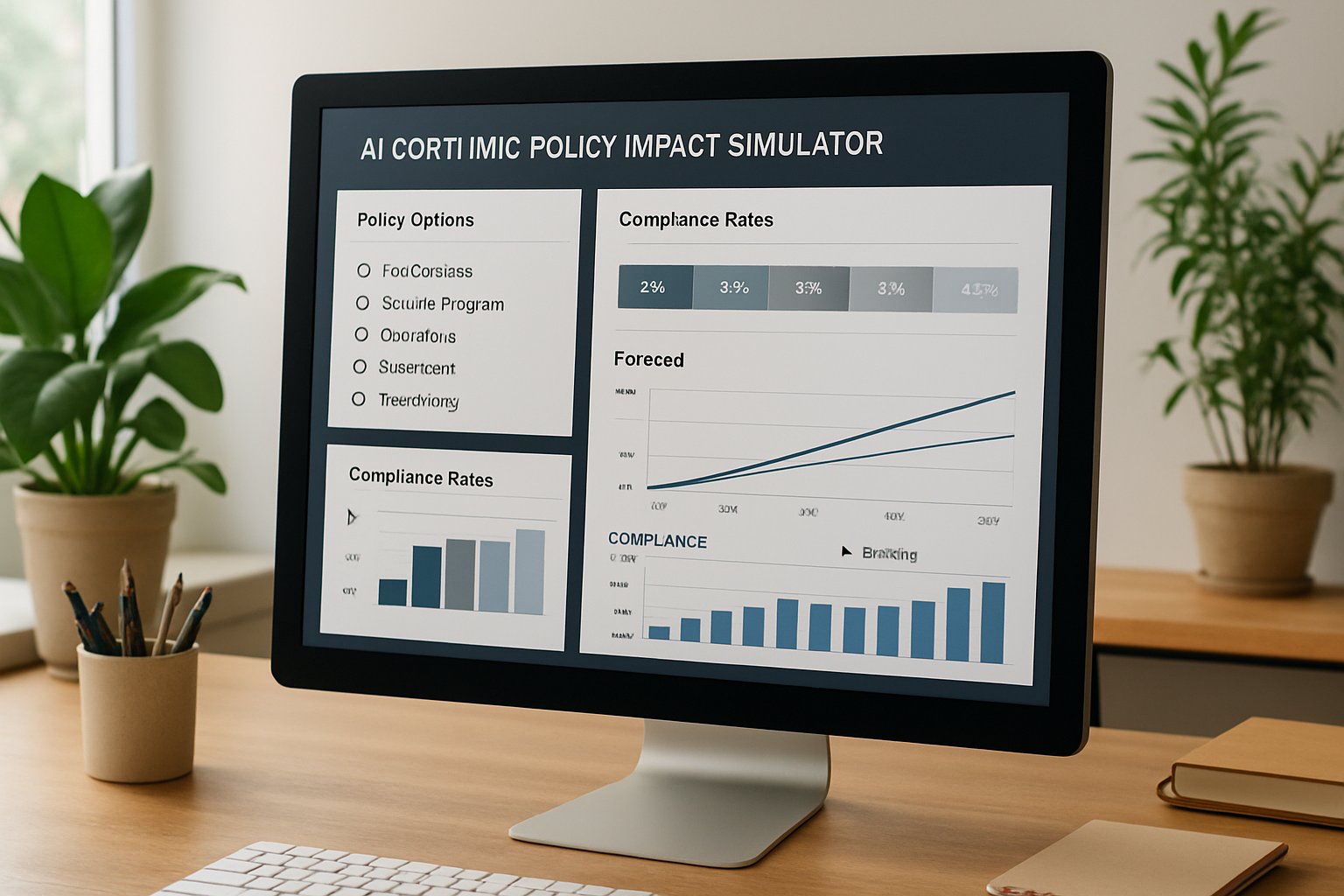
At its core, a simulator converts policy text into executable models. Therefore, agencies can test outcomes before rules hit the street. These engines blend impact assessments, rules-as-code, and agent-based worlds. Quantitative dashboards then summarise uncertainty, fairness, and workload projections for decision makers. Simulators thus bridge lofty mandates and operational evidence. Next, we examine why momentum is accelerating.
Why Simulators Now Matter
Several policy shifts push governments toward proactive analytics. Consequently, ACUS Recommendation 2024-5 urges enforcement teams to validate AI tools before delegation. Meanwhile, the EU’s ECAT demands reproducible analyses for platform oversight. Algorithmic policy impact simulators answer these demands by offering rapid regulatory forecasting at scale. Moreover, NIST’s AI RMF links simulation metrics to its Measure and Manage pillars. These converging incentives explain the heightened interest. In summary, policy pressure and standards alignment create fertile soil for adoption. Accordingly, we now unpack the underlying technology.
Core Technology Building Blocks
Modern stacks mix deterministic and stochastic modules. Rules-as-code parses legal text into executable logic. Additionally, digital twins stream live data into city scale dashboards. Agent-based or LLM-driven personas inject realistic behaviour diversity. Together, these layers feed regulatory forecasting engines that explore thousands of scenarios nightly. For deeper compliance modeling, causal components estimate distributional impacts across demographics. An evidence dashboard then visualises uncertainty bounds for auditors. Thus, algorithmic policy impact simulators become modular, explainable toolchains rather than black boxes. These architectural pillars enable varied enforcement use cases discussed next. Technology choices determine scalability and auditability. Consequently, use cases must align with available blocks.
Enforcement Planning Use Cases
Inspectors often ask which firms to audit first. Moreover, simulators can rank targets by expected harm while controlling resource spend. Algorithmic policy impact simulators run stress tests that reveal false positive risks and equity gaps. They also link regulatory forecasting outputs to staffing budgets, letting chiefs pre-approve overtime lines. For fairness reviews, compliance modeling modules quantify demographic disparities before notices go out. During extreme scenarios, multi-agent adversaries probe rule thresholds for vulnerabilities. Consequently, teams adjust detection logic before real criminals adapt. Another benefit is participatory simulation, where public dashboards invite comment on draft sanctions. Algorithmic policy impact simulators thereby convert opaque math into transparent negotiation tables. These outcomes illustrate tangible value. Use cases span prioritisation, stress testing, and engagement. Next, we assess the market landscape supporting those tasks.
Market Trends And Players
Investment in AI governance tools is soaring. For example, Mordor Intelligence pegs the market at USD 0.34 B in 2025, growing 28% annually. Furthermore, regtech trackers foresee several billion in model risk spending by 2031. Demand arises because agencies want turnkey simulation, analytics, and dashboards instead of bespoke code. Consequently, vendors brand offerings as algorithmic policy impact simulators even when components differ.
- ACUS adoption drives U.S. pilot procurements across 10 agencies.
- EU ECAT funding expands third-party audit tooling for platforms.
- City twins like DUET cut policy experimentation time by 40%.
Moreover, cloud giants now bundle simulation sandboxes with compliance suites. However, independent validation standards remain fluid, creating due diligence challenges. Market momentum is strong yet uneven. Accordingly, implementation guidance becomes crucial.
Implementation Best Practice Steps
Start small with a bounded enforcement objective. Therefore, pick one detection threshold rather than entire statutes. Insert rules-as-code for deterministic checks and plug in stochastic agents for behaviour variance. Maintain audit logs, version control, and documented calibration plans. For compliance modeling, benchmark outputs against historical cases before live deployment. Moreover, red-team the simulator to expose gaming vectors. Algorithmic policy impact simulators should always feed human review dashboards, not trigger automatic sanctions. Professionals can enhance their expertise with the AI Learning Development™ certification. Consequently, teams gain shared vocabulary and validated skills. Disciplined processes and trained staff mitigate most operational risks. Nevertheless, understanding risk trade-offs remains essential.
Key Benefits And Risks
Benefits include faster iteration, evidence-based transparency, and improved stakeholder trust. Moreover, regulatory forecasting cuts guesswork from budget proposals. Compliance modeling clarifies demographic impacts and helps pre-empt litigation. Nevertheless, garbage-in-garbage-out remains a core danger. Opaque models can entrench bias or invite gaming. Algorithmic policy impact simulators must therefore embed rigorous validation and uncertainty reporting. Finally, publishing non-sensitive summaries balances transparency and security. The value is clear yet contingent on governance. Accordingly, final reflections follow.
Simulation is no longer optional for modern enforcement teams. Consequently, organisations adopting algorithmic policy impact simulators gain strategic foresight and defensible evidence. Regulatory forecasting aligns scarce resources with highest risk areas. Additionally, compliance modeling protects equity and due process. However, rigorous validation, human oversight, and clear documentation remain non-negotiable. Professionals should pilot narrow, auditable applications and scale only after lessons crystallise. Explore emerging standards and earn advanced credentials to stay ahead. Therefore, consider the linked certification to deepen skills and lead ethical implementation.


