

AI CERTs
2 months ago
Airbus Taps Humanoid Robots: UBTech Walker S2 Enters Production
Airbus has long pursued flexible automation, yet many assembly stations remain manual. Consequently, the aerospace giant now turns to Humanoid Robots from Chinese vendor UBTech. The partners announced a service agreement on 18 January 2026, covering Walker S2 deployments in Aviation Manufacturing lines. Meanwhile, UBTech began mass production in November 2025, shipping several hundred units across multiple industries. This article unpacks the deal, production data, technical strengths, and unresolved questions shaping industrial Humanoid Robots. Additionally, professionals will find certification pathways to deepen their expertise. UBTech forecasts delivering 5,000 units in 2026 and scaling annual capacity to 10,000 by 2027. However, industry analysts highlight safety certification, integration costs, and video authenticity controversies. In this context, the Airbus pilot becomes a critical validation test for the broader humanoid market. Therefore, stakeholders must weigh proven metrics against marketing claims before scaling such platforms enterprise-wide. Moreover, each section ends with concise takeaways, ensuring quick navigation for busy readers.
Why Airbus Moves Now
Airbus factories juggle thousands of discrete tasks that resist classic automation. Fastener installation, bracket positioning, and circuit-breaker checks still rely on skilled technicians. Consequently, labor shortages and ergonomic injuries inflate assembly costs. Human-scale dexterity offered by Humanoid Robots promises flexible assistance without redesigning workstations. Moreover, previous EU research under the COMANOID project proved humanoids could navigate narrow fuselage bays safely.
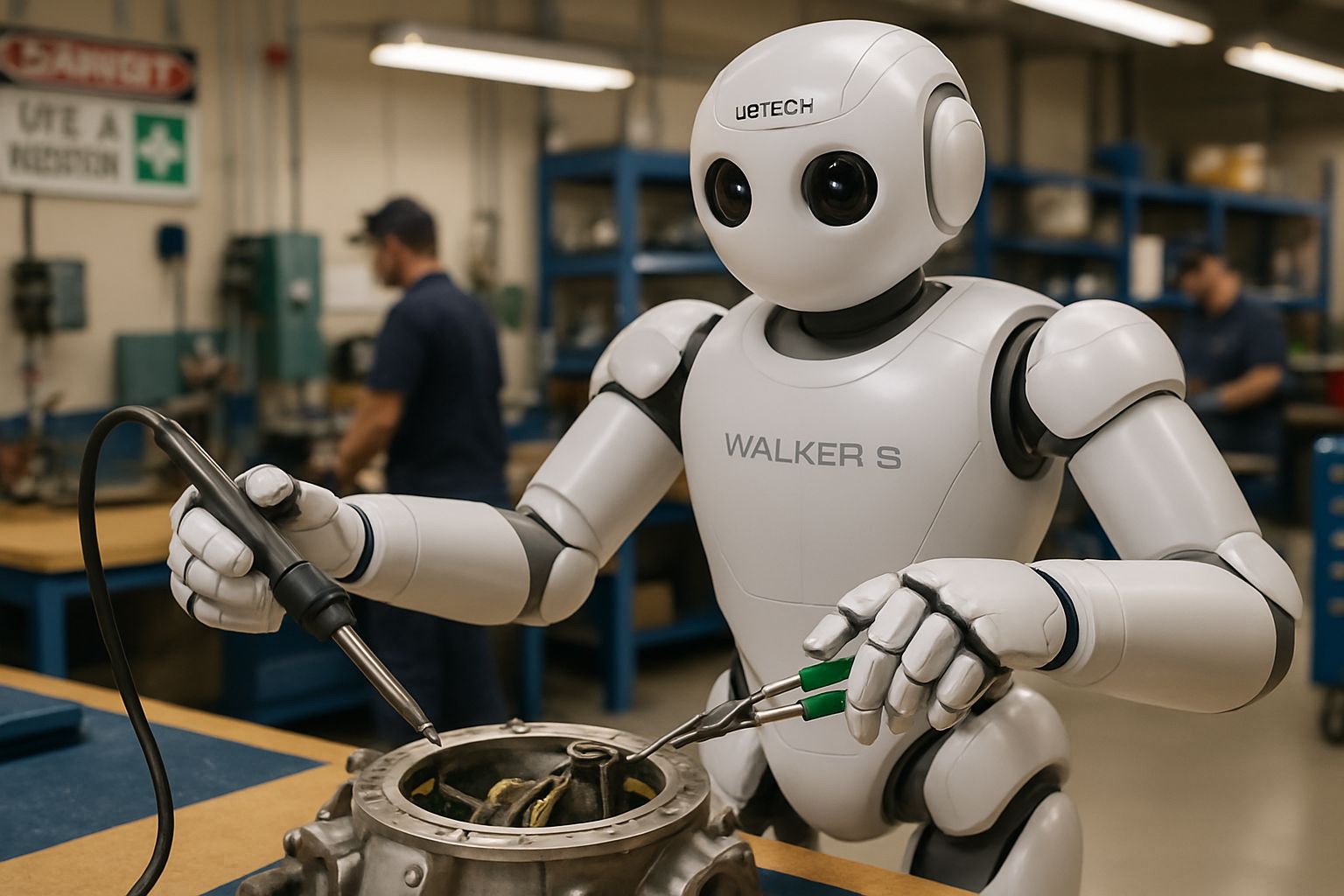
Airbus now seeks commercial scale, and the Walker S2 contract provides an affordable pilot path. Nevertheless, the OEM has not yet released an English statement, leaving deployment scope uncertain. Independent confirmation from European plants remains pending.
Airbus pursues flexibility to solve persistent manual bottlenecks. However, opaque details mean observers await official clarification before judging full impact.
UBTech Production Milestone Details
UBTech announced mass production of Walker S2 on 17 November 2025. The company cited orders exceeding RMB 800 million at that time. Subsequently, December filings raised the 2025 order figure to nearly RMB 1.4 billion. Meanwhile, several outlets reported the 1,000th Walker S2 rolling off the Shenzhen line in late December.
UBTech targets 500 deliveries during 2025 and 5,000 units during 2026. Furthermore, executives project 10,000 annual capacity by 2027, matching forecasts from global humanoid competitors. These numbers matter because scaled output lowers unit cost, a prerequisite for widespread Humanoid Robots adoption. Yet skeptics warn that production capacity does not guarantee field integration success. In contrast, proven deployments, especially inside Aviation Manufacturing sites, will decide long-term credibility.
UBTech’s volume targets appear aggressive yet technically feasible given current pace. Therefore, the partnership with Airbus becomes the signal test of those projections.
Key Technical Features Explained
Walker S2 stands 1.65 meters tall and weighs about 85 kilograms. It handles 5-kilogram payloads per arm and walks at 3 kilometers per hour. Additionally, UBTech advertises 6-hour endurance per battery pack. Co-Agent, an onboard planner, combines vision, force sensors, and large-language models for task reasoning. BrainNet then coordinates multiple units across factory zones through a cloud dashboard. Consequently, fleet managers can assign jobs, monitor torque data, and push software updates remotely. These capabilities position the Humanoid Robots as drop-in assistants for high-mix production lines.
Autonomous Battery Swap Process
The robot drives to a docking rack when power falls below threshold. Electromechanical clamps release the spent module and secure a fresh pack within 90 seconds. Moreover, no human intervention is required, enabling near-continuous uptime. However, additional testing must confirm connector durability under aviation cleanliness standards.
UBTech integrates hardware and orchestration software into a single vendor package. Such integration simplifies procurement, yet rigorous factory acceptance tests still lie ahead.
Humanoid Robots Safety Hurdles
Aircraft assembly enforces stringent torque, traceability, and foreign-object rules. Therefore, any new tool must satisfy both Airbus internal standards and national aviation authorities. Humanoid Robots introduce dynamic motion, raising collision and stability concerns. Previous COMANOID trials used safety cages and controlled speeds to pass risk assessments. Nevertheless, Airbus aims for cage-free collaboration to unlock productivity.
UBTech claims Walker S2 meets ISO 10218 and forthcoming Chinese embodied-intelligence guidelines. Furthermore, the company released behind-the-scenes footage to address CGI accusations. Independent laboratories have not yet published validation papers, leaving a gap in peer review. Consequently, operators will demand redundant sensors, real-time torque logging, and stop-distance testing before greenlighting Aviation Manufacturing pilots.
Safety certification remains the critical gating factor for scaled deployment. Meanwhile, transparency around validation data could accelerate regulator trust.
Market Impact And Risks
Investor enthusiasm for embodied AI has surged since 2024, fueling multibillion-dollar valuations. However, revenue realities often lag bold projections. Key indicators help contextualize UBTech’s momentum.
- Orders reported: RMB 1.4 billion for 2025 after initial RMB 800 million disclosure.
- Share price jumped over 5% on 19 January 2026 following Airbus news.
- Global Humanoid Robots market forecast to reach US$9 billion by 2030.
- Competitor Figure AI raised US$675 million in 2025 funding round.
Despite momentum, several risks could derail ROI. Cost per unit still exceeds US$100,000, challenging payback calculations for Aviation Manufacturing. Moreover, integration delays can inflate total project budgets. In contrast, early adopters could secure talent retention and brand differentiation advantages.
Financial upside exists, yet execution risk remains substantial. Consequently, diversified pilot programs will likely precede any large-scale roll-outs.
Outlook For Industrial Adoption
Analysts forecast escalating competition as multiple vendors race to secure reference factories. Consequently, buyer leverage will improve, pressuring prices downward. For UBTech, the first validated Aviation Manufacturing case could unlock international tenders. Furthermore, successful trials would prove that Humanoid Robots can meet aerospace quality gates. Governments may also accelerate standards development to cover collaborative humanoid tooling. Professionals wanting to steward these transitions should update their foundational AI skills. They can start with the AI Foundation certification, which aligns technical, ethical, and safety frameworks. Moreover, interdisciplinary fluency will help teams optimise cell design when Humanoid Robots join mixed fleets.
Industrial adoption will hinge on proven safety, economic clarity, and workforce upskilling. Therefore, 2026 stands as the pivotal year for commercial humanoid validation.
Conclusion And Next Steps
UBTech’s Walker S2 rollout marks a decisive test for next-generation factory assistance. Airbus cooperation, if confirmed, would showcase Humanoid Robots operating under the world’s strictest production rules. However, safety audits, cost discipline, and transparent data remain essential. Moreover, rival vendors and shifting regulations could reshape competitive dynamics quickly. Consequently, practitioners should track validation milestones while sharpening multidisciplinary skills. Explore the cited certification to stay ahead of embodied-AI integration curves. Informed teams will convert early insights into sustainable operational advantage. Ultimately, sound engineering and cautious scaling will determine whether hype becomes durable productivity.


